

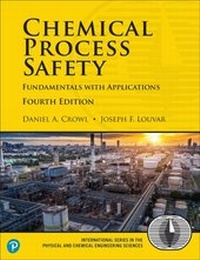
Chemical Process Safety
Fundamentals with Applications
4th Edition
Published on 1. March 2019
656 pages
978-0-13-485784-8 (ISBN)
Description

The #1 Process Safety Guide, Now Extensively Updated for Current Industrial Processes, Systems, and Practices
Process safety has seen a dramatic consolidation of concepts in the past few years. Chemical Process Safety, Fourth Edition, provides students and working engineers with the understanding necessary to apply these new concepts to safely design and operate any process.
Long the definitive guide in the field, this edition fully reflects major recent advances in process safety technology and practice. Readers will find extensive new and updated coverage of relief sizing, hazards identification, risk assessment, and many other topics. Several chapters have been completely rewritten, and all are substantially modified. This textbook includes 50 new problems and solutions (mostly in SI units), and 25 new case histories.
Safety culture
Preventive and mitigative safeguards
The CCPS 20 elements of Risk Based Process Safety (RBPS)
Toxicology, industrial hygiene, and source models
Hazardous material dispersion
Fires, explosions, and concepts for preventing them
Chemical reactivity
Reliefs and relief sizing
Hazards identification and evaluation
Risk analysis and assessment, including Layer of Protection Analysis (LOPA)
Safety strategies, procedures, designs, case histories, and lessons learned
Crowl and Louvar link key academic concepts to modern industrial practice, making this guide invaluable for all engineering students and for all working engineers.
Register your product for convenient access to downloads, updates, and/or corrections as they become available. See inside book for details.
Process safety has seen a dramatic consolidation of concepts in the past few years. Chemical Process Safety, Fourth Edition, provides students and working engineers with the understanding necessary to apply these new concepts to safely design and operate any process.
Long the definitive guide in the field, this edition fully reflects major recent advances in process safety technology and practice. Readers will find extensive new and updated coverage of relief sizing, hazards identification, risk assessment, and many other topics. Several chapters have been completely rewritten, and all are substantially modified. This textbook includes 50 new problems and solutions (mostly in SI units), and 25 new case histories.
Safety culture
Preventive and mitigative safeguards
The CCPS 20 elements of Risk Based Process Safety (RBPS)
Toxicology, industrial hygiene, and source models
Hazardous material dispersion
Fires, explosions, and concepts for preventing them
Chemical reactivity
Reliefs and relief sizing
Hazards identification and evaluation
Risk analysis and assessment, including Layer of Protection Analysis (LOPA)
Safety strategies, procedures, designs, case histories, and lessons learned
Crowl and Louvar link key academic concepts to modern industrial practice, making this guide invaluable for all engineering students and for all working engineers.
Register your product for convenient access to downloads, updates, and/or corrections as they become available. See inside book for details.
All prices
More details
Series
Edition
4th edition
Language
English
Place of publication
Hoboken
United States
Publishing group
Pearson Education (US)
Target group
Professional and scholarly
File size
27,37 MB
ISBN-13
978-0-13-485784-8 (9780134857848)
Copyright in bibliographic data and cover images is held by Nielsen Book Services Limited or by the publishers or by their respective licensors: all rights reserved.
Schweitzer Classification
Other editions
Additional editions
Daniel Crowl | Daniel A. Crowl | Joseph F. Louvar
Chemical Process Safety: Fundamentals with Applications
Fundamentals with Applications
Book
07/2020
4th Edition
Pearson
€206.00
Shipment within 5-8 weeks
Persons
Daniel A. Crowl is the Herbert H. Dow Professor for Chemical Process Safety at Michigan Technological University. Professor Crowl received his B.S. in fuel science from Pennsylvania State University and his M.S. and Ph.D. in chemical engineering from the University of Illinois. He is coauthor of the textbook Chemical Process Safety: Fundamentals with Applications, published by Pearson. He is also author/editor of several AIChE books on process safety and editor of the safety section in the eighth edition of Perry's Chemical Engineer's Handbook. Professor Crowl has won numerous awards, including the Bill Doyle award from AIChE, the Chemical Health and Safety Award from ACS, the Walton/Miller award from the Safety and Health Division of AIChE, and the Gary Leach Award from the AIChE Board. Professor Crowl is a Fellow of AIChE, ACS Safety and Health Division, and CCPS.
Joseph F. Louvar has a B.S., M.S., and Ph.D. in chemical engineering. He is currently a professor at Wayne State University after having retired from the BASF Corporation. While working at the BASF Corporation, he was a director of BASF's chemical engineering department; his responsibilities included the production of specialty chemicals, and he managed the implementation and maintenance of five processes that handled highly hazardous chemicals that were covered by Process Safety Management. As a professor at Wayne State University, he teaches chemical process safety, risk assessment, and process design. Professor Louvar is the author of many safety-related publications and the coauthor of two books, Chemical Process Safety: Fundamentals with Applications and Health and Environmental Risk Analysis: Fundamentals with Applications, both published by Pearson. Professor Louvar has been the chair of the Loss Prevention Committee and the Safety and Health Division. He is the CCPS staff consultant for the Undergraduate Education Committee, commonly known as the Safety and Chemical Engineering Education Committee (SAChE), and he is the coeditor of AIChE's journal for process safety, Process Safety Progress.
Joseph F. Louvar has a B.S., M.S., and Ph.D. in chemical engineering. He is currently a professor at Wayne State University after having retired from the BASF Corporation. While working at the BASF Corporation, he was a director of BASF's chemical engineering department; his responsibilities included the production of specialty chemicals, and he managed the implementation and maintenance of five processes that handled highly hazardous chemicals that were covered by Process Safety Management. As a professor at Wayne State University, he teaches chemical process safety, risk assessment, and process design. Professor Louvar is the author of many safety-related publications and the coauthor of two books, Chemical Process Safety: Fundamentals with Applications and Health and Environmental Risk Analysis: Fundamentals with Applications, both published by Pearson. Professor Louvar has been the chair of the Loss Prevention Committee and the Safety and Health Division. He is the CCPS staff consultant for the Undergraduate Education Committee, commonly known as the Safety and Chemical Engineering Education Committee (SAChE), and he is the coeditor of AIChE's journal for process safety, Process Safety Progress.
Content
1. Introduction
2. Toxicology
3. Industrial Hygiene
4. Source Models
5. Toxic Release and Dispersion Models
6. Fires and Explosions
7. Concepts to Prevent Fires and Explosions
8. Chemical Reactivity
9. Introduction to Reliefs
10. Relief Sizing
11. Hazards Identification.
12. Risk Assessment
13. Safety Procedures and Designs
14. Case Histories
2. Toxicology
3. Industrial Hygiene
4. Source Models
5. Toxic Release and Dispersion Models
6. Fires and Explosions
7. Concepts to Prevent Fires and Explosions
8. Chemical Reactivity
9. Introduction to Reliefs
10. Relief Sizing
11. Hazards Identification.
12. Risk Assessment
13. Safety Procedures and Designs
14. Case Histories
