

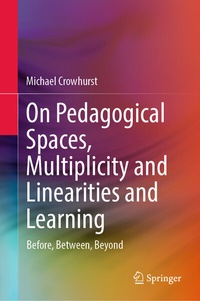
On Pedagogical Spaces, Multiplicity and Linearities and Learning
Description

This book introduces a research method called 'auto-teach(er)/ing-focused research,' a research process that aims to document understandings generated by, and for the teacher when that teacher teaches or re-teaches a course. It demonstrates how this method is applied by the author/researcher within the pedagogical space that is the teaching of a course, one that has been taught numerous times by the author/researcher over many years. This book documents understandings about learning and teaching that have emerged within the pedagogical space that is the teaching of a course, and the pedagogical space that is the writing of a book. It explores the notion that pedagogical spaces are complex, and that subjects navigate and are produced within them in a multiplicity of ways. This book applies a research method that generates a knowledge product that research practitioners in a variety of settings might find useful to adopt or adapt.
More details
Other editions
Additional editions
Person
Dr Michael Crowhurst teaches and co-ordinates a number of courses, conducts research, and supervises postgraduate students in the School of Education at RMIT University, Australia. He has a longstanding interest in education, and in the experiences of lesbian, gay, bisexual, transgender, intersex, and questioning (LGBTIQ) people in educative systems. He is also interested in thinking about the ways that education is constructed, and the impacts that education can have on different groups of people. His research interests include arts-based research, reflective practice and research, and autoethnographic research. He teaches pre-service teacher education courses, writes articles and other forms of academic literature, conducts small unfunded research projects, and supervises postgraduate students. He sees himself as a teacher who writes about what he teaches about.
Dr Michael Emslie is currently employed as a part-time lecturer in youth work at RMIT University, Australia. Michael's academic work builds on a 30-year career studying, practicing, researching, and teaching human services with a focus on youth work. Michael draws on this rich lived experience in his educative, research and scholarly work. Michael's teaching and research demonstrates a commitment to produce and share knowledge that will inspire imaginative and good practice in youth work and related fields. Michael coordinates and teaches many courses on youth work and youth studies. Michael's research covers areas of creative research methods, youth work studies, youth studies, LGBTQI+ young people and practitioners, and good practice in human services.
