

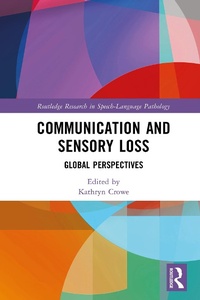
Communication and Sensory Loss
Global Perspectives
1st Edition
Published on 14. August 2024
268 pages
978-1-040-02615-1 (ISBN)
Description

This collection explores communication differences in individuals with sensory impairment/loss relevant to health and education students and professionals.
Children and adults with hearing, vision, and dual sensory impairment/ loss may experience differences and/or difficulties with communication. This book goes beyond describing sensory loss to encourage readers to think about sensory loss and communication as part of a biopsychosocial view of health and the intersecting identities of the clients and families that they service. The book takes a strengths-based, evidence-informed approach and utilises the International Classification of Functioning, Disability and Health (ICF) of the World Health Organization (WHO). Each chapter focuses on either children or adults with hearing, vision, dual sensory impairment/loss, or sensory loss and complex communication needs. Each chapter introduces the group described in the chapter and issues around appropriate use of terminology, followed by a discussion of the sensory impairment/loss and communication needs considered within each component of the ICF. Chapters conclude with case studies highlighting cultural and linguistic diversity, high-resourced and low- resourced contexts, and intersecting identities in which the framework of the ICF is applied.
This book is a valuable resource for scholars, educators, and clinicians interested in evidence-based practices to support their work with individuals experiencing sensory loss.
Children and adults with hearing, vision, and dual sensory impairment/ loss may experience differences and/or difficulties with communication. This book goes beyond describing sensory loss to encourage readers to think about sensory loss and communication as part of a biopsychosocial view of health and the intersecting identities of the clients and families that they service. The book takes a strengths-based, evidence-informed approach and utilises the International Classification of Functioning, Disability and Health (ICF) of the World Health Organization (WHO). Each chapter focuses on either children or adults with hearing, vision, dual sensory impairment/loss, or sensory loss and complex communication needs. Each chapter introduces the group described in the chapter and issues around appropriate use of terminology, followed by a discussion of the sensory impairment/loss and communication needs considered within each component of the ICF. Chapters conclude with case studies highlighting cultural and linguistic diversity, high-resourced and low- resourced contexts, and intersecting identities in which the framework of the ICF is applied.
This book is a valuable resource for scholars, educators, and clinicians interested in evidence-based practices to support their work with individuals experiencing sensory loss.
More details
Series
Edition
1. Auflage
Language
English
Place of publication
London
United Kingdom
Publishing group
Taylor & Francis Ltd
Target group
College/higher education
Illustrations
2 Tables, black and white; 3 Line drawings, black and white; 3 Illustrations, black and white
ISBN-13
978-1-040-02615-1 (9781040026151)
Copyright in bibliographic data and cover images is held by Nielsen Book Services Limited or by the publishers or by their respective licensors: all rights reserved.
Schweitzer Classification
Other editions
Additional editions
Book
12/2025
1st Edition
Routledge
€69.00
Shipment within 10-20 days
Book
08/2024
1st Edition
Routledge
€193.90
Shipment within 10-20 days
Person
Kathryn Crowe is an adjunct at the University of Iceland, Iceland. She is also an affiliate of the National Technical Institute of the Deaf, Rochester Institute of Technology, USA, and an adjunct associate research professor at Charles Sturt University, Australia.
Content
Contents
List of Contributors
Foreword
Acknowledgements
List of Acronyms and Abbreviations
Part 1. Context
Chapter 1. Introduction to Frameworks and Hearing and Vision Terminology. Kathryn Crowe and Walter Wittich.
Chapter 2. Intersecting Identities and Experience of Sensory Loss. Suzanne C. Hopf, Kathryn Crowe, Joanne Mosen, Sureni Perera, Ekawati Liu, and Shrutilata Singh.
Part 2. Sensory Loss in Childhood
Chapter 3. Hearing Loss. Faheema Mahomed-Asmail, Kathryn Crowe, and Jeanne d'Arc Ntigulirwa.
Chapter 4. Visual impairment. Renata R. Eccles, Paula Conroy, and Jeannie van der Linde.
Chapter 5. Deafblindness. Susan M. Bruce, Kerstin M. Toensing, and Shakila Dada.
Chapter 6. Complex Communication Needs. Amy Szarkowski, Cristina Lacerda, Shoko Yamamoto, Karla N. Washington
Part 3. Sensory Loss in Adulthood
Chapter 7. Acquired Communication Impairment in Adults with Sensory Loss from Childhood. Nannette Nicholson, Ahmad A. Alanazi, and Kathryn Crowe.
Chapter 8. Hearing Loss. Elin Karlsson and Faheema Mahomed-Asmail.
Chapter 9. Vision Loss. Natalina Martiniello, Joanne Mosen, Sonia Wasi, and Walter Wittich.
Chapter 10. Deafblindness. Atul Jaiswal, Uttam Kumar, Akhil Paul, Sanja Tarczay, and Walter Wittich.
Chapter 11. Complex Communication Needs. Kerstin M. Toensing, Saskia Damen, Margje van der Schuit, and Shakila Dada.
Index
List of Contributors
Foreword
Acknowledgements
List of Acronyms and Abbreviations
Part 1. Context
Chapter 1. Introduction to Frameworks and Hearing and Vision Terminology. Kathryn Crowe and Walter Wittich.
Chapter 2. Intersecting Identities and Experience of Sensory Loss. Suzanne C. Hopf, Kathryn Crowe, Joanne Mosen, Sureni Perera, Ekawati Liu, and Shrutilata Singh.
Part 2. Sensory Loss in Childhood
Chapter 3. Hearing Loss. Faheema Mahomed-Asmail, Kathryn Crowe, and Jeanne d'Arc Ntigulirwa.
Chapter 4. Visual impairment. Renata R. Eccles, Paula Conroy, and Jeannie van der Linde.
Chapter 5. Deafblindness. Susan M. Bruce, Kerstin M. Toensing, and Shakila Dada.
Chapter 6. Complex Communication Needs. Amy Szarkowski, Cristina Lacerda, Shoko Yamamoto, Karla N. Washington
Part 3. Sensory Loss in Adulthood
Chapter 7. Acquired Communication Impairment in Adults with Sensory Loss from Childhood. Nannette Nicholson, Ahmad A. Alanazi, and Kathryn Crowe.
Chapter 8. Hearing Loss. Elin Karlsson and Faheema Mahomed-Asmail.
Chapter 9. Vision Loss. Natalina Martiniello, Joanne Mosen, Sonia Wasi, and Walter Wittich.
Chapter 10. Deafblindness. Atul Jaiswal, Uttam Kumar, Akhil Paul, Sanja Tarczay, and Walter Wittich.
Chapter 11. Complex Communication Needs. Kerstin M. Toensing, Saskia Damen, Margje van der Schuit, and Shakila Dada.
Index
