

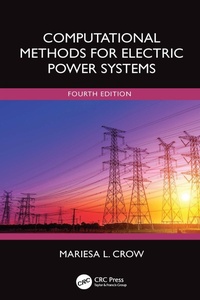
Computational Methods for Electric Power Systems
4th Edition
Published on 3. March 2026
360 pages
978-1-040-57945-9 (ISBN)
Description

As power systems increasingly operate under stressed conditions, computer simulation will play a large role in control and security assessment. Commercial packages routinely fail or give erroneous results when used to simulate stressed systems. Understanding the underlying numerical algorithms is imperative to correctly interpret the results of commercial packages.
The first part of the book provides the basic concepts of linear and nonlinear computational methods. These methods are then extended to include more specialized approaches including time domain simulation, optimization, sparsity methods, and eigensystem analysis. Computational Methods for Electric Power Systems is an indispensable handbook for any practicing power systems engineer.
Includes Instructor Resources, Solution Manuals and MATLAB (R) Codes for all examples
Provides up-to-date algorithms and approaches
Provides a comprehensive overview of many of the algorithmic methods used in modern power systems analysis
Contains expanded examples, end of chapter exercises, and computer-based projects.
The first part of the book provides the basic concepts of linear and nonlinear computational methods. These methods are then extended to include more specialized approaches including time domain simulation, optimization, sparsity methods, and eigensystem analysis. Computational Methods for Electric Power Systems is an indispensable handbook for any practicing power systems engineer.
Includes Instructor Resources, Solution Manuals and MATLAB (R) Codes for all examples
Provides up-to-date algorithms and approaches
Provides a comprehensive overview of many of the algorithmic methods used in modern power systems analysis
Contains expanded examples, end of chapter exercises, and computer-based projects.
More details
Edition
4th edition
Language
English
Place of publication
London
United Kingdom
Publishing group
Taylor & Francis Ltd
Target group
Professional and scholarly
Illustrations
97 Line drawings, black and white; 97 Illustrations, black and white
File size
8,72 MB
ISBN-13
978-1-040-57945-9 (9781040579459)
Copyright in bibliographic data and cover images is held by Nielsen Book Services Limited or by the publishers or by their respective licensors: all rights reserved.
Schweitzer Classification
Other editions
Additional editions
Mariesa L. Crow
Computational Methods for Electric Power Systems
Book
approx. 03/2026
4th Edition
CRC Press
€136.30
Not yet published
Person
Mariesa L. Crow is a professor of electrical engineering at the Missouri University of Science and Technology, Rolla, USA. Dr. Crow is director of the Energy Research and Development Center. Her areas of research include computer-aided analysis of power systems; dynamics and security analysis; voltage stability; computational algorithms for analyzing stressed, non-linear, non-continuous systems; power-electronic applications in bulk power systems (FACTS); and parameter estimation.
Content
1 Introduction 2 The Solution of Linear Systems 3 Systems of Nonlinear Equations 4 Sparse Matrix Solution Techniques 5 Numerical Integration 6 Optimization 7 Eigensystem Analysis
