

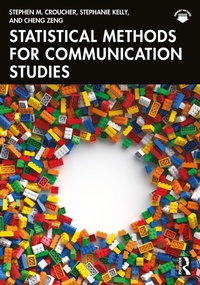
Statistical Methods for Communication Studies
Published on 24. October 2025
264 pages
978-1-040-45071-0 (ISBN)
Description

A step-by-step guide through various stages of data preparation and analysis, this text demonstrates descriptive and inferential statistics in communication studies.
This book equips communication students with the tools they need to engage in quantitative research, ensuring that they understand why the statistical tools they chose are most appropriate for their data. Using examples and data directly relevant to communication researchers, this text provides guidance on how to use and interpret SPSS and write up results, with further guidance via free online material in using Excel and R. Instead of focusing on formulas and in-depth mathematics, this book provides a hands-on approach to understanding the theory, practice, and application of statistical methods in communication. In addition to covering the standard statistical tools used to analyze social science data for hypothesis testing (e.g., correlation, regression, ANOVA), it also covers advanced factor-analytic techniques specific to measurement validation as well as data visualization guidance.
Ideally suited for statistics or quantitative methods courses in communication studies programs at the advanced and graduate level.
Online resources include tutorials on SPSS, Excel, and R for key constructs and practice quizzes for students. Instructors will find an instructor manual and test bank. Please visit www.routledge.com/9781032814872.
This book equips communication students with the tools they need to engage in quantitative research, ensuring that they understand why the statistical tools they chose are most appropriate for their data. Using examples and data directly relevant to communication researchers, this text provides guidance on how to use and interpret SPSS and write up results, with further guidance via free online material in using Excel and R. Instead of focusing on formulas and in-depth mathematics, this book provides a hands-on approach to understanding the theory, practice, and application of statistical methods in communication. In addition to covering the standard statistical tools used to analyze social science data for hypothesis testing (e.g., correlation, regression, ANOVA), it also covers advanced factor-analytic techniques specific to measurement validation as well as data visualization guidance.
Ideally suited for statistics or quantitative methods courses in communication studies programs at the advanced and graduate level.
Online resources include tutorials on SPSS, Excel, and R for key constructs and practice quizzes for students. Instructors will find an instructor manual and test bank. Please visit www.routledge.com/9781032814872.
More details
Language
English
Place of publication
London
United Kingdom
Publishing group
Taylor & Francis Ltd
Target group
College/higher education
Illustrations
93 Tables, black and white; 121 Line drawings, black and white; 20 Halftones, black and white; 141 Illustrations, black and white
File size
14,43 MB
ISBN-13
978-1-040-45071-0 (9781040450710)
Copyright in bibliographic data and cover images is held by Nielsen Book Services Limited or by the publishers or by their respective licensors: all rights reserved.
Schweitzer Classification
Other editions
Additional editions
Stephen M. Croucher | Stephanie Kelly | Cheng Zeng
Statistical Methods for Communication Studies
Book
10/2025
1st Edition
Routledge
€89.30
Shipment within 10-20 days
Stephen M. Croucher | Stephanie Kelly | Cheng Zeng
Statistical Methods for Communication Studies
Book
10/2025
1st Edition
Routledge
€206.30
Shipment within 10-20 days
Persons
Stephen M. Croucher is a professor in the Department of Communication at Clemson University, U.S.A. He studies organizational and intercultural communication. He has authored more than 130 journal articles and authored/co-edited more than 15 books. He has served as the editor of the Journal of Intercultural Communication Research, Speaker & Gavel, and the Review of Communication, and is editor-elect for Communication Monographs. He is a fellow of the International Communication Association and president of the World Communication Association.
Stephanie Kelly is a professor of data and communication at North Carolina A&T State University, U.S.A. Her research focuses on presence variables such as immediacy, credibility, and solidarity in workplace, educational, and technology-mediated contexts. She has published over 100 peer-reviewed articles in journals such as Communication Education, Communication Quarterly, and the International Journal of Business Communication. She currently serves as editor-elect of the Review of Communication.
Cheng Zeng is an associate professor in the Department of Communication at North Dakota State University, U.S.A. His research focuses on organizational communication phenomena, including organizational dissent, assimilation, and workplace freedom of speech across diverse cultural contexts. His work has been published in well-regarded communication journals such as the Journal of Communication Management, Journal of Strategic Communication, and Communication Studies.
Stephanie Kelly is a professor of data and communication at North Carolina A&T State University, U.S.A. Her research focuses on presence variables such as immediacy, credibility, and solidarity in workplace, educational, and technology-mediated contexts. She has published over 100 peer-reviewed articles in journals such as Communication Education, Communication Quarterly, and the International Journal of Business Communication. She currently serves as editor-elect of the Review of Communication.
Cheng Zeng is an associate professor in the Department of Communication at North Dakota State University, U.S.A. His research focuses on organizational communication phenomena, including organizational dissent, assimilation, and workplace freedom of speech across diverse cultural contexts. His work has been published in well-regarded communication journals such as the Journal of Communication Management, Journal of Strategic Communication, and Communication Studies.
Content
1. Introduction 2. Measurement Fundamentals 3. SPSS and Excel 4. Data Visualization 5. Describing Data 6. Normality And Outliers 7. The Research Process 8. Correlation 9. Simple Linear Regression 10. Multiple Regression 11. t-Tests 12. Analysis of Variance (Anova) 13. Multiple Analysis of Variance (Manova) 14. Analysis And Multiple Analysis of Covariance (Ancova And Mancova) 15. Repeated Measures 16. Chi-Square (c2) 17. Reliability Analysis 18. Exploratory Factor Analysis 19. Principal Components Analysis 20. Confirmatory Factor Analysis
