

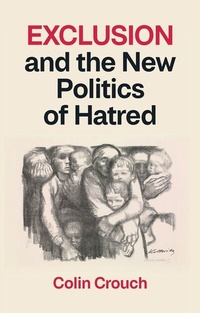
Exclusion and the New Politics of Hatred
Description

Colin Crouch argues that at the base of all political conflicts are struggles over which types of people should be included in and which excluded from various rights, including the right to exist at all within a particular society. This is more fundamental than any conflict between left and right or between classes, and it gives rise to tropes of inclusionary and exclusionary rhetoric that can be transferred across issues - from ethnicity to gender and sexual orientation, and including demands for nations to isolate themselves as much as possible from contacts with others. Today the forces seeking exclusions of many kinds are gaining ground in the strategies of many governments, parties and movements. Drives to exclude lead rapidly to the incitement of hatred, which leads in turn to acts of performative cruelty and physical violence. Deeply opposed as he is to the politics of exclusion, Crouch seeks to understand and explain its rationality. He passionately advocates a politics of inclusion but, at the same time, he recognises the real obstacles that a commitment to inclusion must confront. While not optimistic about how these struggles will play out in the coming years, he seeks a path through which campaigns for openness and welcome could still triumph in dark times.
More details
Other editions
Additional editions
Content
2
'Us not them': the rational and emotive power of social exclusion
It is tempting for advocates of social inclusion to regard our position as based on rationality, while the supporters of various forms of exclusion are seen as irrational and guided by negative emotion, hatred and bias. The main grounds for claiming a rational higher ground for inclusion are that it implies universalism, a view of the equal entitlement of all human beings, without prejudice. Prejudice is almost by definition irrational as it literally means making judgements before having the evidence that would justify them. However, there is a twofold case against taking this self-congratulatory view. First, the advocates of exclusion do not lack rationality; and second, a politics of inclusion that lacks an emotional drive will itself be weak. The US psychologist Drew Westen has argued that the reason liberals kept losing US elections was that they failed to appreciate the role of emotion in political behaviour.1 He wrote this in 2007, several years before the political rise of Donald Trump. These issues will be explored in this and the next chapter. Here we are concerned with exclusion; in the next, with inclusion.
The free market and material exclusion
As mentioned in the previous chapter, issues of inequality and social class are usually seen as material, because they concern the distribution of income and wealth. However, if they are to carry political heft, to speak to felt political identities, they need to be personified as categories of 'them' and 'us'. This can happen only if there are cultural boundaries around the categories concerned. Material inequality in itself does not produce broad groups, just a very long continuum of often minutely differentiated levels of income and wealth. True, the continuum has an odd shape. In the US as of 2024, one of the most unequal of democratic countries, the top 0.1% held 13.8% of total national wealth, while the bottom 50% held 2.5%. Nevertheless, there is still a continuum of small gradations along most of the graph, which does not make for identities. As explained in the previous chapter, when, in the late nineteenth and early twentieth centuries, struggles for and against inclusion in citizenship rights were raging, matters seemed clearer. An industrial working class embodied not just a range of lower income levels, but ways of life that were deemed inferior by wealthier groups. This is far less clear today.
Policies of the social democratic type, which pursued the reduction of inequality by appealing to the solidarity of the growing industrial working class, were well placed to make 'us too' appeals, because people knew to whom 'us' applied. Material and cultural identities reinforced each other. Today, social democrats have increasingly lost the taken for granted cultural accompaniment to their material appeal. This does not mean that those parties could have remained stronger if only they had maintained a strong class profile: a culturally defined working class was ceasing to exist - even though the issues of redistribution on which social democratic politics was based remained fundamental to political conflict. Late twentieth-century politics remained devoid of cultural referents but concerned with vital issues, especially when the main opponents of social democracy became neoliberalism: the belief in free markets and opposition to the welfare state. Neoliberalism had no need of hatred of those who were to be relatively excluded by greater reliance on the market. It was just a mechanism that delivered unequal life chances.
There used to be a saying that 'Anyone can dine at the Ritz Hotel', meaning that there were no barriers of race or class that would prevent someone dining there - those would have been cultural exclusions. The saying was a joke because only the very rich can afford to dine at the Ritz. Those who cannot do so are therefore excluded. But the market is a complex form of exclusion, because it includes a large element of choice. The suppliers of goods and services need to provide things that are of a certain type, quality and price, otherwise we would not buy them. And since customers have a wide variety of tastes and levels of income, well-functioning markets ensure that that variety of tastes and income levels can be satisfied. There are doubtless people who could afford to dine at the Ritz from time to time, but who choose not to do so; they might prefer to go to the opera. They can hardly be said to be excluded. Further down the income scale, things do not look so comfortable. During a cold winter, people on very low incomes may have to choose between eating less and heating their room; normally, food and rent take all their income. Food or warmth - that is a choice. It is not, however, a choice in the sense that the Ritz or opera is a choice. The poor person is being excluded by the market from most of the choices which that mechanism claims to provide. But this will not in itself produce political identities.
In recent years, there has been considerable policy development around the idea of reducing what is explicitly labelled social exclusion. The context has moved on from the original confrontation at the founding of modern welfare states, between a poor working class seeking the basic supports of life and wealthy classes seeking to preserve their market privileges. By the end of the twentieth century, the possibilities of the market had expanded enormously, as had the overall wealth of societies. Most people, even those on modest incomes, could make considerable use of market choices. At the same time, as Thomas Piketty has shown, trends towards lower income and wealth inequality that had been evident earlier in that century were being reversed - particularly in the US, but also more generally.2 The dominant economic ideology of neoliberalism favoured reducing the social state and progressive taxation ever further, with a clear tendency to increasing inequality. There was a strong possibility of the bottom 10 per cent or even 20 per cent of the income distribution falling severely behind the rest of society, often trapped in highly insecure jobs or with no jobs at all, unable to enjoy the fruits of highly prosperous societies, and in effect socially excluded.
The more thoughtful policymakers saw the risks here of highly divided societies, with what Guy Standing called an excluded 'precariat' at the bottom.3 The European Commission developed indicators of social exclusion and recommended various policies to reduce it.4 It defined social exclusion as: 'a situation whereby a person is prevented (or excluded) from contributing to and benefiting from economic and social progress'. There is no cultural component to definitions of the socially excluded; they are an administrative category identified by statistical analysis - most people defined as socially excluded have little idea what the concept means. It is not an identity; it does not provide much sense of an 'us too'. Parties that historically stood for the advancement of a deprived working class are increasingly under pressure: either to abandon attempts at representing an identifiable class and become parties claiming vaguely to represent everybody, or to champion the causes of cultural minorities among the deprived, losing contact with low- and moderate-income people who do not have a claim to be a cultural minority.
These latter cannot provide as much for themselves in the market as the wealthy, but they can certainly buy many things. If taxes rise to pay for a stronger social state, they will have that much less to spend for themselves. They might also come to believe that much social spending is going on groups with whom they have no identity: the disabled, immigrants and other ethnic minorities. They may then wish that such people could be excluded from access to the welfare state. They therefore now have ready access to some 'us not them' positions, replacing their parents' and grandparents' access to 'us too'. If these citizens also do not trust government to spend taxation wisely, they may be further inclined to this view. They may well also consider that on their modest incomes they cannot afford to care about the future and climate change: 'us now, not anyone in the future'. In effect they are seeking to exclude future generations from enjoying a good life, but they can argue that they themselves are already finding it ever harder to access the good life. Several of the parties adopting exclusionary positions have come out to meet them, differentiating between social spending that helps 'hard-working' native citizens living now (which they would retain) and those elements that seem, or can be presented as seeming, to concentrate on helping minorities or future generations (which they would abolish).
The rationality of cultural exclusion
The struggle over exclusion thus acquires a cultural component that was missing for much of mid- to late-twentieth-century politics. This had been preoccupied with a restrained conflict between the more wealthy seeking low taxes and the less welloff supporting a strong welfare state.
It might be thought that the 'them' in 'us not them' could have been defined as the very wealthy, and small socialist parties attempted this; but they have remained small. Seeking the exclusion of the rich could be achieved only by very radical action, which might well fail and would almost certainly...
