

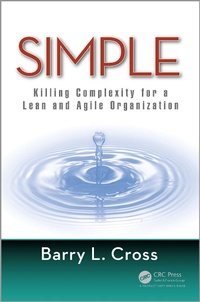
Simple
Killing Complexity for a Lean and Agile Organization
Published on 12. May 2017
200 pages
978-1-351-77395-9 (ISBN)
Description

The parameters of competition in business today are changing -- big does not necessarily beat small anymore; fast is beating slow. Agility, speed, and flexibility are the key elements of a successful strategy and execution in the corporate world as wells as in government agencies, health care, and education..
How well will your firm execute its strategy? What barriers exist that inhibit your execution? Are you keeping one eye on tomorrow's customers, while you manage those of today? These are all key questions as we strive to deliver value on an ongoing basis.
Simple: Killing Complexity for a Lean and Agile Organization is about agility and simplicity, in which achieving simplicity comes from a focus on the customer. Agility begins with planning, and leadership teams must develop decent vision. Generally, leaders know what they want to do, but many organizations break down, however, I when trying to implement the action plan. With over 25 years of industry, teaching, and consulting experience, the author illustrates how organizations can:
Recognize who their true customers are, and appreciate what those customers want
Begin to eliminate the products, services, processes and 'work' that gets in the way of delivering value to those customers
Focus people and processes towards value creation, even in what are perceived as non-customer centric operations
Avoid brand confusion and the 'all things to all people' mentality
The complexities of managing in today's world both obscures decision making and layers on challenges that bog an organization down, preventing leadership from understanding what their customers want.
By understanding who those customers are, and what they want, leaders can focus innovation strategy and projects in ways that deliver sustainable value. Even in not-for-profit and government agencies, executing in an aligned organization can become the profitable standard business process.
How well will your firm execute its strategy? What barriers exist that inhibit your execution? Are you keeping one eye on tomorrow's customers, while you manage those of today? These are all key questions as we strive to deliver value on an ongoing basis.
Simple: Killing Complexity for a Lean and Agile Organization is about agility and simplicity, in which achieving simplicity comes from a focus on the customer. Agility begins with planning, and leadership teams must develop decent vision. Generally, leaders know what they want to do, but many organizations break down, however, I when trying to implement the action plan. With over 25 years of industry, teaching, and consulting experience, the author illustrates how organizations can:
Recognize who their true customers are, and appreciate what those customers want
Begin to eliminate the products, services, processes and 'work' that gets in the way of delivering value to those customers
Focus people and processes towards value creation, even in what are perceived as non-customer centric operations
Avoid brand confusion and the 'all things to all people' mentality
The complexities of managing in today's world both obscures decision making and layers on challenges that bog an organization down, preventing leadership from understanding what their customers want.
By understanding who those customers are, and what they want, leaders can focus innovation strategy and projects in ways that deliver sustainable value. Even in not-for-profit and government agencies, executing in an aligned organization can become the profitable standard business process.
More details
Language
English
Place of publication
London
United Kingdom
Publishing group
Taylor & Francis Ltd
Target group
Professional and scholarly
Illustrations
32 s/w Abbildungen, 2 s/w Tabellen, 5 s/w Photographien bzw. Rasterbilder, 27 s/w Zeichnungen
2 Tables, black and white; 27 Line drawings, black and white; 5 Halftones, black and white; 32 Illustrations, black and white
File size
4,38 MB
ISBN-13
978-1-351-77395-9 (9781351773959)
Copyright in bibliographic data and cover images is held by Nielsen Book Services Limited or by the publishers or by their respective licensors: all rights reserved.
Schweitzer Classification
Other editions
Additional editions
Book
05/2017
1st Edition
CRC Press
€56.00
Shipment within 10-20 days
Person
Barry Cross's career spans over 25 years of industry, teaching and consulting experience. He joined Queen's University in 2006 after spending 18 years in various Executive and Management positions with Magna International, Autosystems Manufacturing and DuPont. While in Industry, Barry led many key strategic initiatives, including a $200 Million business unit with operations in three countries.
Barry now teaches at Queen's Smith School of Business in Strategy, Operations Management, Service Management and Project Management, where he is an Assistant Professor and Distinguished Faculty Fellow in Operations Strategy. At the corporate level, he speaks and consults regularly on Lean, Innovation, Execution, Operations and Project Management.
He has an MBA from Queen's University and a Bachelor of Science degree from the University of Waterloo. He is quoted widely in radio, television and the written media, and has published numerous articles and two previous books. He is the Globe and Mail #1 best-selling author of Lean Innovation: Understanding What's Next in Today's Economy (Taylor and Francis, 2012), and Project Leadership: Creating Value with an Adaptive Project Organization (Taylor and Francis, 2014; co-authored with Kathryn Brohman).
Barry now teaches at Queen's Smith School of Business in Strategy, Operations Management, Service Management and Project Management, where he is an Assistant Professor and Distinguished Faculty Fellow in Operations Strategy. At the corporate level, he speaks and consults regularly on Lean, Innovation, Execution, Operations and Project Management.
He has an MBA from Queen's University and a Bachelor of Science degree from the University of Waterloo. He is quoted widely in radio, television and the written media, and has published numerous articles and two previous books. He is the Globe and Mail #1 best-selling author of Lean Innovation: Understanding What's Next in Today's Economy (Taylor and Francis, 2012), and Project Leadership: Creating Value with an Adaptive Project Organization (Taylor and Francis, 2014; co-authored with Kathryn Brohman).
Content
Chapter 1 - Who is your customer?
Chapter 2 - Complexity and the Barriers to Agility
Chapter 3 - Lean and Enabling Agility
Chapter 4 - Simple Strategy and Building a Vision
Chapter 5 - Execution and the Operating Plan
Chapter 6 - Lean Innovation
Chapter 7 - Communication and Selling the Plan
Chapter 8 - Agile is the New White - Organizational Culture
Chapter 2 - Complexity and the Barriers to Agility
Chapter 3 - Lean and Enabling Agility
Chapter 4 - Simple Strategy and Building a Vision
Chapter 5 - Execution and the Operating Plan
Chapter 6 - Lean Innovation
Chapter 7 - Communication and Selling the Plan
Chapter 8 - Agile is the New White - Organizational Culture
