

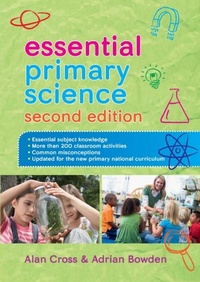
Essential Primary Science
1st Edition
Published on 1. September 2014
426 pages
978-0-335-26335-6 (ISBN)
Available for download
Description

The book is an essential textbook for primary science modules and provides teachers, trainers and tutors with a practical and accessible introduction to the fundamental aspects of teaching and learning primary science.
More details
Other editions
Additional editions
Alan Cross | Adrian Bowden
Essential Primary Science
Book
09/2014
2nd Edition
Open University Press
€59.60
Shipment within 15-20 days
Content
- Cover page
- Halftitle page
- Title page
- Copyright page
- Praise for this book
- Dedication
- Contents
- Acknowledgements
- 1 Knowledge and understanding of science
- Organisation of the book
- Rationale
- Guiding principles
- Language/literacy and science
- The importance of questions
- Dealing with pupils' questions
- Teacher confidence
- The importance of practical work
- Assessment, self- assessment, and feedback
- Establishing and maintaining interest
- Conclusion
- 2 Working scientifically
- What does the National Curriculum for England require?
- Science enquiry skills
- Teacher demonstration of science skills
- Full scientific investigations
- Progression in scientific enquiry and investigation skills - working scientifically
- Using a framework to plan and carry out an investigation
- Conclusion
- Web resources
- 3 Assessment in primary science
- Forms of assessment
- Assessment in science classes
- Vehicles for assessment of science
- Assessing science investigation skills
- Target setting
- Feedback
- Differentiation
- Challenge
- Recording assessment
- Conclusion
- 4 Life processes - plants
- Alive, dead, and never alive
- Does the exception prove the rule?
- Plants are widespread and exhibit great variety
- The plant kingdom
- Organisms often confused with plants
- Observation and identification of plants
- Structure of a flowering plant
- What do plants need to survive?
- Movement
- Plants obtain energy from the Sun
- Other plant requirements
- Plant cells
- The structure of a leaf
- The basic structure of a flower
- Pollination and fertilisation (sexual reproduction in plants)
- The structure of seeds
- Dispersal of plant seeds
- Germination of seeds
- Some plants make clones (asexual reproduction)
- Lower Key Stage 2
- Upper Key Stage 2
- Pupil activity 4.1
- Pupil activity 4.2
- Pupil activity 4.3
- Pupil activity 4.4
- Pupil activity 4.5
- Pupil activity 4.6
- Pupil activity 4.7
- Pupil discussion 4.8
- Pupil activity 4.9
- Pupil activity 4.10
- Pupil investigation skills 4.11
- Pupil activity 4.12
- Teacher demonstration 4.13
- Pupil activity 4.14
- Pupil activity 4.15
- Pupil activity 4.16
- Pupil activity 4.17
- Pupil activity 4.18
- Pupil activity 4.19
- Pupil discussion 4.20
- Pupil investigation skills 4.21
- Pupil investigation skills 4.22
- Pupil investigation skills 4.23
- Pupil investigation skills 4.24
- Pupil investigation skills 4.25
- Self-test
- Self-test answers
- Misconceptions
- Web resources
- 5 Life processes - animals
- What is an animal?
- Observing and identifying common animals
- Conditions required for life
- Animal cells
- Growth and the human life cycle
- Movement and the human skeleton
- Circulation of the blood
- Breathing
- Respiration
- Sensitivity
- Nutrition
- Keeping healthy
- Pupils' questions
- Learning about humans and other animals
- Pupil activity 5.1
- Pupil activity 5.2
- Pupil activity 5.3
- Pupil activity 5.4
- Pupil investigation skills 5.5
- Pupil activity 5.6
- Pupil activity 5.7
- Pupil activity 5.8
- Pupil activity 5.9
- Pupil activity 5.10
- Pupil activity 5.11
- Teacher demonstration 5.12
- Pupil activity 5.13
- Pupil activity 5.14
- Pupil investigation skills 5.15
- Pupil activity 5.16
- Pupil activity 5.17
- Pupil activity 5.18
- Pupil activity 5.19
- Pupil activity 5.20
- Pupil investigation skills 5.21
- Pupil investigation skills 5.22
- Self-test
- Self-test answers
- Misconceptions
- Web resources
- 6 Variation and diversity
- Similarity and difference
- DNA, genes, and chromosomes
- Evolution
- Genetics
- Differences in groups (diversity in a population)
- Grouping and classifying
- Pupil activity 6.1
- Pupil activity 6.2
- Pupil activity 6.3
- Pupil activity 6.4
- Pupil activity 6.5
- The need to group animals and plants
- Pupil activity 6.6
- Pupil activity 6.7
- Pupil investigative skills 6.8
- Pupil activity 6.9
- Pupil activity 6.10
- Pupil activity 6.11
- Pupil activity 6.12
- Pupil activity 6.13
- Pupil activity 6.14
- Self-test
- Self-test answers
- Misconceptions
- Web resources
- 7 The environment
- The planet as a biosphere
- Ecosystems
- Habitats
- Food chains, food webs, and pyramids of numbers
- The water cycle
- The carbon cycle
- Acid rain
- Ozone depletion
- Greenhouse effect
- Climate change caused by humankind
- Lower Key Stage 2
- Upper Key Stage 2
- Find out about different plants and animals in the local environment
- Pupil activity 7.1
- Pupil activity 7.2
- Pupil activity 7.3
- Pupil activity 7.4
- Pupil activity 7.5
- Pupil investigation skills 7.6
- Pupil activity 7.7
- Pupil activity 7.8
- Pupil activity 7.9
- Pupil activity 7.10
- Pupil activity 7.11
- Pupil activity 7.12
- Pupil activity 7.13
- Pupil activity 7.14
- Pupil activity 7.15
- Pupil activity 7.16
- Pupil activity 7.17
- Pupil activity 7.18
- Pupil Activity 7.19
- Pupil discussion 7.20
- Pupil investigation skills 7.21
- Self-test
- Self-test answers
- Misconceptions
- Web resources
- 8 Materials
- Materials are selected for purposes because of their properties
- Atoms
- Elements
- Arranging the elements: molecules, compounds, and mixtures
- Solids, liquids, and gases
- Reversible and irreversible changes
- Polymers
- Everyday materials
- Uses of everyday materials
- Lower Key Stage 2
- States of matter
- Upper Key Stage 2
- Properties and changes to materials
- Naming materials and identifying their properties
- Pupil activity 8.1
- Pupil activity 8.2
- Pupil activity 8.3
- Natural, manufactured, and modified materials
- Pupil activity 8.4
- Pupil activity 8.5
- Pupil activity 8.6
- Testing materials
- Pupil investigation skills 8.7
- Pupil investigation skills 8.8
- Pupil investigation skills 8.9
- Pupil activity 8.10
- Pupil activity 8.11
- Heating and cooling materials
- Pupil activity 8.12
- Pupil investigation skills 8.13
- More complex properties of materials
- Pupil investigation skills 8.14
- Pupil investigation skills 8.15
- Pupil investigation skills 8.16
- Pupil investigation skills 8.17
- Pupil investigation skills 8.18
- Pupil investigation skills 8.19
- Solids and liquids
- Pupil investigation skills 8.20
- Gases
- Pupil activity 8.21
- Teacher demonstration 8.22
- Pupil activity 8.23
- Changing state: melting, solidifying, evaporating, and condensing
- Pupil activity 8.24
- Teacher demonstration 8.25
- Pupil activity 8.26
- Pupil investigation skills 8.27
- Pupil investigation skills 8.28
- Pupil activity 8.29
- Pupil activity 8.30
- Water cycle
- Making mixtures
- Pupil investigation skills 8.31
- Pupil activity 8.32
- Pupil investigation skills 8.33
- Separating mixtures
- Pupil activity 8.34
- Pupil activity 8.35
- Pupil activity 8.36
- Pupil activity 8.37
- Pupil activity 8.38
- Irreversible changes
- Pupil investigation skills 8.39
- Pupil investigation skills 8.40
- Pupil investigation skills 8.41
- Making a polymer
- Pupil Activity 8.42
- Researching new materials
- Self-test
- Self-test answers
- Misconceptions
- Web resources
- 9 Rocks and soils
- Three different groups of rock
- Fossils
- Soils
- Lower Key Stage 2
- Pupil activity 9.1
- Pupil activity 9.2
- Pupil investigation skills 9.3
- Pupil activity 9.4
- Pupil investigation skills 9.5
- Pupil investigation skills 9.6
- Pupil discussion 9.7
- Fossils
- Pupil activity 9.8
- Pupil activity 9.9
- Soils
- Pupil activity 9.10
- Pupil investigation skills 9.11
- Self-test
- Self-test answers
- Misconceptions
- Web resources
- 10 Forces
- Simple contact forces
- Magnetism
- Friction
- Air resistance
- Water resistance
- Gravity and weight
- The Moon
- Support forces can 'cancel out' the effect of gravity
- Balanced and unbalanced forces
- Upthrust in water
- Levers
- Pulleys
- Gears
- Pulling and pushing - springs and rubber
- Lower Key Stage 2
- Introduction to friction
- Everyday forces
- Magnets
- Magnetic materials
- Upper Key Stage 2
- Everyday forces
- Gravity
- Forms of friction: contact between two surfaces (ordinary friction), air resistance, water resistance
- Simple mechanisms: levers, pulleys, gears and springs
- Contact forces
- Pupil activity 10.1
- Pupil activity 10.2
- Pupil activity 10.3
- Pupil activity 10.4
- Pupil activity 10.5
- Pupil activity 10.6
- Pupil activity 10.7
- Pupil activity 10.8
- Pupil activity 10.9
- Learning about forces with springs
- Pupil activity 10.10
- Pupil activity 10.11
- Pupil investigation skills 10.12
- Learning about magnetism
- Pupil investigation skills 10.13
- Discussion: What do magnets look like?
- Pupil investigation skills 10.14
- Pupil activity 10.15
- Pupil investigation skills 10.16
- Pupil investigation skills 10.17
- Pupil investigation skills 10.18
- Pupil investigation skills 10.19
- Pupil investigation skills 10.20
- Friction
- Pupil investigation skills 10.21
- Pupil investigation skills 10.22
- Pupil investigation skills 10.23
- Pupil investigation skills 10.24
- Pupil discussion 10.25
- Pupil discussion 10.26
- Teacher demonstration 10.27
- Teacher demonstration 10.28
- Pupil activity 10.29
- Pupil investigation skills 10.30
- Water resistance
- Teaching floating and sinking with weight and upthrust
- Pupil activity 10.31
- Upthrust in air
- Teacher demonstration 10.32
- Gravity and weight
- Pupil activity 10.33
- Teacher demonstration 10.34
- Simple mechanisms: levers, gears and pulleys
- Pupil activity 10.35
- Pupil activity 10.36
- Teacher demonstration 10.37
- Teacher demonstration 10.38
- Self-test
- Self-test answers
- Misconceptions
- Web resources
- 11 The Earth in space
- Earth is a planet which orbits the Sun as part of our Solar System
- The Moon and how it orbits the Earth
- The phases of the Moon (or why the Moon appears to change shape!)
- The presence of the Moon and the turning of the Earth cause the ocean tides
- Eclipses are caused by the relative movement of the Earth, the Moon, and the Sun
- Asteroids, meteorites, and comets
- Our Solar System in the Universe
- Upper Key Stage 2
- Stellar bodies and movement
- Pupil activity 11.1
- Pupil activity 11.2
- Sun, Earth, and Moon
- Teacher demonstration 11.3
- Pupil activity 11.4
- Teacher demonstration 11.5
- Pupil activity 11.6
- Pupil investigation 11.7
- Pupil activity 11.8
- Pupil activity 11.9
- Year length and the seasons
- Teacher demonstration 11.10
- Pupil activity 11.11
- Pupil activity 11.12
- Pupil activity 11.13
- The Moon
- Pupil activity 11.14
- Pupil activity 11.15
- Pupil activity 11.16
- The Solar System
- Pupil activity 11.17
- Pupil activity 11.18
- Pupil activity 11.19
- Pupil activity 11.20
- Pupil activity 11.21
- Self-test
- Self-test answers
- Misconceptions
- Web resources
- 12 Electricity
- What is electricity?
- Static and current electricity
- Current electricity
- A series circuit
- Batteries and cells
- Bulbs
- Buzzers
- Motors
- Conductors
- Insulators
- Resistance
- Parallel circuits
- Lower Key Stage 2
- Upper Key Stage 2
- Things that use batteries and things that use mains electricity
- Pupil activity 12.1
- Pupil activity 12.2
- Pupil activity 12.3
- Pupil activity 12.4
- Pupil investigation skills 12.5
- Exploring parallel circuits
- Pupil activity 12.6
- Pupil activity 12.7
- Symbols and drawings
- Pupil investigation skills 12.8
- More interesting conductors
- Pupil investigation skills 12.9
- Pupil activity 12.10
- Pupil activity 12.11
- Self-test
- Self-test answers
- Misconceptions
- Web resources
- 13 Sound
- Sound is a form of energy
- Sound sources
- Hearing sound
- Sound travels
- Properties of sound
- Lower Key Stage 2
- Pupil activity 13.1
- Pupil activity 13.2
- Pupil activity 13.3
- Pupil activity 13.4
- Pupil activity 13.5
- Practical activity 13.6
- Pupil activity 13.7
- Pupil activity 13.8
- Pupil activity 13.9
- Pupil activity 13.10
- Pupil activity 13.11
- Teacher demonstration 13.12
- Teacher demonstration 13.13
- Pupil activity 13.14
- Teacher demonstration and pupil discussion 13.15
- Pupil Activity 13.16
- Self-test
- Self-test answers
- Misconceptions
- Web resources
- 14 Light
- Light sources
- White light is made of different colours
- Light travelling
- Shadow formation
- Reflection
- Seeing colours
- Transparent materials
- Colour filters
- Translucent materials
- Refraction of light
- Light is a form of energy
- Lower Key Stage 2
- Upper Key Stage 2
- Light sources
- Pupil activity 14.1
- Pupil investigation skills 14.2
- Teacher demonstration 14.3
- Pupil investigation skills 14.4
- Pupil discussion 14.5
- Pupil activity 14.6
- Pupil activity 14.7
- Shadow formation and light travelling from a source
- Teacher demonstration 14.8
- Shadow making
- Pupil activity 14.9
- Pupil activity 14.10
- Teacher demonstration 14.11
- Pupil activity 14.12
- Pupil investigation skills 14.13
- Pupil investigation skills 14.14
- How we see things
- Pupil discussion 14.15
- Teacher demonstration 14.16
- Reflection
- Pupil investigation skills 14.17
- Pupil activity 14.18
- Activities with mirrors
- Pupil activity 14.19
- Pupil activity 14.20
- White light is made up of the colours of the rainbow
- Teacher demonstration 14.21
- Pupil activity 14.22
- Coloured filters
- Pupil activity 14.23
- Diffraction
- Pupil activity 14.24
- Self-test
- Self-test answers
- Misconceptions
- Web resources
- Appendix 1: Paper Sun, Earth, and Moon model or orrery
- Appendix 2: Simple three- dimensional orrery that can be made by pupils
- Appendix 3: My science development diary
- Bibliography
- Index

