

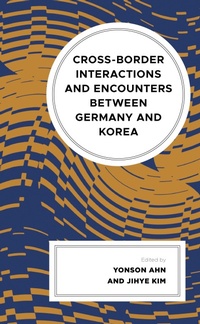
Cross-border Interactions and Encounters between Germany and Korea
Lexington Books (Publisher)
1st Edition
Published on 15. October 2023
1 pages
978-1-9787-9154-1 (ISBN)
Description

Cross-Border Interactions and Encounters between Germany and Korea offers a rich, interdisciplinary examination of the evolving relationships between Korea and Germany, illuminating a dynamic yet often overlooked field of study.
Bringing together scholars from diverse disciplines, the volume traces how migration, cultural exchange, and intellectual transfer have produced layered and shifting forms of connection between the two contexts.
Across three thematically organized sections, the book moves from lived experience to cultural production to institutional and discursive representation. The first part examines Korean migration in Germany, highlighting how diasporic identities are negotiated through race, family life, labor, and entrepreneurship, and how new migratory patterns are reshaping established Korean communities. The second part turns to cultural interactions, exploring how artistic practices, ethnographic collections, and translation mediate and transform understandings of "Korean culture" in German contexts and beyond. The final section investigates representation in media and academia, analyzing how ideas, historical events, and scholarly traditions are interpreted, contested, and institutionalized across national borders.
Taken together, these contributions reveal cross-border exchange not as a linear process of influence, but as a multidirectional field of encounters shaped by power, memory, creativity, and negotiation. By foregrounding both historical depth and contemporary developments, the volume offers new insight into how transnational relationships are produced and reimagined over time.
In doing so, it not only advances Korean-German studies but also demonstrates why examining such entangled, transnational dynamics is essential for understanding cultural globalization in a more nuanced and grounded way.
Bringing together scholars from diverse disciplines, the volume traces how migration, cultural exchange, and intellectual transfer have produced layered and shifting forms of connection between the two contexts.
Across three thematically organized sections, the book moves from lived experience to cultural production to institutional and discursive representation. The first part examines Korean migration in Germany, highlighting how diasporic identities are negotiated through race, family life, labor, and entrepreneurship, and how new migratory patterns are reshaping established Korean communities. The second part turns to cultural interactions, exploring how artistic practices, ethnographic collections, and translation mediate and transform understandings of "Korean culture" in German contexts and beyond. The final section investigates representation in media and academia, analyzing how ideas, historical events, and scholarly traditions are interpreted, contested, and institutionalized across national borders.
Taken together, these contributions reveal cross-border exchange not as a linear process of influence, but as a multidirectional field of encounters shaped by power, memory, creativity, and negotiation. By foregrounding both historical depth and contemporary developments, the volume offers new insight into how transnational relationships are produced and reimagined over time.
In doing so, it not only advances Korean-German studies but also demonstrates why examining such entangled, transnational dynamics is essential for understanding cultural globalization in a more nuanced and grounded way.
More details
Series
Edition
1. Auflage
Language
English
Place of publication
United States
Publishing group
Bloomsbury Publishing Plc
Target group
Professional and scholarly
Illustrations
5 b/w illustrations; 6 tables;
ISBN-13
978-1-9787-9154-1 (9781978791541)
Copyright in bibliographic data and cover images is held by Nielsen Book Services Limited or by the publishers or by their respective licensors: all rights reserved.
Schweitzer Classification
Other editions
Additional editions
Yonson Ahn | Jihye Kim
Cross-border Interactions and Encounters between Germany and Korea
Book
10/2023
Lexington Books
€109.40
Shipment within 3-4 weeks
Persons
Yonson Ahn is professor, chair of Korean Studies at the Goethe University of Frankfurt, Germany.
Jihye Kim is lecturer in Korean Studies at the University of Central Lancashire in the UK.
Jihye Kim is lecturer in Korean Studies at the University of Central Lancashire in the UK.
Content
Acknowledgments
Introduction by Yonson Ahn and Jihye Kim
Part I: Korean Migration in Germany
Chapter 1. Challenging "Other-ness" in Berlin: German Koreans, Multi-raciality, and Diasporic Resources by Helen Kim
Chapter 2. Mothering Practices of Korean Healthcare Workers in Germany by Yonson Ahn
Chapter 3. Korean Newcomers in Germany: The Changing Sociodemographics of Korean Immigrants by Jaok Kwon
Chapter 4. Recent Immigration and Self-Employment: Motivations and Factors in the Rise of Korean Restaurants in Frankfurt by Jihye Kim
Part II: Cultural Interactions
Chapter 5. P'ansori in Germany: Korean Singing-Storytelling, from Representation of Culture to Creative Collaboration by Jan Creutzenberg
Chapter 6. Ethnographic Collecting and Transculturally Shaped Images of Korean Culture in Germany Towards the End of the Choson Dynasty by Katharina Süberkrüb
Chapter 7. Translation as Cultural Transfer between Korean and German by Yuri Ko
Part III: Representation in Media and Academia
PART III: REPRESENTATION IN MEDIA AND ACADEMIA
Chapter 8: Discursive Conflicts in the Transfer of Ideas and Institutions across Borders: Narratives of the "German Model" in South Korean Media by Jin-Wook Shin and Boyeong Jeong
Chapter 9: German Diplomats' and Journalists' Perspectives on the April Revolution in South Korea by Hannes B. Mosler
Chapter 10: Initiating German Korean Studies in Context: 1930s,the GDR, and the FRG by Yvonne Schulz Zinda
Chapter 11: The History of German Language and Literature Studies in South Korea: A Female Philologist's Personal Perspective by Yonsuk Chae
Index
About the Contributors
Introduction by Yonson Ahn and Jihye Kim
Part I: Korean Migration in Germany
Chapter 1. Challenging "Other-ness" in Berlin: German Koreans, Multi-raciality, and Diasporic Resources by Helen Kim
Chapter 2. Mothering Practices of Korean Healthcare Workers in Germany by Yonson Ahn
Chapter 3. Korean Newcomers in Germany: The Changing Sociodemographics of Korean Immigrants by Jaok Kwon
Chapter 4. Recent Immigration and Self-Employment: Motivations and Factors in the Rise of Korean Restaurants in Frankfurt by Jihye Kim
Part II: Cultural Interactions
Chapter 5. P'ansori in Germany: Korean Singing-Storytelling, from Representation of Culture to Creative Collaboration by Jan Creutzenberg
Chapter 6. Ethnographic Collecting and Transculturally Shaped Images of Korean Culture in Germany Towards the End of the Choson Dynasty by Katharina Süberkrüb
Chapter 7. Translation as Cultural Transfer between Korean and German by Yuri Ko
Part III: Representation in Media and Academia
PART III: REPRESENTATION IN MEDIA AND ACADEMIA
Chapter 8: Discursive Conflicts in the Transfer of Ideas and Institutions across Borders: Narratives of the "German Model" in South Korean Media by Jin-Wook Shin and Boyeong Jeong
Chapter 9: German Diplomats' and Journalists' Perspectives on the April Revolution in South Korea by Hannes B. Mosler
Chapter 10: Initiating German Korean Studies in Context: 1930s,the GDR, and the FRG by Yvonne Schulz Zinda
Chapter 11: The History of German Language and Literature Studies in South Korea: A Female Philologist's Personal Perspective by Yonsuk Chae
Index
About the Contributors
