

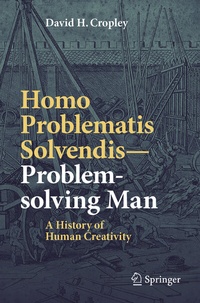
Homo Problematis Solvendis-Problem-solving Man
Description

This book presents the history of modern human creativity/innovation through examples of solutions to basic human needs that have been developed over time. The title - Homo problematis solvendis - is a play on the scientific classifications of humans (e.g. Homo habilis, Homo erectus, Homo sapiens), and is intended to suggest that a defining characteristic of modern humans is our fundamental ability to solve problems (i.e. problem- solving human = Homo problematis solvendis).
The book not only offers new perspectives on the history of technology, but also helps readers connect the popular interest in creativity and innovation (in schools, in businesses) with their psychological underpinnings. It discusses why creativity and innovation are vital to societies, and how these key abilities have made it possible for societies to develop into what they are today.
Reviews / Votes
"Readable, albeit unusual, study of a handful of inventions from prehistory to the 21st century. .There are a few surprises in the author's final scores. What reader would guess that the velocipede (an early bicycle) would receive a perfect score of 16 while Gutenberg's printing press would receive a rather modest score of 12.5?" (T. Timmons, Choice, Vol. 56 (10), June, 2019)
More details
Other editions
Additional editions
Person
David H. Cropley is an internationally recognised expert on creativity and innovation. His teaching interests focus on systems engineering and related concepts, and his research examines a range of aspects of creativity and innovation, both in the field of engineering, and more broadly. David has appeared on "Redesign My Brain" (ABC TV, 2013) and "Life at 9" (ABC TV, 2014) discussing various aspects of creativity. He will appear on a new series of Redesign My Brain in 2015, looking at cognitive flexibility and problem solving.
Content
Prehistory.- The Classical Period.- The Medieval Period.- The Renaissance.- The Age of Exploration.- The Age of Enlightenment.- The Romantic Period.- The Modern Age.- The Postmodern Age.- The Information Age.- Conclusions.
