

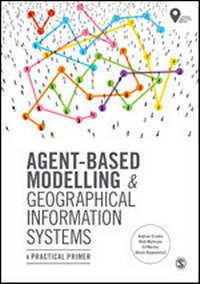
Agent-Based Modelling and Geographical Information Systems
A Practical Primer
1st Edition
Published on 13. December 2018
408 pages
978-1-5264-5416-4 (ISBN)
Description

This is the era of Big Data and computational social science. It is an era that requires tools which can do more than visualise data but also model the complex relation between data and human action, and interaction. Agent-Based Models (ABM) - computational models which simulate human action and interaction - do just that.
This textbook explains how to design and build ABM and how to link the models to Geographical Information Systems. It guides you from the basics through to constructing more complex models which work with data and human behaviour in a spatial context. All of the fundamental concepts are explained and related to practical examples to facilitate learning (with models developed in NetLogo with all code examples available on the accompanying website). You will be able to use these models to develop your own applications and link, where appropriate, to Geographical Information Systems.
All of the key ideas and methods are explained in detail:
geographical modelling;
an introduction to ABM;
the fundamentals of Geographical Information Science;
why ABM and GIS;
using QGIS;
designing and building an ABM;
calibration and validation;
modelling human behavior.
An applied primer, that provides fundamental knowledge and practical skills, it will provide you with the skills to build and run your own models, and to begin your own research projects.
This textbook explains how to design and build ABM and how to link the models to Geographical Information Systems. It guides you from the basics through to constructing more complex models which work with data and human behaviour in a spatial context. All of the fundamental concepts are explained and related to practical examples to facilitate learning (with models developed in NetLogo with all code examples available on the accompanying website). You will be able to use these models to develop your own applications and link, where appropriate, to Geographical Information Systems.
All of the key ideas and methods are explained in detail:
geographical modelling;
an introduction to ABM;
the fundamentals of Geographical Information Science;
why ABM and GIS;
using QGIS;
designing and building an ABM;
calibration and validation;
modelling human behavior.
An applied primer, that provides fundamental knowledge and practical skills, it will provide you with the skills to build and run your own models, and to begin your own research projects.
Reviews / Votes
A great introduction for all those interested in learning about agent-based simulation where physical space is an important factor. Importantly this integrates GIS and other common geographic approaches with simulation approaches. Both beginners and more advanced researchers will find a lot of useful information here. -- Bruce Edmonds A highly original textbook linking complex systems and agent-based modeling with GIS using theoretical and methodological perspectives, software implementations, and real-world applications. A much-needed book for students at all levels to learn about geosimulation and modelling with geographic automata. -- Suzana Dragicevic This textbook is a must-have for everybody who wants to learn or know about agent-based models integrated with geographic information systems. It combines in-depth introductions to basic concepts with hands-on advice on technical detail and covers all relevant aspects. -- Volker Grimm I fully expect to recommend individual chapters to students when they come to me with detailed questions, when they need a refresher on some of the concepts, or when they show specific knowledge gaps that need to be filled in. -- Julia Kasmire * SAGE Journal: Environment and Planning B: Urban Analytics and City Science *More details
Series
Edition
First Edition
Language
English
Place of publication
London
United Kingdom
Target group
College/higher education
ISBN-13
978-1-5264-5416-4 (9781526454164)
Copyright in bibliographic data and cover images is held by Nielsen Book Services Limited or by the publishers or by their respective licensors: all rights reserved.
Schweitzer Classification
Other editions
Additional editions
Andrew Crooks | Nick Malleson | Ed Manley
Agent-Based Modelling and Geographical Information Systems
A Practical Primer
Book
12/2018
1st Edition
SAGE Publications Ltd
€218.60
Shipment within 15-20 days
Andrew Crooks | Nick Malleson | Ed Manley
Agent-Based Modelling and Geographical Information Systems
A Practical Primer
Book
12/2018
1st Edition
SAGE Publications Ltd
€155.80
Shipment within 15-20 days
Content
Chapter 1 Agent-based Modelling and Geographical Information Systems
Chapter 2 Introduction to Agent-based Modelling
Chapter 3 Designing and Developing an Agent-based Model
Chapter 4 Building Agent-based Models with NetLogo
Chapter 5 Fundamentals of GIS
Chapter 6 Integrating Agent-based Models and GIS
Chapter 7 Modelling Human Behaviour
Chapter 8 Networks
Chapter 9 Spatial Statistics
Chapter 10 Evaluating Models: Verification, Calibration, Validation
Chapter 11 Alternative Modelling Approaches
Chapter 12 Summary and Outlook
Appendix
Chapter 2 Introduction to Agent-based Modelling
Chapter 3 Designing and Developing an Agent-based Model
Chapter 4 Building Agent-based Models with NetLogo
Chapter 5 Fundamentals of GIS
Chapter 6 Integrating Agent-based Models and GIS
Chapter 7 Modelling Human Behaviour
Chapter 8 Networks
Chapter 9 Spatial Statistics
Chapter 10 Evaluating Models: Verification, Calibration, Validation
Chapter 11 Alternative Modelling Approaches
Chapter 12 Summary and Outlook
Appendix
