

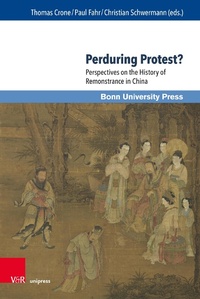
Perduring Protest?
Perspectives on the History of Remonstrance in China
1st Edition
Published on 4. December 2023
204 pages
978-3-8470-1651-9 (ISBN)
Description

Early Chinese inscriptions show that already the kings of the Western Zhou period (1045-771 BCE) called upon officials to submit remonstrances. However, it was not until the Warring States period (fifth century BCE to 221 BCE) that remonstrance was explained to mean that monarchical rule would be optimized if officials could object to the monarch's decisions. This book examines the history of remonstrance in China from conceptual, institutional, literary, and comparative perspectives, pointing out parallels to European institutions and the expression of dissent in modern China. Special attention is paid to the historical semantics of remonstrance, the strategies and intentions of remonstrants, and the perspective of the rulers who instrumentalized criticism to pursue their own goals.
More details
Other editions
Additional editions
Thomas Crone | Paul Fahr | Christian Schwermann
Perduring Protest?
Perspectives on the History of Remonstrance in China
Book
12/2023
1st Edition
Brill Deutschland
€45.00
Shipment within 5-7 days
Content
- Intro
- Title Page
- Copyright
- Table of Contents
- Body
- Series Editors' Preface
- Thomas Crone: Introduction
- Bibliography
- Primary Sources
- Secondary Literature
- Thomas Crone: A Different Flavour: The Concept of "Remonstrance" (jian ) in Texts of the Zhou Period
- 1 Zhou Period Remonstrance
- 2 Peripheral Aspects
- 3 Conclusion
- Bibliography
- Primary Sources
- Secondary Literature
- Felix Bohlen: Narrative Discourses on Power and Rule: The Anecdote and the Exemplum in the Shanghai Manuscript 'The Remonstrance of Bao Shuya and Xi Peng'
- 1 'The Remonstrance of Bao Shuya and Xi Peng': Structure and Internal Criticism
- 2 The Exemplum of Gao Zong and His Advisor Zu Ji: Structure, Function, and Teaching
- 3 Structural, Formal, and Conceptual Relations to Transmitted Texts
- 4 Conclusion
- Bibliography
- Primary Sources
- Secondary Literature
- Paul Fahr: Remonstrating under Difficult Circumstances: The Case of Wang Jia in 'Hanshu', Chapter 86
- 1 Introduction
- 2 High Officials under Pressure
- 3 Chapter 86: An Overview
- 4 Wang Jia's Memorials
- 4.1 Consult Advisors and Value Their Advice
- 4.2 Keep Apart What Is Public and What Is Private
- 4.3 Be Concerned about Public Approval
- 4.4 Uphold the Dignity of Your Office and the Achievements of Your Ancestors
- 5 Conclusion
- Bibliography
- Primary Sources
- Secondary Literature
- Béatrice L'Haridon: Remonstrance in a Declining Empire: The Case of Chen Fan, Minister to Emperors Huan and Ling of the Eastern Han Dynasty
- 1 Remonstrances at the End of the Eastern Han Dynasty
- 2 Remonstrances in Chen Fan's Biographical Account
- 3 Remonstrances and Their Resonances
- 3.1 Contemporary Resonances
- 3.2 Later Resonances
- 4 Conclusion
- Bibliography
- Primary Sources
- Secondary Literature
- Eugen Wiens: Errant Grace? Criticism of Amnesties in Imperial China with a Focus on the Tang Dynasty
- 1 Amnesties in Pre-Imperial and Medieval Times
- 2 Early Statements on Amnesties and Their Reception in Remonstrances
- 3 Influence of the Remonstrances
- 4 Comparison to Other Critiques
- 5 Evaluation of the Relevant Statements in the Classical Writings and Remonstrances of the First Type
- 6 Second Category of Remonstrances against Amnesties
- 7 Conclusion
- Bibliography
- Primary Sources
- Secondary Literature
- Christian Schwermann: The Place of Remonstrance in Chinese History: Its Function, Institutional Embedding, and Legacy
- 1 Remonstrating in East and West: Some Parallels
- 2 The Place of Remonstrance in the 'Institutional Body' of the Empire
- 3 The Legacy of Remonstrance in Modern China
- 4 Conclusion
- Bibliography
- Primary Sources
- Secondary Literature
- List of Contributors
