

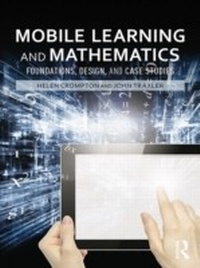
Mobile Learning and Mathematics
Foundations, Design, and Case Studies
1st Edition
Published on 11. February 2015
256 pages
978-1-317-80421-5 (ISBN)
Description

Mobile Learning and Mathematics provides an overview of current research on how mobile devices are supporting mathematics educators in classrooms across the globe.
Through nine case studies, chapter authors investigate the use of mobile technologies over a range of grade levels and mathematical topics, while connecting chapters provide a strong foundational background in mobile learning theories, instructional design, and learner support.
For current educators, Mobile Learning and Mathematics provides concrete ideas and strategies for integrating mobile learning into their mathematics instruction-for example, by sharing resources that will help implement Common Core State Standards, or by streamlining the process of selecting from the competing and often confusing technology options currently available. A cutting edge research volume, this collection also provides a springboard for educational researchers to conduct further study.
Through nine case studies, chapter authors investigate the use of mobile technologies over a range of grade levels and mathematical topics, while connecting chapters provide a strong foundational background in mobile learning theories, instructional design, and learner support.
For current educators, Mobile Learning and Mathematics provides concrete ideas and strategies for integrating mobile learning into their mathematics instruction-for example, by sharing resources that will help implement Common Core State Standards, or by streamlining the process of selecting from the competing and often confusing technology options currently available. A cutting edge research volume, this collection also provides a springboard for educational researchers to conduct further study.
Reviews / Votes
"The data is clear: students want to use their mobile devices for learning in school. Crompton and Traxler show you how. Teachers will find this book absolutely accessible-there are "take-aways" that can be used in the classroom tomorrow. Principals: buy this book for your K-12 math teachers. They will thank you."Cathie Norris, high school math teacher and Regents Professor, Department of Learning Technologies, University of North Texas, USA
"Crompton and Traxler have set a very high bar with the first substantive book on the use of mobile devices in mathematics instruction! This is the book with which mobile math researchers must start and to which educators will come for ideas. Its eighteen diverse chapters are chock-full of the latest ideas in mobile mathematics learning."
Elliot Soloway, Arthur F. Thurnau Professor, CSE Department, University of Michigan, USA
"Mobile technologies are ubiquitous and will transform math learning. These authors act as inspiring and thoughtful guides, setting down a strong foundation."
Jere Confrey, Joseph D. Moore Distinguished University Professor, North Carolina State University, USA
More details
Language
English
Place of publication
London
United Kingdom
Publishing group
Taylor & Francis Ltd
Target group
College/higher education
Illustrations
5 s/w Tabellen
5 Tables, black and white
File size
2,70 MB
ISBN-13
978-1-317-80421-5 (9781317804215)
Copyright in bibliographic data and cover images is held by Nielsen Book Services Limited or by the publishers or by their respective licensors: all rights reserved.
Schweitzer Classification
Other editions
Additional editions
Book
03/2015
1st Edition
Routledge
€76.60
Shipment within 15-20 days
Book
02/2015
1st Edition
Routledge
€206.50
Shipment within 15-20 days
Persons
Helen Crompton is Assistant Professor of Instructional Technology at Old Dominion University in Norfolk, Virginia, USA.
John Traxler is Professor of Mobile Learning at the University of Wolverhampton, UK, where he also directs the Learning Lab.
John Traxler is Professor of Mobile Learning at the University of Wolverhampton, UK, where he also directs the Learning Lab.
Content
Introduction
Helen Crompton and John Traxler
Chapter 1
Bridging the Gap: Using Mobile Devices to Connect Mathematics to Out-of-School Contexts
Sandra Sawaya, Ralph Putnam
Chapter 2
Mobile Applications for Math Education - How Should They Be Done?
Martin Ebner
Chapter 3
Inquiry-based Mobilized Math Classroom with SMILE
Donggil Song, Paul Kim
Chapter 4
Smartphones Welcome! Preparatory Course in Mathematics Using the Mobile App MassMatics
Eva Decker, Barbara Meier, Andreas Christ, Gisela Hillenbrand, Stephan Claus, Robert Koschig
Chapter 5
Students' Behaviour, Perceptions and Emotions when Learning Mathematics with Cellular Phones
Wajeeh Daher, Nimer Baya'a
Chapter 6
Designing with Mobile Technologies for Enabling Transitions Across Mathematical Contexts
Hakan Sollervall, Marcelo Milrad
Chapter 7
Breaking barriers between out-of-school and classroom mathematics with documenting
Tim Jay, Ulises Xolocotzin
Chapter 8
Realistic Mathematics Education, Mobile Learning and the Bridge21 Model for 21st Century Learning: A Perfect Storm
Brendan Tangney, Aibhin Bray, Elizabeth Oldham
Chapter 9
Using Mobile Games in the Classroom: The Good and the Bad of a New Math Language
Anders Kluge and Jan Dolonen
Chapter 10
Guidelines for Developing Mobile Learning Games for Mathematics Based on a Cased Study
Vani Kalloo, Permanand Mohan
Chapter 11
Virtual 10-Frames and Mobile Technology in a Canadian Primary Classroom
Helen Wight, Andrew Kitchenham
Chapter 12
Students' Mathematical Conjectures when Interacting with a Mobile Device
S. Asli OEzguen-Koca, Thomas G. Edwards
Chapter 13
Support in Hand: Mobile Nudges for Math Success
Jarek Sierschynski, Colleen Carmean, Jill Frankfort
Chapter 14
Mobile Help Seeking in Mathematics: An Exploratory Study with Mexican Engineering Students
Mario S. Aguilar, Danelly E. Puga
Chapter 15
Confessions of a Dr Math Tutor
Laurie Butgereit, Adele Botha, Vicki Boysen
Chapter 16
Case Study: Tangerine (R): Class for Data-Informed Instructional Decision Making in Kenya
Carmen Strigel, Mildren Lango'o, Dunstone Kwayumba, Sarah Koko
Chapter 17
Mobilizing Mathematics: Participants' Perspectives on Bring Your Own Device
Billie Jean Holubz
Conclusion
Mobile Maths: Figuring What Next
John Traxler & Helen Crompton
Contributor Biographies
Index
Helen Crompton and John Traxler
Chapter 1
Bridging the Gap: Using Mobile Devices to Connect Mathematics to Out-of-School Contexts
Sandra Sawaya, Ralph Putnam
Chapter 2
Mobile Applications for Math Education - How Should They Be Done?
Martin Ebner
Chapter 3
Inquiry-based Mobilized Math Classroom with SMILE
Donggil Song, Paul Kim
Chapter 4
Smartphones Welcome! Preparatory Course in Mathematics Using the Mobile App MassMatics
Eva Decker, Barbara Meier, Andreas Christ, Gisela Hillenbrand, Stephan Claus, Robert Koschig
Chapter 5
Students' Behaviour, Perceptions and Emotions when Learning Mathematics with Cellular Phones
Wajeeh Daher, Nimer Baya'a
Chapter 6
Designing with Mobile Technologies for Enabling Transitions Across Mathematical Contexts
Hakan Sollervall, Marcelo Milrad
Chapter 7
Breaking barriers between out-of-school and classroom mathematics with documenting
Tim Jay, Ulises Xolocotzin
Chapter 8
Realistic Mathematics Education, Mobile Learning and the Bridge21 Model for 21st Century Learning: A Perfect Storm
Brendan Tangney, Aibhin Bray, Elizabeth Oldham
Chapter 9
Using Mobile Games in the Classroom: The Good and the Bad of a New Math Language
Anders Kluge and Jan Dolonen
Chapter 10
Guidelines for Developing Mobile Learning Games for Mathematics Based on a Cased Study
Vani Kalloo, Permanand Mohan
Chapter 11
Virtual 10-Frames and Mobile Technology in a Canadian Primary Classroom
Helen Wight, Andrew Kitchenham
Chapter 12
Students' Mathematical Conjectures when Interacting with a Mobile Device
S. Asli OEzguen-Koca, Thomas G. Edwards
Chapter 13
Support in Hand: Mobile Nudges for Math Success
Jarek Sierschynski, Colleen Carmean, Jill Frankfort
Chapter 14
Mobile Help Seeking in Mathematics: An Exploratory Study with Mexican Engineering Students
Mario S. Aguilar, Danelly E. Puga
Chapter 15
Confessions of a Dr Math Tutor
Laurie Butgereit, Adele Botha, Vicki Boysen
Chapter 16
Case Study: Tangerine (R): Class for Data-Informed Instructional Decision Making in Kenya
Carmen Strigel, Mildren Lango'o, Dunstone Kwayumba, Sarah Koko
Chapter 17
Mobilizing Mathematics: Participants' Perspectives on Bring Your Own Device
Billie Jean Holubz
Conclusion
Mobile Maths: Figuring What Next
John Traxler & Helen Crompton
Contributor Biographies
Index
