

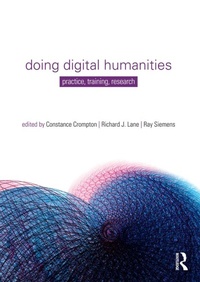
Doing Digital Humanities
Practice, Training, Research
Published on 13. September 2016
444 pages
978-1-317-48113-3 (ISBN)
Description

Digital Humanities is rapidly evolving as a significant approach to/method of teaching, learning and research across the humanities. This is a first-stop book for people interested in getting to grips with digital humanities whether as a student or a professor. The book offers a practical guide to the area as well as offering reflection on the main objectives and processes, including:
Accessible introductions of the basics of Digital Humanities through to more complex ideas
A wide range of topics from feminist Digital Humanities, digital journal publishing, gaming, text encoding, project management and pedagogy
Contextualised case studies
Resources for starting Digital Humanities such as links, training materials and exercises
Doing Digital Humanities looks at the practicalities of how digital research and creation can enhance both learning and research and offers an approachable way into this complex, yet essential topic.
Accessible introductions of the basics of Digital Humanities through to more complex ideas
A wide range of topics from feminist Digital Humanities, digital journal publishing, gaming, text encoding, project management and pedagogy
Contextualised case studies
Resources for starting Digital Humanities such as links, training materials and exercises
Doing Digital Humanities looks at the practicalities of how digital research and creation can enhance both learning and research and offers an approachable way into this complex, yet essential topic.
More details
Language
English
Place of publication
London
United Kingdom
Publishing group
Taylor & Francis Ltd
Target group
Professional and scholarly
College/higher education
Illustrations
17 s/w Tabellen
17 Tables, black and white
File size
4,80 MB
ISBN-13
978-1-317-48113-3 (9781317481133)
Copyright in bibliographic data and cover images is held by Nielsen Book Services Limited or by the publishers or by their respective licensors: all rights reserved.
Schweitzer Classification
Other editions
Additional editions
Constance Crompton | Richard Lane | Ray Siemens
Doing Digital Humanities
Practice, Training, Research
Book
08/2016
1st Edition
Routledge
€238.09
Shipment within 10-20 days
Constance Crompton | Richard Lane | Ray Siemens
Doing Digital Humanities
Practice, Training, Research
Book
07/2016
1st Edition
Routledge
€54.50
Shipment within 10-20 days
Persons
Constance Crompton is Assistant Professor of Digital Humanities at the University of British Columbia-Okanagan Campus, Canada.
Richard J. Lane is a Professor and Principal Investigator of the MeTA Digital Humanities Lab at Vancouver Island University, Canada.
Ray Siemens is the Canada Research Chair in Humanities Computing and Distinguished Professor in the Faculty of Humanities in English and Computer Science at the University of Victoria, Canada.
Richard J. Lane is a Professor and Principal Investigator of the MeTA Digital Humanities Lab at Vancouver Island University, Canada.
Ray Siemens is the Canada Research Chair in Humanities Computing and Distinguished Professor in the Faculty of Humanities in English and Computer Science at the University of Victoria, Canada.
Content
Preface, Raymond Siemens
Introduction, Constance Crompton, Richard J. Lane and Raymond Siemens
Notes on Contributors
Foundations
1. Thinking-Through the History of Computer-Assisted Text Analysis, Geoffrey Rockwell and Stefan Sinclair
2. Global Outlooks in Digital Humanities: Multilingual Practices and Minimal Computing, Alex Gil and Elika Ortega
3. Problems with White Feminism: Intersectionality and Digital Humanities, Jacqueline Wernimont and Elizabeth Losh
4. Towards Best Practices in Collaborative Online Knowledge Production, Susan Brown
5. Understanding the Pre-Digital Book, Helene Cazes and J. Matthew Huculak
Core Concepts and Skills
6. Critical Computing in the Humanities, Phillip R. Polefrone, John Simpson, and Dennis Yi Tenen
7. Text Encoding, Julia Flanders, Syd Bauman, and Sarah Connell
8. Computational Stylistics and Text Analysis, Jan Rybicki, Maciej Eder, and David Hoover
9. Databases, Harvey Quamen and Jon Bath
10. Digitalization Fundamentals, Robin Davies and Michael Nixon
11. Geographical Information Systems as a Tool for Exploring the Spatial Humanities, Ian Gregory and Patricia Murrieta-Flores
12. Electronic Literature and Digital Humanities: Opportunities for Practice, Scholarship, and Teaching, Dene Grigar
12a. Electronic Literature: What Is It?, N. Katherine Hayles
12.b Electronic Literature: Where Is It?, Dene Grigar
Creation, Remediation, and Curation
13. Foundations for Digital Editing, with Focus on the Documentary Tradition, Jennifer Stertzer
14. XSLT: Transforming our XML Data, Julia Flanders, Syd Bauman, and Sarah Connell
15. Working with the Semantic Web, James Smith
16. Drupal and Other Content Management Systems, Quinn Dombrowski
17. Augmented Reality, Markus Wust
18. Fabrication and Research-Creation in the Arts and Humanities, Nicole Clouston and Jentery Sayers
19. From Theory to Experience to Making to Breaking: Iterative Game Design for Digital Humanists, Matt Bouchard and Andy Keenan
Administration, Dissemination, and Teaching
20. Project Management and the Digital Humanist, Lynne Siemens
21. Doing DH in the Classroom: Transforming the Humanities Curriculum through Digital Engagement, Diane Jakacki and Katherine Faull
22. Digital Liberal Arts and Project-Based Pedagogies, Aaron Mauro
23. Dissemination as Cultivation: Scholarly Communications in a Digital Age, James O'Sullivan, Christopher P. Long, and Mark Mattson
Introduction, Constance Crompton, Richard J. Lane and Raymond Siemens
Notes on Contributors
Foundations
1. Thinking-Through the History of Computer-Assisted Text Analysis, Geoffrey Rockwell and Stefan Sinclair
2. Global Outlooks in Digital Humanities: Multilingual Practices and Minimal Computing, Alex Gil and Elika Ortega
3. Problems with White Feminism: Intersectionality and Digital Humanities, Jacqueline Wernimont and Elizabeth Losh
4. Towards Best Practices in Collaborative Online Knowledge Production, Susan Brown
5. Understanding the Pre-Digital Book, Helene Cazes and J. Matthew Huculak
Core Concepts and Skills
6. Critical Computing in the Humanities, Phillip R. Polefrone, John Simpson, and Dennis Yi Tenen
7. Text Encoding, Julia Flanders, Syd Bauman, and Sarah Connell
8. Computational Stylistics and Text Analysis, Jan Rybicki, Maciej Eder, and David Hoover
9. Databases, Harvey Quamen and Jon Bath
10. Digitalization Fundamentals, Robin Davies and Michael Nixon
11. Geographical Information Systems as a Tool for Exploring the Spatial Humanities, Ian Gregory and Patricia Murrieta-Flores
12. Electronic Literature and Digital Humanities: Opportunities for Practice, Scholarship, and Teaching, Dene Grigar
12a. Electronic Literature: What Is It?, N. Katherine Hayles
12.b Electronic Literature: Where Is It?, Dene Grigar
Creation, Remediation, and Curation
13. Foundations for Digital Editing, with Focus on the Documentary Tradition, Jennifer Stertzer
14. XSLT: Transforming our XML Data, Julia Flanders, Syd Bauman, and Sarah Connell
15. Working with the Semantic Web, James Smith
16. Drupal and Other Content Management Systems, Quinn Dombrowski
17. Augmented Reality, Markus Wust
18. Fabrication and Research-Creation in the Arts and Humanities, Nicole Clouston and Jentery Sayers
19. From Theory to Experience to Making to Breaking: Iterative Game Design for Digital Humanists, Matt Bouchard and Andy Keenan
Administration, Dissemination, and Teaching
20. Project Management and the Digital Humanist, Lynne Siemens
21. Doing DH in the Classroom: Transforming the Humanities Curriculum through Digital Engagement, Diane Jakacki and Katherine Faull
22. Digital Liberal Arts and Project-Based Pedagogies, Aaron Mauro
23. Dissemination as Cultivation: Scholarly Communications in a Digital Age, James O'Sullivan, Christopher P. Long, and Mark Mattson
