

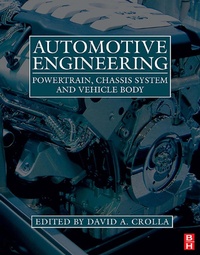
Automotive Engineering e-Mega Reference
Published on 24. September 2009
850 pages
978-1-85617-578-4 (ISBN)
Description

This one-stop Mega Reference eBook brings together the essential professional reference content from leading international contributors in the automotive field. An expansion the Automotive Engineering print edition, this fully searchable electronic reference book of 2500 pages delivers content to meet all the main information needs of engineers working in vehicle design and development.Material ranges from basic to advanced topics from engines and transmissions to vehicle dynamics and modelling.* A fully searchable Mega Reference Ebook, providing all the essential material needed by Automotive Engineers on a day-to-day basis. * Fundamentals, key techniques, engineering best practice and rules-of-thumb together in one quick-reference.* Over 2,500 pages of reference material, including over 1,500 pages not included in the print edition
More details
Other editions
Additional editions
Book
09/2009
Butterworth-Heinemann
€171.50
Shipment within 10-15 days
Content
Section 1 Introduction to Engine Design 1.1 Piston-Engine Cycles of OperationSection 2 Engine Testing 2.1 Measurement of Torque, Power, Speed and Fuel Consumption; Acceptance and Type Tests, Accuracy of the Measurements 2.2 Test Cell Control and Data Acquisition 2.3 Measurement of Fuel, Combustion Air and Oil Consumption 2.4 Thermal Efficiency, Measurement of Heat and Mechanical Losses 2.5 The Combustion Process and Combustion Analysis 2.6 Exhaust Emissions 2.7 Data Collection, Handling, Post-Test Processing, Engine Calibration and MappingSection 3 Engine Emissions 3.1 Emissions ControlSection 4 Digital Engine Control 4.1 Digital Engine Control Systems 4.2 The Basics of Electronic Engine Control 4.3 Sensors and ActuatorsSection 5 Transmission 5.1 Transmissions and DrivelineSection 6 Electric Vehicles 6.1 Battery/Fuel-Cell EV Design PackagesSection 7 Hybrid Vehicles 7.1 Hybrid Vehicle DesignSection 8 Suspensions 8.1 Types of Suspension and Drive 8.2 Wheel Travel and Elastokinematics 8.3 Modelling and Analysis of SuspensionSection 9 Steering 9.1 SteeringSection 10 Tyres 10.1 Tyres and Wheels 10.2 Basic Tyre Modelling Considerations 10.3 Theory of Steady-State Slip Force and Moment Generation 10.4 Semi-Empirical Tyre ModelsSection 11 Handling 11.1 Tyre Characteristics and Vehicle Handling and Stability 11.2 Simulation Output and InterpretationSection 12 Brakes 12.1 Braking SystemsSection 13 Vehicle Control Systems 13.1 Vehicle Motion Control 13.2 Control Systems in AutomobilesSection 14 Intelligent Transport Systems 14.1 Global Positioning Technology 14.2 Decisional ArchitectureSection 15 Vehicle Modelling 15.1 Modelling and Assembly of the Full VehicleSection 16 Structural Design 16.1 Terminology and Overview of Vehicle Structure Types 16.2 Standard Sedan (Saloon) - Baseline Load Paths 16.3 Alternative Construction 16.4 Case StudiesSection 17 Vehicle Safety 17.1 Vehicle Safety 17.2 Crashworthiness and Its Influence on Vehicle DesignSection 18 Materials 18.1 Design and Material Utilization 18.2 Materials for Consideration and Use in Automotive Body StructuresSection 19 Aerodynamics 19.1 Body Design: AerodynamicsSection 20 Refinement 20.1 Vehicle Refinement: Purpose and Targets 20.2 Noise Vibration and HarshnessSection 21 Interior Noise 21.1 Interior Noise: Assessment and ControlSection 22 Exterior Noise 22.1 Exterior Noise: Assessment and ControlSection 23 Instrumentation and Telematics 23.1 Automotive Instrumentation and TelematicsSection 24 Ergonomics 24.1 ErgonomicsSection 25 Manufacture and Quality 25.1 Component Manufacture 25.2 Component Assembly 25.3 Quality Management System
