

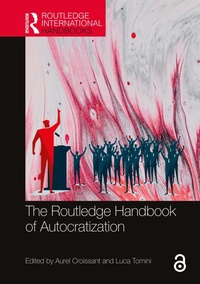
The Routledge Handbook of Autocratization
1st Edition
Published on 14. May 2024
622 pages
978-1-040-04018-8 (ISBN)
Description

The Routledge Handbook of Autocratization comprehensively and systematically explores the current understanding, and unchartered research paths, of autocratization.
With wide-reaching regional coverage and expert analysis from Asia, North and South America, Europa, the Middle East, and North Africa, this handbook reveals cross-country, and cross-regional, analysis and insights and presents in-depth explanations and consequences of autocratization. Arranged in five thematic parts, chapters explore the basic aspects of conceptualization, theorization, and measurement of autocratization; the role of various political and non-political actors as perpetrators, supporters, bystanders, or defenders of democracy against autocratization processes; and the consequences across various policy fields. Showcasing cutting-edge research developments, the handbook illustrates the deeply complex nature of the field, examining important topics in need of renewed consideration at a time of growing concerns for democracy and the global spread of authoritarian challenges to democracy.
The Routledge Handbook of Autocratization will be a key reference for those interested in, and studying authoritarianism, democratization, human rights, governance, democracy and more broadly comparative politics, and regional/area studies.
Chapter 2 and Chapter 11 of this book is freely available as a downloadable Open Access PDF at http://www.taylorfrancis.com under a Creative Commons Attribution-Non Commercial-No Derivatives (CC-BY-NC-ND) 4.0 International license (chapter 2) and Creative Commons Attribution (CC-BY) 4.0 International license (Chapter 11).
With wide-reaching regional coverage and expert analysis from Asia, North and South America, Europa, the Middle East, and North Africa, this handbook reveals cross-country, and cross-regional, analysis and insights and presents in-depth explanations and consequences of autocratization. Arranged in five thematic parts, chapters explore the basic aspects of conceptualization, theorization, and measurement of autocratization; the role of various political and non-political actors as perpetrators, supporters, bystanders, or defenders of democracy against autocratization processes; and the consequences across various policy fields. Showcasing cutting-edge research developments, the handbook illustrates the deeply complex nature of the field, examining important topics in need of renewed consideration at a time of growing concerns for democracy and the global spread of authoritarian challenges to democracy.
The Routledge Handbook of Autocratization will be a key reference for those interested in, and studying authoritarianism, democratization, human rights, governance, democracy and more broadly comparative politics, and regional/area studies.
Chapter 2 and Chapter 11 of this book is freely available as a downloadable Open Access PDF at http://www.taylorfrancis.com under a Creative Commons Attribution-Non Commercial-No Derivatives (CC-BY-NC-ND) 4.0 International license (chapter 2) and Creative Commons Attribution (CC-BY) 4.0 International license (Chapter 11).
Reviews / Votes
"This ambitious collection succeeds at marrying breadth and depth. In addition to offering countless insights on the structures, actors, history, geography, and consequences of autocratization, it sets a compelling agenda for future research. Anyone seeking to understand autocratization will benefit from reading this handbook."Nancy Bermeo, Oxford University, UK
"Authoritarianism, autocratization, backsliding: these concepts have defined a wide-ranging and fecund research agenda. This collection gathers thoughtful essays by a 'who's who' in the study of autocratization. The volume is organized in a particularly useful way, considering questions of conceptualization, measurement, and the causes as well as effects of backsliding and authoritarian regress. An added benefit is a cluster of essays that review the phenomenon through a regional lens, capturing nuances we can miss taking a global approach. An important and well-timed collection that surveys the most pressing political problem of our time."
Stephan Haggard, University of California San Diego, USA
More details
Series
Edition
1. Auflage
Language
English
Place of publication
London
United Kingdom
Publishing group
Taylor & Francis Ltd
Target group
College/higher education
Illustrations
28 Tables, black and white; 43 Line drawings, black and white; 43 Illustrations, black and white
File size
16,89 MB
ISBN-13
978-1-040-04018-8 (9781040040188)
Copyright in bibliographic data and cover images is held by Nielsen Book Services Limited or by the publishers or by their respective licensors: all rights reserved.
Schweitzer Classification
Other editions
Additional editions
Aurel Croissant | Luca Tomini
The Routledge Handbook of Autocratization
Book
05/2026
1st Edition
Routledge
€63.50
Shipment within 10-20 days
Aurel Croissant | Luca Tomini
The Routledge Handbook of Autocratization
Book
05/2024
1st Edition
Routledge
€332.10
Shipment within 10-20 days
Persons
Aurel Croissant is Professor at the Institute of Political Science, Heidelberg University, Germany, and Visiting Professor at GSIS Ewha Womans University, South Korea.
Luca Tomini is FNRS Research Associate and Professor of Political Science at the Universite libre de Bruxelles (ULB), Belgium.
Luca Tomini is FNRS Research Associate and Professor of Political Science at the Universite libre de Bruxelles (ULB), Belgium.
Content
1. Introduction Part 1: Concepts, Approaches and Measurements 2. Rethinking Democratic Subversion 3. Conceptualizing autocratization 4. Measuring autocratization 5. Identifying episodes of autocratization Part 2: Structures and Institutions 6. Economic development and autocratization 7. Inequality and autocratization 8. Social classes and autocratization 9. Past legacies and autocratization 10. Polarization and autocratization 11. Ideological modules of autocratization 12. Elections and autocratization 13. Autocratization and the three faces of judicial power 14. Autocratization by legal means in weak presidential democracies 15. The Internet and autocratization 16. Subnational dimensions of autocratization 17. The international order and autocratization Part 3: Actors 18. International actors and autocratization 19. Parties, government leaders, and autocratization 20. Populism and autocratization 21. Religious actors and autocratization 22. Civil society and autocratization 23. Economic actors and autocratization 24. The Military and autocratization Part 4: Consequences and Impact 25. Autocratization and development 26. Administrative backsliding 27. Autocratization and health outcomes 28. Autocratization and gender politics 29. Autocratization and environmental performance 30. Autocratization and ethnic relations 31. Autocratization and political conflict Part 5: Regional Perspectives 32. Western Europe 33. Central and Eastern Europe 34. Western Balkans 35. Post-Soviet States 36. Latin America 37. Middle East and North Africa 38. Sub-Saharan Africa 39. East and Southeast Asia 40. South Asia
