

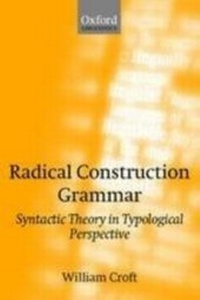
Radical Construction Grammar
Syntactic Theory in Typological Perspective
1st Edition
Published on 25. October 2001
445 pages
978-0-19-154479-8 (ISBN)
Description

Radical Construction Grammar presents a profound critique of syntactic theory and argumentation, and offers a genuinely new approach to syntax based on the fact of grammatical diversity. Recent syntactic theories are essentially formal models for the representation of grammatical knowledge and posit complex syntactic structures in the analysis of sentences. The result has been a endless cycle of new and revised theories of syntactic representation. Radical Construction Grammar argues that this approach to syntax is incompatible with the grammatical variation found within and across languages. This book defends three fundamental theses: (i) constructions are the primitive units of syntactic representation, and grammatical categories are defined by constructions, not the other way around, (ii) the only syntactic structures are the part-whole relations between a construction and the syntactic elements that make it up, (iii) not only are grammatical categories construction-specific, but constructions are language-specific. In other words, syntactic structure is almost entirely language-specific, attempts to find a universal formal model are doomed to failure. Radical Construction Grammar integrates concepts from typological theory and construction grammar to uncover the genuine universals of grammar. Constructions are represented as complex symbolic units pairing form and meaning. The semantic map model of typological theory is used to map category distributions on a largely universal conceptual space. Universals of grammar are found in the mapping of meaning onto form. Systematic patterns of grammatical variation provide evidence for the topography of conceptual space, which in turn reflects the geography of the human mind.
More details
Other editions
Additional editions
Book
10/2001
Oxford University Press
€398.50
Shipment within 15-20 days
Content
- Intro
- Contents
- Preface
- Acknowledgments
- List of Figures
- List of Tables
- List of Abbreviations
- List of Symbols
- PART ONE: FROM SYNTACTIC CATEGORIES TO SEMANTIC MAPS
- 1. Syntactic Argumentation and Radical Construction Grammar
- 1.1. Introduction
- 1.2. Methodology and Theory in Syntax
- 1.3. Constructions and Construction Grammar
- 1.4. Distributional Analysis and Cross-linguistic Universals
- 1.5. Distributional Analysis and the Representation of Particular Language Grammars
- 1.6. Radical Construction Grammar: Frequently Asked Questions
- 1.7. Conclusion and Prospects
- 2. Parts of Speech
- 2.1. Introduction
- 2.2. The Alleged Absence of Parts of Speech in Particular Languages
- 2.3. From Lumping to Splitting
- 2.4. Conceptual Space, Semantic Maps and a Universal Theory of Parts of Speech
- 2.5. Integrating the Language-particular and the Universal in the Representation of Grammatical Knowledge
- 3. Syntactic Categories and Semantic Relativity
- 3.1. The Relationship between Form and Meaning
- 3.2. Hidden Assumptions in Arguments for Semantic Relativity
- 3.3. The Dynamic, Fluctuating Character of Linguistic "Relativity"
- 3.4. Semantic Universals, Relativity, and Radical Construction Grammar
- 4. Clausal Syntactic Roles ("Grammatical Relations")
- 4.1. Introduction
- 4.2. Language Universals without Universal Syntactic Roles
- 4.3. Language Universals without Global Syntactic Roles
- 4.4. Some Further Complications
- 4.5. Conclusion
- PART TWO: FROM SYNTACTIC RELATIONS TO SYMBOLIC RELATIONS
- 5. Dependency, Constituency, and Linear Order
- 5.1. Introduction
- 5.2. Collocational Dependencies as Semantic Relations
- 5.3. Constituency and Linear Order
- 5.4. Overtly Coded Dependencies
- 5.5. Conclusion
- 6. A Radical Approach to Syntactic Relations
- 6.1. The Logical Argument against Syntactic Relations
- 6.2. Syntactic Relations vs. Symbolic Relations
- 6.3. Syntactic Relations vs. Syntactic Roles
- 6.4. Comprehending Constructions without Syntactic Relations
- 7. Heads, Arguments, and Adjuncts
- 7.1. Introduction
- 7.2. Criteria for Headhood
- 7.3. Deconstructing Heads
- 7.4. A Semantic Definition of "Head"
- 7.5. Grammaticalization and the PIBU Profile Equivalent
- 7.6. "Heads" and Roots in Morphology
- 7.7. The Argument-Adjunct Distinction
- PART THREE: FROM UNIVERSAL CONSTRUCTIONS TO SYNTACTIC SPACE
- 8. The Voice Continuum
- 8.1. Introduction
- 8.2. Prelude: Animacy Constraints in Actives and Passives
- 8.3. The Structural Variety of Actives and Passives
- 8.4. Blurring the Active-Nonactive Distinction
- 8.5. A Typological-Universal Analysis of Voice Constructions
- 9. The Coordination-Subordination Continuum
- 9.1. Introduction
- 9.2. A Gestalt Analysis of Coordination and Adverbial Subordination
- 9.3. E-site Elaboration and the Typology of Complements and Relative Clauses
- 9.4. The Syntactic Space of Complex Sentences: the Deranking Hierarchy
- 9.5. Conclusion
- 10. Syntactic Theory and the Theory of Language
- References
- Index of Authors
- A
- B
- C
- D
- E
- F
- G
- H
- J
- K
- L
- M
- N
- O
- P
- Q
- R
- S
- T
- U
- V
- W
- Y
- Z
- Index of Languages
- A
- B
- C
- D
- E
- F
- G
- H
- I
- J
- K
- L
- M
- N
- O
- P
- Q
- R
- S
- T
- U
- V
- W
- X
- Y
- Index of Constructions, Categories, and Features
- A
- B
- C
- D
- E
- F
- G
- I
- K
- L
- M
- N
- O
- P
- Q
- R
- S
- T
- U
- V
- Index of Subjects
- A
- B
- C
- D
- E
- F
- G
- H
- I
- L
- M
- N
- O
- P
- Q
- R
- S
- T
- U
- V
- W
- X
- Z
