

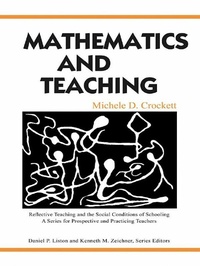
Mathematics and Teaching
Published on 1. June 2008
144 pages
978-1-135-70513-8 (ISBN)
Description

Mathematics and Teaching uses case studies to explore complex and pervasive issues that arise in teaching. In this volume, school mathematics is the context in which to consider race, equity, political contexts and the broader social and cultural circumstances in which schooling occurs. This book does not provide immediate or definitive resolutions. Rather, its goal is to provoke and facilitate thoughtful discussion about critical issues for professional decision-making in mathematics teaching.
This is the 7th volume in Reflective Teaching and the Social Conditions of Schooling: A Series for Prospective and Practicing Teachers, edited by Daniel P. Liston and Kenneth M. Zeichner. It follows the same format as previous volumes in the series.
Part I includes four case studies of classroom experiences: "Race and Teacher Expectations"; "Mathematics for All?"; "Culture and School Mathematics"; and "Politics and School Mathematics." Each case is followed by a space for readers' own reactions and reflections, school stakeholders' reactions, and a summary with additional questions for further discussion.
Part II presents three public arguments representing different views about the issues that arise in mathematics teaching: conservative, liberal and radical multiculturalist.
Part III offers the authors' reflections on the centrality of culture in teaching mathematics, resources and exercises for further reflection, and a bibliography for further reading.
Mathematics and Teaching is pertinent for all prospective and practicing teachers at any stage in their teaching careers. It is appropriate for any undergraduate and graduate course addressing mathematics teaching issues.
This is the 7th volume in Reflective Teaching and the Social Conditions of Schooling: A Series for Prospective and Practicing Teachers, edited by Daniel P. Liston and Kenneth M. Zeichner. It follows the same format as previous volumes in the series.
Part I includes four case studies of classroom experiences: "Race and Teacher Expectations"; "Mathematics for All?"; "Culture and School Mathematics"; and "Politics and School Mathematics." Each case is followed by a space for readers' own reactions and reflections, school stakeholders' reactions, and a summary with additional questions for further discussion.
Part II presents three public arguments representing different views about the issues that arise in mathematics teaching: conservative, liberal and radical multiculturalist.
Part III offers the authors' reflections on the centrality of culture in teaching mathematics, resources and exercises for further reflection, and a bibliography for further reading.
Mathematics and Teaching is pertinent for all prospective and practicing teachers at any stage in their teaching careers. It is appropriate for any undergraduate and graduate course addressing mathematics teaching issues.
Reviews / Votes
"The book uses case stories and reactions to those stories to explore various dimensions of the relationships among mathematics, schools, and culture...I can imagine using the cases and political arguments presented in Mathematics and Teaching with a number of audiences...The book itself includes reactions from parents, grandparents, school board members, administrators, and other professionals associated with K-12 schooling.These audiences are not listed explicitly as intended audiences in the series title, but it seems to me that the author did a very powerful thing by having discussions with such people about the cases and including their comments in the reactions sections. These groups can be influential in decision-making processes and are critical in the support structure for teachers who are trying to be maximally effective for all students."--Teri J. Murphy, MAA Reviews (2009)More details
Series
Language
English
Place of publication
London
United Kingdom
Publishing group
Taylor & Francis Ltd
Target group
College/higher education
File size
0,95 MB
ISBN-13
978-1-135-70513-8 (9781135705138)
Copyright in bibliographic data and cover images is held by Nielsen Book Services Limited or by the publishers or by their respective licensors: all rights reserved.
Schweitzer Classification
Other editions
Additional editions
Michele D. Crockett
Mathematics and Teaching
Book
07/2017
1st Edition
Routledge
€271.50
Shipment within 10-20 days
Michele D. Crockett
Mathematics and Teaching
Reflective Teaching and the Social Conditions of Schooling
Book
05/2008
1st Edition
Routledge
€81.80
Shipment within 10-20 days
Person
Michele D. Crockett is an assistant professor in the Mathematics, Science and Technology division, Department of Curriculum and Instruction, at the University of Illinois at Urbana-Champaign She is a Spencer/National Academy of Education Postdoctoral Fellowship recipient. Her research interests focus on professional development in mathematics education and school reform.
Content
Selected Contents:
Table of Contents
Series Preface iii
Preface iv
Acknowledgments x
Introduction 1
PART I: CASES AND REACTIONS 12
Introduction to Case 1 12
Case 1: "Race and Teacher Expectations" 13
Reader Reactions to "Race and Teacher Expectations" 19
Reactions to "Race and Teacher Expectation 20
Summary and Additional Questions 34
Introduction to Case 2 35
Case 2: "Mathematics for All?" 36
Reader Reactions to "Mathematics for All?" 42
Reactions to "Mathematics for All?" 43
Summary and Additional Questions 55
Introduction to Case 3 57
Case 3: "Culture and School Mathematics" 59
Reader Reactions to "Culture and School Mathematics" 64
Reactions to "Culture and School Mathematics" 65
Summary and Additional Questions 76
Introduction to Case 4 79
Case 4: "Politics and School Mathematics" 81
Reader Reactions to "Politics and School Mathematics" 87
Reactions to "Politics and School Mathematics" 88
Summary and Additional Questions 104
Reader Reactions to the Four Cases 107
Reactions to the Four Cases 108
Part II. Public Arguments 119
A "Conservative View": Mathematics for Global Economic Leadership 122
Comments and Questions 135
A "Liberal View": Equality of Opportunity and School Mathematics in a Democracy 138
Comments and Questions 147
A "Radical Multiculturalist View": Mathematics for Developing Critical Dispositions for Social Reconstruction 150
Comments and Questions 164
Part III. Concluding Remarks, Some Reflections, and Resources for Further Reflections
Table of Contents
Series Preface iii
Preface iv
Acknowledgments x
Introduction 1
PART I: CASES AND REACTIONS 12
Introduction to Case 1 12
Case 1: "Race and Teacher Expectations" 13
Reader Reactions to "Race and Teacher Expectations" 19
Reactions to "Race and Teacher Expectation 20
Summary and Additional Questions 34
Introduction to Case 2 35
Case 2: "Mathematics for All?" 36
Reader Reactions to "Mathematics for All?" 42
Reactions to "Mathematics for All?" 43
Summary and Additional Questions 55
Introduction to Case 3 57
Case 3: "Culture and School Mathematics" 59
Reader Reactions to "Culture and School Mathematics" 64
Reactions to "Culture and School Mathematics" 65
Summary and Additional Questions 76
Introduction to Case 4 79
Case 4: "Politics and School Mathematics" 81
Reader Reactions to "Politics and School Mathematics" 87
Reactions to "Politics and School Mathematics" 88
Summary and Additional Questions 104
Reader Reactions to the Four Cases 107
Reactions to the Four Cases 108
Part II. Public Arguments 119
A "Conservative View": Mathematics for Global Economic Leadership 122
Comments and Questions 135
A "Liberal View": Equality of Opportunity and School Mathematics in a Democracy 138
Comments and Questions 147
A "Radical Multiculturalist View": Mathematics for Developing Critical Dispositions for Social Reconstruction 150
Comments and Questions 164
Part III. Concluding Remarks, Some Reflections, and Resources for Further Reflections
