

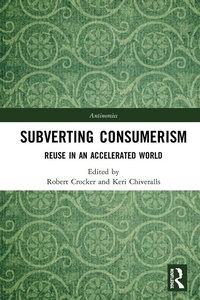
Subverting Consumerism
Reuse in an Accelerated World
1st Edition
Published on 24. July 2018
246 pages
978-1-317-28113-9 (ISBN)
Description

There is now a widespread interest in reuse in many domains, from opera houses built over old warehouses, to vintage clothes and everyday goods incorporating repurposed materials or parts. Despite its ubiquity, this extensive creative work is typically seen in narrowly environmental terms, as a means of reducing carbon, resource use or waste. However, as this volume shows, reuse also has aesthetic and cultural dimensions and a rich social currency, invoked to consciously subvert the accelerated consumer culture responsible for our unfolding environmental crisis.
In three parts, the essays in this book consider reuse in terms of values, aesthetics and meaning, its application in contemporary urban and spatial settings, and the revival of social practices involving a more conscious recourse to reuse and repair. These are bookended by the editors' essays: the first, on the significant relationship between reuse and technological and social acceleration evident in the surrounding consumer society; and the last, on the multiple forms of reuse deployed in a contemporary alternative building practice, and their contributions to presenting alternative ways of living in the world.
Challenging dominant understandings of 'waste' and 'consumption', Subverting Consumerism shows how reuse has become a means for many to creatively engage with the past, and to discover a continuity and sense of place eroded by the accelerative regimes of contemporary consumerism. Becoming a means of resistance, and offering a range of aesthetic, social and economic possibilities, reuse can be found to subvert and challenge the obsessive quest for the new found in contemporary consumerism.
In three parts, the essays in this book consider reuse in terms of values, aesthetics and meaning, its application in contemporary urban and spatial settings, and the revival of social practices involving a more conscious recourse to reuse and repair. These are bookended by the editors' essays: the first, on the significant relationship between reuse and technological and social acceleration evident in the surrounding consumer society; and the last, on the multiple forms of reuse deployed in a contemporary alternative building practice, and their contributions to presenting alternative ways of living in the world.
Challenging dominant understandings of 'waste' and 'consumption', Subverting Consumerism shows how reuse has become a means for many to creatively engage with the past, and to discover a continuity and sense of place eroded by the accelerative regimes of contemporary consumerism. Becoming a means of resistance, and offering a range of aesthetic, social and economic possibilities, reuse can be found to subvert and challenge the obsessive quest for the new found in contemporary consumerism.
More details
Series
Edition
1. Auflage
Language
English
Place of publication
London
United Kingdom
Publishing group
Taylor & Francis Ltd
Target group
College/higher education
Product notice
Reflowable
Illustrations
2 s/w Abbildungen, 3 farbige Abbildungen, 1 s/w Tabelle, 34 Farbfotos bzw. farbige Rasterbilder, 1 s/w Zeichnung, 2 farbige Zeichnungen
1 Tables, black and white; 7 Line drawings, color; 2 Line drawings, black and white; 36 Halftones, color; 7 Illustrations, color; 2 Illustrations, black and white
ISBN-13
978-1-317-28113-9 (9781317281139)
Copyright in bibliographic data and cover images is held by Nielsen Book Services Limited or by the publishers or by their respective licensors: all rights reserved.
Schweitzer Classification
Other editions
Additional editions
Book
09/2020
1st Edition
Routledge
€55.70
Shipment within 15-20 days
Book
07/2018
1st Edition
Routledge
€252.55
Shipment within 10-20 days
Persons
Robert Crocker (DPhil.) teaches the history and theory of design and design for sustainability in the School of Art, Architecture and Design at the University of South Australia, where he is Deputy Director of the China Australia Centre for Sustainable Urban Development. His research is focused on consumption and its contributing role in our environmental crisis. His most recent book is Somebody Else's Problem: Consumerism, Sustainability and Design (Greenleaf / Routledge 2016).
Keri Chiveralls (PhD.) is the Discipline Lead and Head of Program for the first full degree course offered in Permaculture at CQUniversity. Her research interests are in cultural and environmental anthropology, social movement studies and theories of social change. She received her doctorate in Anthropology/Social Inquiry at the University of Adelaide in 2008. Since then she has published book chapters, journal articles and presented at national and international conferences.
Keri Chiveralls (PhD.) is the Discipline Lead and Head of Program for the first full degree course offered in Permaculture at CQUniversity. Her research interests are in cultural and environmental anthropology, social movement studies and theories of social change. She received her doctorate in Anthropology/Social Inquiry at the University of Adelaide in 2008. Since then she has published book chapters, journal articles and presented at national and international conferences.
Content
Introduction
Robert Crocker and Keri Chiveralls
Acceleration, Consumerism and Reuse: A Changing Paradigm
Robert Crocker
PART I: CULTURE, MEANING AND VALUE
Using Art to Research Diverse Economies: Social Experiments in Re-Valuing Waste
Max Liboiron
Repurposing Cultural Heritages Collections: The Aesthetics and Meaning of Reuse
Sally Butler
The Devil's Horns are Made from Toilet Rolls: Creating Costumes and Communities from 'Junk' Objects
Claire Langsford
PART II: STRATEGIES AND LANDSCAPES OF REUSE
Renew(ing) Newcastle and Complicating Capitalism: Contributory Economies, Artisanal Production and the DIY Occupation of Disused Commercial Space
Cathy Smith
Rapid Urbanisation and Wang Shu's Architecture: The Use of Spolia and Vernacular Traditions in China
Hing-Wah Chau
Public Space for Changing Times: Reuse Strategies in transforming the 'Wastelands' of Cities
Gini Lee
PART III: REVIVING PRACTICES OF REPAIR AND REUSE
Fix it: Barriers to Repair and Opportunities for Change
Tim Cooper and Giuseppe Salvia
ReDress: Maximising Component Reuse for Fashion
Kim Fraser
Composting as Everyday Alchemy: Producing Compost from Food Scraps in Twenty-First Century Urban Environments
Vivienne Waller, Linkda Blackall and Peter Newton
Reuse in Earthship Construction: Reclaiming the Past to Shape the Future
Keri Chiveralls
Robert Crocker and Keri Chiveralls
Acceleration, Consumerism and Reuse: A Changing Paradigm
Robert Crocker
PART I: CULTURE, MEANING AND VALUE
Using Art to Research Diverse Economies: Social Experiments in Re-Valuing Waste
Max Liboiron
Repurposing Cultural Heritages Collections: The Aesthetics and Meaning of Reuse
Sally Butler
The Devil's Horns are Made from Toilet Rolls: Creating Costumes and Communities from 'Junk' Objects
Claire Langsford
PART II: STRATEGIES AND LANDSCAPES OF REUSE
Renew(ing) Newcastle and Complicating Capitalism: Contributory Economies, Artisanal Production and the DIY Occupation of Disused Commercial Space
Cathy Smith
Rapid Urbanisation and Wang Shu's Architecture: The Use of Spolia and Vernacular Traditions in China
Hing-Wah Chau
Public Space for Changing Times: Reuse Strategies in transforming the 'Wastelands' of Cities
Gini Lee
PART III: REVIVING PRACTICES OF REPAIR AND REUSE
Fix it: Barriers to Repair and Opportunities for Change
Tim Cooper and Giuseppe Salvia
ReDress: Maximising Component Reuse for Fashion
Kim Fraser
Composting as Everyday Alchemy: Producing Compost from Food Scraps in Twenty-First Century Urban Environments
Vivienne Waller, Linkda Blackall and Peter Newton
Reuse in Earthship Construction: Reclaiming the Past to Shape the Future
Keri Chiveralls
