

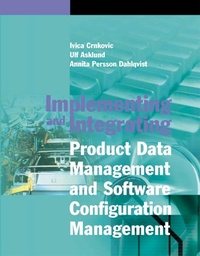
Implementing and Integrating Product Data Management and Software Configuration Management
1st Edition
Published on 1. January 2002
366 pages
978-1-58053-685-1 (ISBN)
Description

Because today's products rely on tightly integrated hardware and software components, system and software engineers, and project and product managers need to have an understanding of both product data management (PDM) and software configuration management (SCM). This groundbreaking book offers you that essential knowledge, pointing out the similarities and differences of these two processes, and showing you how they can be combined to ensure effective and efficient product and system development, production and maintenance.
More details
Other editions
Additional editions
Ulf Asklund | Ivica Crnkovic | Annita Persson Dahlqvist
Implementing and Integrating Product Data Management and Software Configuration Management
Book
06/2003
Artech House Publishers
€104.18
Shipment within 10-20 days
Content
- Intro
- Contents
- Foreward
- Preface
- Part 1: Basic Principles of PDM and SCM
- Chapter1: Requirements of complex pro
- 1.1 Products are all around us
- 1.2 Product life cycle
- 1.3 Complexity increases
- 1.4 PDM and SCM
- Chapter 2: General description of PDM
- 2.1 Introduction
- 2.2 Basic functionality
- 2.3 Information architecture
- 2.4 System architecture
- 2.5 Applications
- 2.6 Trends in PDM
- 2.7 Summary
- Chapter 3: General description of SCM
- 3.1 Introduction
- 3.2 Basic functions
- 3.3 Related domains
- 3.4 Trends
- 3.5 Summary
- Part 2: Similarities and Differences between PDM and SCM
- Chapter 4: Comparison of technical principles and key functionality
- 4.1 Comparison of principles
- 4.2 Comparison of key functionality
- 4.3 Summary
- Chapter 5: Analysis and general findings
- 5.1 Development process and information management
- 5.2 A case study-Information management and PLC
- 5.3 Complex products
- 5.4 Integration requirements and constraints
- 5.5 Summary
- Part 3: Integration and Deployment
- Chapter 6: PDM and SCM integration
- 6.1 Possible integrations
- 6.2 Different scenarios in an integrated environment
- 6.3 Examples of integrations
- 6.4 Summary
- Chapter 7: Evaluation and deployment
- 7.1 Evaluation and deployment of complex systems
- 7.2 Evaluation
- 7.3 Deployment
- 7.4 Summary
- Part 4: Case Studies
- Chapter 8: Case Studies
- 8.1 Introduction
- 8.2 Sun Microsystmes, Inc.
- 8.3 Mentor Graphics Corporation
- 8.4 Ericsson Radio Systems AB
- 8.5 Ericsson Mobile Communications AB
- 8.6 ABB Automation Technology Products
- 8.7 SaabTech Electronics AB
- 8.8 Summary
- Part 5: Tools and Standards Survey
- Chapter 9: A survey of PDM tools
- 9.1 PDM resources on the Internet
- 9.2 PDM systems
- 9.3 List of PDM tools
- 9.4 Summary
- Chapter 10: Survey of SCM tools
- 10.1 SCM resources on the Internet
- 10.2 Commercial SCM tools
- 10.3 List of SCM commercial tools
- 10.4 Freeware SCM tools
- 10.5 Summary
- Chapter 11: Document management systems
- 11.1 Document management and PDM
- 11.2 Document life cycle and document management
- 11.3 Document management and related technologies
- 11.4 Document management resources on the Internet
- 11.5 List of document and content management systems
- 11.6 Summary
- Chapter 12: Standards and de facto standards in PDM and SCM
- 12.1 PDM standards
- 12.2 CM standards
- 12.3 SCM standards
- 12.4 Life cycle processes
- 12.5 CMM and CMM Integration
- 12.6 SGML and XML
- 12.7 Summary
- List of Acronyms
- About the authors
- Index
