

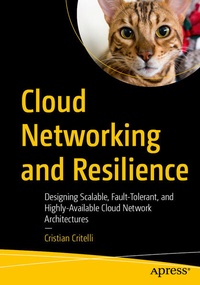
Cloud Networking and Resilience
Description

Cloud Networking and Resilience is a focused, practical guide to designing cloud infrastructure that stays robust, scalable, and always available-even when applications and networks suffer service impairment. While most cloud books offer broad overviews, this book zeroes in on the networking layer, providing a detailed roadmap for building resilient cloud networks that can withstand outages, absorb and adapt to failure, all while supporting mission-critical applications.
The book starts by explaining key concepts such as resilience, availability, and disaster recovery, helping readers understand the unique role each plays in modern cloud architecture. From there, it explores the technical backbone of cloud networking, including virtualization, software-defined networking (SDN), and DNS fundamentals. Dedicated chapters walk through real-world strategies for DNS failover, BGP optimization, Anycast routing, and multi-region architectures-equipping readers with tools to minimize downtime and performance degradation.
A standout aspect of this book is its layer-by-layer approach to resilience, aligned with the OSI model-from physical connectivity to application-level failovers. It also dives into cutting-edge traffic engineering and cell-based architectures to enhance scalability and isolate faults. Later chapters cover automation frameworks, network observability, continuous resilience testing, and predictive AIOps, demonstrating how resilient cloud networks evolve from reactive monitoring to proactive prevention and automated verification.
Whether you're a cloud architect, DevOps professional, or network engineer, this book offers the knowledge and best practices you need to build fault-tolerant cloud environments. With case studies, emerging trends like AIOps, and a forward-looking take on quantum networking, path aware routing, and edge computing, this is an essential guide for building the next generation of resilient cloud networks.
What you will learn:
Design cloud networks that are resilient by default to reduce outages and service impairments.
Apply DNS failover and multi-cloud strategies to ensure continuous availability
Optimize traffic routing using BGP and other techniques for efficient global performance
Follow best practices for building distributed networks engineered for high availability and fault tolerance
Who this book is for:
This book is for cloud architects, network engineers, and DevOps teams. It's especially useful for those working on multi-cloud, hybrid deployments, and disaster recovery planning. Ideal for anyone focused on traffic engineering, high availability, and business continuity in the cloud. It is equally valuable for organizations running mission-critical systems across regulated industries-such as financial services, healthcare, and the public sector-where operational resilience, continuity, and mandatory testing are required by frameworks like DORA, NIS2, and other global regulations.
More details
Other editions
Additional editions
Person
Cristian Critelli is a cloud networking and resilience specialist with deep expertise in network engineering, multi-region architectures, and traffic engineering. As the EMEA Lead for Networking and Resilience at Amazon Web Services (AWS), he helps enterprises and partners design and operate scalable, highly available, and fault-tolerant cloud solutions. With a background in network engineering, cloud networking, and reliability, Cristian has authored technical blogs, white papers, and enablement material used by cloud professionals worldwide. He holds over 57 certifications across AWS, CISCO, Microsoft, Riverbed, and Wireshark, and is a recognized technical speaker, industry expert and advocate for resilient, failure-tolerant cloud architectures.
Content
Chapter 1. What is Resilience in Resilience in the Cloud era.- Chapter 2. Fundamentals of Cloud Networking and Network Topologies.- Chapter 3. DNS Fundamentals.- Chapter 4. Resilient DNS Architectures and Techniques.- Chapter 5. Implementing Resilience Throughout the OSI Model with AWS Examples.- Chapter 6. Building Network Isolation with Cell-Based Architectures, Availability Zones and Regions.- Chapter 7. Traffic Engineering for Cloud Resilience and Performance.- Chapter 8. Operational Resilience and Disaster Recovery.- Chapter 9. The Next Decade of Cloud Resilience.
