

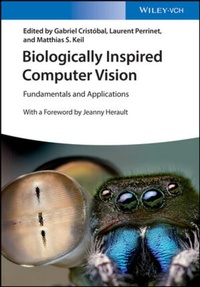
Biologically Inspired Computer Vision
Fundamentals and Applications
1st Edition
Published on 31. August 2015
XXII, 458 pages
978-3-527-68049-8 (ISBN)
Description

As the state-of-the-art imaging technologies became more and more advanced, yielding scientific data at unprecedented detail and volume, the need to process and interpret all the data has made image processing and computer vision increasingly important. Sources of data that have to be routinely dealt with today's applications include video transmission, wireless communication, automatic fingerprint processing, massive databanks, non-weary and accurate automatic airport screening, robust night vision, just to name a few. Multidisciplinary inputs from other disciplines such as physics, computational neuroscience, cognitive science, mathematics, and biology will have a fundamental impact in the progress of imaging and vision sciences. One of the advantages of the study of biological organisms is to devise very different type of computational paradigms by implementing a neural network with a high degree of local connectivity.
This is a comprehensive and rigorous reference in the area of biologically motivated vision sensors. The study of biologically visual systems can be considered as a two way avenue. On the one hand, biological organisms can provide a source of inspiration for new computational efficient and robust vision models and on the other hand machine vision approaches can provide new insights for understanding biological visual systems. Along the different chapters, this book covers a wide range of topics from fundamental to more specialized topics, including visual analysis based on a computational level, hardware implementation, and the design of new more advanced vision sensors. The last two sections of the book provide an overview of a few representative applications and current state of the art of the research in this area. This makes it a valuable book for graduate, Master, PhD students and also researchers in the field.
This is a comprehensive and rigorous reference in the area of biologically motivated vision sensors. The study of biologically visual systems can be considered as a two way avenue. On the one hand, biological organisms can provide a source of inspiration for new computational efficient and robust vision models and on the other hand machine vision approaches can provide new insights for understanding biological visual systems. Along the different chapters, this book covers a wide range of topics from fundamental to more specialized topics, including visual analysis based on a computational level, hardware implementation, and the design of new more advanced vision sensors. The last two sections of the book provide an overview of a few representative applications and current state of the art of the research in this area. This makes it a valuable book for graduate, Master, PhD students and also researchers in the field.
More details
Other editions
Additional editions
Gabriel Cristóbal | Laurent Perrinet | Matthias Keil
Biologically Inspired Computer Vision
Fundamentals and Applications
Book
10/2015
1st Edition
Wiley
€169.00
Article exhausted; check different version
Gabriel Cristobal | Laurent Perrinet | Matthias S. Keil
Biologically-inspired Computer Vision - Fundamentals and Applications
Software
08/2015
Wiley-VCH
€214.78
No shipping information available
Persons
Prof. Gabriel Cristobal is currently a Research Scientist at the Instituto de Optica, Spanish Council for Scientific Research (CSIC). His current research interests are joint representations, vision modelling and multidimensional signal processing. Prof. Cristobal is a Senior Member of the IEEE, member of the Optical Society of America (OSA), EURASIP Spanish liaison officer for the period 2009-2010 and member of the ISO/IEC JTC1/SC29/WG1 (JPEG2000). He is co-editor of the book "Optical and Digital Image Processing" by G. Cristobal, P. Schelkens and H. Thienpont, Wiley VCH, 2011.
Prof. Matthias Keil is currently Ramon and Cajal researcher in the Basic Psychology Department of the University of Barcelona (Spain). He received his PhD degree from the University of Ulm (Germany) for proposing a novel architecture for early visual information processing in the human brain. His research interests are centered on computational neuroscience and diffusion-based image processing. Examples of former and current research lines include computational modeling of brightness and lightness perception, tone mapping, time to contact perception, modeling of insect vision, and biologically motivated collision avoidance systems.
Dr. Laurent Perrinet is researcher in Computational Neuroscience at the "Institut de Neurosciences de la Timone" at Aix-Marseille Université, France. His research is focused on bridging the complex dynamics of realistic models of large-scale models of spiking neurons with functional models of low-level vision.
Prof. Matthias Keil is currently Ramon and Cajal researcher in the Basic Psychology Department of the University of Barcelona (Spain). He received his PhD degree from the University of Ulm (Germany) for proposing a novel architecture for early visual information processing in the human brain. His research interests are centered on computational neuroscience and diffusion-based image processing. Examples of former and current research lines include computational modeling of brightness and lightness perception, tone mapping, time to contact perception, modeling of insect vision, and biologically motivated collision avoidance systems.
Dr. Laurent Perrinet is researcher in Computational Neuroscience at the "Institut de Neurosciences de la Timone" at Aix-Marseille Université, France. His research is focused on bridging the complex dynamics of realistic models of large-scale models of spiking neurons with functional models of low-level vision.
Content
Section I. Fundamentals
1. Bioinspired Vision
2. Retinal Processing
3. Modeling Natural Image Statistics
4. Perceptual Psychophysics
Section II. Optics and Sensing
5. Bioinspired Optical Imaging
6. Bioinspired Compound Vision
7. Plenoptic Sensors
Section III. Modeling
8. Bayesian Models and Priors
9. From Neuronal Models to Neuronal Dynamics
10. Visual Attention and Applications
11. Visual Motion Processing and Human Tracking Behaviour
12. Cortical Networks of Visual Recognition
13. Sparse Models for Computer Vision
14. Biologically Inspired Keypoint Detectors
Section IV. Applications
15. Nightvision Based on a Biological Model.
16. Bioinspired Motion Detection Based on an FPGA Platform.
17. Visual Navigation in a Cluttered World
1. Bioinspired Vision
2. Retinal Processing
3. Modeling Natural Image Statistics
4. Perceptual Psychophysics
Section II. Optics and Sensing
5. Bioinspired Optical Imaging
6. Bioinspired Compound Vision
7. Plenoptic Sensors
Section III. Modeling
8. Bayesian Models and Priors
9. From Neuronal Models to Neuronal Dynamics
10. Visual Attention and Applications
11. Visual Motion Processing and Human Tracking Behaviour
12. Cortical Networks of Visual Recognition
13. Sparse Models for Computer Vision
14. Biologically Inspired Keypoint Detectors
Section IV. Applications
15. Nightvision Based on a Biological Model.
16. Bioinspired Motion Detection Based on an FPGA Platform.
17. Visual Navigation in a Cluttered World
