

Biologically Inspired Computer Vision
Description

This is a comprehensive and rigorous reference in the area of biologically motivated vision sensors. The study of biologically visual systems can be considered as a two way avenue. On the one hand, biological organisms can provide a source of inspiration for new computational efficient and robust vision models and on the other hand machine vision approaches can provide new insights for understanding biological visual systems. Along the different chapters, this book covers a wide range of topics from fundamental to more specialized topics, including visual analysis based on a computational level, hardware implementation, and the design of new more advanced vision sensors. The last two sections of the book provide an overview of a few representative applications and current state of the art of the research in this area. This makes it a valuable book for graduate, Master, PhD students and also researchers in the field.
More details
Other editions
Additional editions
Persons
Prof. Matthias Keil is currently Ramon and Cajal researcher in the Basic Psychology Department of the University of Barcelona (Spain). He received his PhD degree from the University of Ulm (Germany) for proposing a novel architecture for early visual information processing in the human brain. His research interests are centered on computational neuroscience and diffusion-based image processing. Examples of former and current research lines include computational modeling of brightness and lightness perception, tone mapping, time to contact perception, modeling of insect vision, and biologically motivated collision avoidance systems.
Dr. Laurent Perrinet is researcher in Computational Neuroscience at the "Institut de Neurosciences de la Timone" at Aix-Marseille Université, France. His research is focused on bridging the complex dynamics of realistic models of large-scale models of spiking neurons with functional models of low-level vision.
Content
1. Bioinspired Vision
2. Retinal Processing
3. Modeling Natural Image Statistics
4. Perceptual Psychophysics
Section II. Optics and Sensing
5. Bioinspired Optical Imaging
6. Bioinspired Compound Vision
7. Plenoptic Sensors
Section III. Modeling
8. Bayesian Models and Priors
9. From Neuronal Models to Neuronal Dynamics
10. Visual Attention and Applications
11. Visual Motion Processing and Human Tracking Behaviour
12. Cortical Networks of Visual Recognition
13. Sparse Models for Computer Vision
14. Biologically Inspired Keypoint Detectors
Section IV. Applications
15. Nightvision Based on a Biological Model.
16. Bioinspired Motion Detection Based on an FPGA Platform.
17. Visual Navigation in a Cluttered World
Chapter 1
Introduction
Gabriel Cristóbal, Laurent U. Perrinet and Matthias S. Keil
And first he will see the shadows best, next the reflections of men and other objects in the water, and then the objects themselves; then he will gaze upon the light of the moon and the stars and the spangled heaven; and he will see the sky and the stars by night better than the sun or the light of the sun by day?
Plato, The Republic, Book VII
As state-of-the-art imaging technologies become more and more advanced, yielding scientific data of unprecedented detail and volume, the need to process and interpret all this data has made image processing and computer vision also increasingly important. Sources of data that have to be routinely dealt with for today's applications include video transmission, wireless communication, automatic fingerprint processing, massive databanks, non-weary and accurate automatic airport screening, and robust night vision to name a few. These technological advances were closely followed by the increase in computer power of traditional, von-Neumann architectures. However, a major concern is that such architectures are efficient only for specific computations such as retrieving an item in a database or to apply a precise sequence of operations. These usually fail when the application comes closer to biological vision, such as the categorization of images independently of changes in lighting, movements, and the environment or the imaging device. Surprisingly, while computers can handle most complex tasks (such as computing hash numbers, logarithms, and linear algebra), most of the time, the "simpler" the task is for humans (such as "find the animal in the image"), the more complex it becomes to implement on a computing device. Multidisciplinary inputs from other disciplines such as computational neuroscience, cognitive science, mathematics, physics, and biology have had, and will have, a fundamental impact on the progress of imaging and vision sciences. One main advantage of the study of biological organisms is to devise very different types of computational paradigms beyond the usual von Neumann architecture, for example, by implementing a neural network with a high degree of local connectivity, which may be more easily adapted to solve the problems of modern imaging.
This book serves as a comprehensive but rigorous reference in the area of biologically inspired computer vision modeling. Biologically inspired vision, that is, the study of visual systems of living beings, can be considered as a two-way process. On the one hand, living organisms can provide a source of inspiration for new computationally efficient and robust vision models, and on the other hand, machine vision approaches can provide new insights into understanding biological visual systems. Over the different chapters, this book covers a wide range from the fundamental to the more specialized topics. This book often follows Marr's classical, three-level approach to vision (computational, algorithmic, and hardware implementation) [1], but also goes beyond Marr's approach in the design of novel and more advanced vision sensors. In particular, the last section of the book provides an overview of a few representative applications and current state of the art of the research in this area.
The scope of this book somewhat overlaps that of a few other books published in this area, most of them corresponding to conference proceedings, for example, Refs [2, 3]. More recently, several special sessions on this same topic were organized at different workshops such as the ones on "Biologically consistent vision" in conjunction with the 2011 Computer Vision and Pattern Recognition Conference and "Biological and Computer Vision Interfaces" in conjunction with the 2012 European Conference on Computer Vision. The first monograph on this topic was published more than 20 years ago [4] and therefore does not reflect the latest advances in the field. A very good reference in the field is the book by Frisby and Stone [5] that provides the foundation for computational and physiological research on vision. Another relevant reference is the book by Petrou and Bharath although it is more focused toward specialized hardware both at low power and high speed [6]. A more recent reference in the area is the book by Pomplun and Suzuki [7] which is more focused on specific aspects of visual function such as attention, binocularity, or cortical structures. At the time of writing, it is worth mentioning a special issue on bioinspired imaging which highlights recent progress in the domain of vision and biological optics [8]. As a consequence, this book is valuable for both undergraduate and graduate students and also for specialized researchers as it presents information that is usually spread out over different sources into a single and comprehensive monograph.
1.1 Why Should We Be Inspired by Biology?
A central question in this area is to understand why and how is it useful to build technical systems with a biological inspiration. Or, in other words, why should biologically-motivated studies be useful for constructing artificial systems? One answer is that living systems are engineered to perfection by evolution, and thus they provide a seemingly inexhaustible source of inspiration for engineering. In this book, to cover few examples of how such biological findings will be of direct benefit, for example, for engineering new devices and sensors. More generally, one objective of this book is to cover "two-way process" analogy previously mentioned. On the one hand, we have chapters where findings from biology, neurobiology, or psychophysics guide the development of computer vision algorithms. On the other hand, we have more technical chapters that are motivated by biology.
In general, we can argue that Nature has been continuously a source of inspiration not only for constructing artificial vision systems but also in other domains such as materials science. The term "biomimetics" has been coined for the field of science and engineering that seeks to understand and to use nature as a model for copying, adapting, and inspiring concepts. An amazingly early design of Nature can be observed in the Erbenochile erbeni, a Devonian trilobite with calcite-derived compound eyes, allowing the animal to see not only 360 on the horizontal plane but also to cover a significant vertical area. Even more intriguing is the fact that their eyes have eye shades for blocking glare, suggesting that trilobites were diurnal and not nocturnal (see Figure 1.1) [9]. Often, the visual system of non-human organisms surpasses the performance of our visual system. Examples include ultraviolet vision of honey bees, infrared vision of some snakes, or the high temporal resolution of the blow fly visual system. All species were optimized by evolution over large time scales. This has led to efficient solutions to many of the challenges they face. It is therefore not surprising that humans always make efforts to use Nature as a model for innovation and problem solving.
Figure 1.1 The Erbenochile erbeni eyes are distributed in a vertical half-cylinder surface with 18 or 19 lenses per vertical row. Note the striking similarity of this natural eye with the CurvACE sensor presented in Figure 22 of Chapter 7. Image credit: Wikipedia
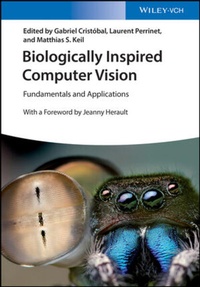
Another intriguing example are the eyes of the peacock mantis shrimp (Odontodactylus japonicus), which are capable of serial or parallel vision, trinocular vision, and depth perception; the color vision is extended to the ultraviolet and infrared ranges (see left cover image of this book). They also exhibit at least 16 different photoreceptors in addition to detection of polarized light and circular polarized light [10]. Inspired by the mantis shrimp's compound eye and polarized vision, an international team of researchers has recently built a miniature sensor that can detect subtle differences in early stage cancerous cells from in vivo endoscopy of the mouse colon [11]. The eyes of other animals use other strategies to solve predatory tasks. The jumping spider uses special staircase-shaped retinas to produce sharp and out-of-focus images simultaneously (see right cover image of this book). By comparing the focused and defocused images, the spider can estimate depth through unmoving eyes. Nagata et al. have developed a mathematical model that predicts the accuracy of the jumps for differentwavelengths [12]. These recent promising results could open up new avenues both in mathematical modeling and signal processing for more challenging applications. In the context of animal vision studies, Land and Nilsson's book [13] provides a fascinating comparative account of the evolution and function of animal eyes with emphasis on the description of the optical system. Furthermore, a very recent book on the same topic is the one by Cronin et al. [14]. As a consequence, biologically inspired computer vision is not only about mimicking the structure of animals' visual systems but also to gain insights from the vast range of different solutions that have emerged through natural selection to provide efficient solutions to vision-based problems.
1.2 Organization of Chapters in the Book
This book contains 18 chapters that have been organized in four different parts:
- Fundamentals
- Sensing
- Modeling
- Applications
The cross-links between the different chapters have been...
