

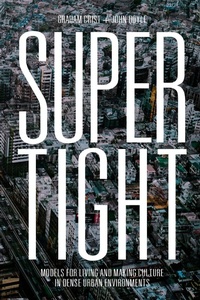
Supertight
Description

Tightness is a positive urban quality, examined through the observations of designers, with a focus on the cities of Asia. The rapidly growing large cities of Asia are critical to understanding our future footprint. Asian cities provide insights into new ways of being densely urbanised. The by-product of this unprecedented metropolitan convergence will be the emergence of new urbanisms and new architectures, new models for living and making culture.
The Supertight refers to the small, intense, robust and hyper-condensed spaces that emerge as a by-product of extreme levels of urban density. Tightness arises as consequence of density, but tightness itself is not density. Tightness is a series of social, economic and cultural practices that have developed in cities as a response to the rapid growth and consolidation of cities. While architectural models of density have been heavily explored, this project investigates the culture of tightness that has emerged in Asian cities over the past thirty years, and the role that designers play in the material and social behaviours of tightness. To be tight is to be small and constrained, but also to be open to the economies and social intimacy of being close. Ultimately this project aims to unpack and convey both the delight and difficulty that emerges through the close occupation of large cities.
With Contributions of Yoshiharu Tsukamoto / Atelier Bow-wow Atelierco Rafael A Balboa with Yasemin Sahiner Sanuki Daisuke Drawing Architecture Studio Desiree Grunewald Sue Hajdu Tohru Horiguchi Alban Mannisi, Yazid Ninsalam, Charles Anderson Minsuk Cho / Mass Studies New Office Works Archie Pizzini Andrew Stiff Superimpose Taishin Shiozaki / Shiozaki Lab WOHA
More details
Other editions
Additional editions
Persons
Content
- Intro
- Foreword
- Reflections on Tightness After Covid from a conversation with Yoshiharu Tsukamoto in 2021
- Conversation with Yoshiharu Tsukamoto and Nigel Bertram
- Essay: Overlapping and Sharing in Tight Cities with Taishin Shiozaki
- Interview with Tohru Horiguchi
- Bingo House: A Super Tight Loose Standing Bar, Tohru Horiguchi
- Conversation with Minsuk Cho and Donald Bates
- Freeze! Mass Studies
- Essay: Rasquachismo and Adjustment versus Control and Planning
- Interview with Sue Hajdu
- Urban Documentation Vietnam Series - Sue Hajdu
- Interview with Archie Pizzini
- Rasquachismo Series Photographs - Archie Pizzini
- Conversation with Aleesha Callaghan and Ian Nazareth
- Essay: The Appearance of the Tight City
- Tight Bar and Tight Hèm Installations
- Interview with Rafael A. Balboa
- Ginza, Shinjuku, Shibuya Series: Rafael A. Balboa and Yasemin Sahiner
- Interview with New Office Works
- Middle Man, Palm Tree, Short Cuts Video Series - New Office Works
- Interview with Sanuki Daisuke
- Ho Chi Minh City House Series - Sanuki Daisuke
- Essay: Situation and Desire in the Tight City
- Conversation with Luke Thornton and Aaron Roberts
- Interview with Ruben Bergambagt
- Spacious Tightness - Superimpose
- Singapore Projects - WOHA
- Conversation with Drawing Architecture Studio
- Diamond Village Series - Drawing Architecture Studio
- Conversation with the City of Moreland
- Conversation with Jana Perkovic and others
- CASACO Project - tomito architecture
- Essay: Tight and Tolerant Cultures
- Conversation with Taishin Shiozaki
- Tight Density, Tight Familiarity, Overlapping City - Shiozaki Lab
- Mapas and Habitats Collage Series - Desirée Grunewald
- Conversation with Vietnam Hem Group
- Hèm and Pha Lau Video Works - Andrew Stiff
- Essay: Production in Tight Cities
- Hokkien Mee Diplomacy - Anderson, Mannisi and Ninsalam
- Conversation with Anderston, Mannisi, Ninsalam
- Conversation with the Design Hub Curators
- Towards a Super Tight City
- Acknowledgments: Image Credits: Notes and References
