

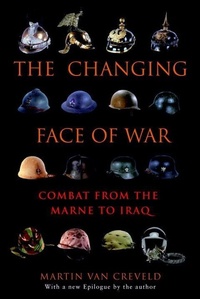
The Changing Face of War
Combat from the Marne to Iraq
Published on 18. December 2008
336 pages
978-0-307-49439-9 (ISBN)
Description

One of the most influential experts on military history and strategy has now written his magnum opus, an original and provocative account of the past hundred years of global conflict. The Changing Face of War is the book that reveals the path that led to the impasse in Iraq, why powerful standing armies are now helpless against ill-equipped insurgents, and how the security of sovereign nations may be maintained in the future.
While paying close attention to the unpredictable human element, Martin van Creveld takes us on a journey from the last century's clashes of massive armies to today's short, high-tech, lopsided skirmishes and frustrating quagmires. Here is the world as it was in 1900, controlled by a handful of "great powers,” mostly European, with the memories of eighteenth-century wars still fresh. Armies were still led by officers riding on horses, messages conveyed by hand, drum, and bugle. As the telegraph, telephone, and radio revolutionized communications, big-gun battleships like the British Dreadnought, the tank, and the airplane altered warfare.
Van Creveld paints a powerful portrait of World War I, in which armies would be counted in the millions, casualties-such as those in the cataclysmic battle of the Marne-would become staggering, and deadly new weapons, such as poison gas, would be introduced. Ultimately, Germany's plans to outmaneuver her enemies to victory came to naught as the battle lines ossified and the winners proved to be those who could produce the most weapons and provide the most soldiers.
The Changing Face of War then propels us to the even greater global carnage of World War II. Innovations in armored warfare and airpower, along with technological breakthroughs from radar to the atom bomb, transformed war from simple slaughter to a complex event requiring new expertise-all in the service of savagery, from Pearl Harbor to Dachau to Hiroshima. The further development of nuclear weapons during the Cold War shifts nations from fighting wars to deterring them: The number of active troops shrinks and the influence of the military declines as civilian think tanks set policy and volunteer forces "decouple” the idea of defense from the world of everyday people.
War today, van Crevald tells us, is a mix of the ancient and the advanced, as state-of-the-art armies fail to defeat small groups of crudely outfitted guerrilla and terrorists, a pattern that began with Britain's exit from India and culminating in American misadventures in Vietnam and Iraq, examples of what the author calls a "long, almost unbroken record of failure.”
How to learn from the recent past to reshape the military for this new challenge-how to still save, in a sense, the free world-is the ultimate lesson of this big, bold, and cautionary work. The Changing Face of War is sure to become the standard source on this essential subject.
While paying close attention to the unpredictable human element, Martin van Creveld takes us on a journey from the last century's clashes of massive armies to today's short, high-tech, lopsided skirmishes and frustrating quagmires. Here is the world as it was in 1900, controlled by a handful of "great powers,” mostly European, with the memories of eighteenth-century wars still fresh. Armies were still led by officers riding on horses, messages conveyed by hand, drum, and bugle. As the telegraph, telephone, and radio revolutionized communications, big-gun battleships like the British Dreadnought, the tank, and the airplane altered warfare.
Van Creveld paints a powerful portrait of World War I, in which armies would be counted in the millions, casualties-such as those in the cataclysmic battle of the Marne-would become staggering, and deadly new weapons, such as poison gas, would be introduced. Ultimately, Germany's plans to outmaneuver her enemies to victory came to naught as the battle lines ossified and the winners proved to be those who could produce the most weapons and provide the most soldiers.
The Changing Face of War then propels us to the even greater global carnage of World War II. Innovations in armored warfare and airpower, along with technological breakthroughs from radar to the atom bomb, transformed war from simple slaughter to a complex event requiring new expertise-all in the service of savagery, from Pearl Harbor to Dachau to Hiroshima. The further development of nuclear weapons during the Cold War shifts nations from fighting wars to deterring them: The number of active troops shrinks and the influence of the military declines as civilian think tanks set policy and volunteer forces "decouple” the idea of defense from the world of everyday people.
War today, van Crevald tells us, is a mix of the ancient and the advanced, as state-of-the-art armies fail to defeat small groups of crudely outfitted guerrilla and terrorists, a pattern that began with Britain's exit from India and culminating in American misadventures in Vietnam and Iraq, examples of what the author calls a "long, almost unbroken record of failure.”
How to learn from the recent past to reshape the military for this new challenge-how to still save, in a sense, the free world-is the ultimate lesson of this big, bold, and cautionary work. The Changing Face of War is sure to become the standard source on this essential subject.
More details
Other editions
Additional editions
Book
01/2008
Presidio Press
€20.50
Article exhausted; check different version
Book
05/2007
Presidio Press
€44.79
Article exhausted; check different version
Person
Martin van Creveld, professor of history at Hebrew University, Jerusalem, is one of the best-known experts on military history and strategy. He has written seventeen books, which have been translated into fourteen languages; most notable among them are Supplying War: Logistics from Wallenstein to Patton, Command in War, and The Transformation of War. Professor van Creveld has consulted to the defense departments of numerous governments, including those of the United States. He was the second civilian expert ever to be invited to address the Israeli General Staff, and has lectured or taught at practically every institute of strategic military study. He has appeared on CNN, BBC, and other international networks and has been featured in many magazines and newspapers, including Newsweek and the International Herald Tribune.
Content
- Intro
- Title Page
- Acknowledgments
- Contents
- Introduction
- Chapter 1 - Prelude, 1900-14
- Chapter 2 - World War I, 1914-18
- Chapter 3 - The Twenty Years' Truce
- Chapter 4 - World War II, 1939-45
- Chapter 5 - In the Shadow of the Bomb
- Chapter 6 - The New World Disorder,: 1991 to the Present
- Chapter 7 - The First and the Last
- Epilogue
- Notes
- About the Author
- Copyright
