

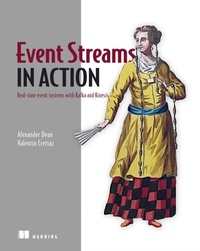
Event Streams in Action
Real-time event systems with Kafka and Kinesis
1st Edition
Published on 10. May 2019
344 pages
978-1-63835-583-0 (ISBN)
Description

Summary
Event Streams in Action is a foundational book introducing the ULP paradigm and presenting techniques to use it effectively in data-rich environments.
Purchase of the print book includes a free eBook in PDF, Kindle, and ePub formats from Manning Publications.
About the Technology
Many high-profile applications, like LinkedIn and Netflix, deliver nimble, responsive performance by reacting to user and system events as they occur. In large-scale systems, this requires efficiently monitoring, managing, and reacting to multiple event streams. Tools like Kafka, along with innovative patterns like unified log processing, help create a coherent data processing architecture for event-based applications.
About the Book
Event Streams in Action teaches you techniques for aggregating, storing, and processing event streams using the unified log processing pattern. In this hands-on guide, you'll discover important application designs like the lambda architecture, stream aggregation, and event reprocessing. You'll also explore scaling, resiliency, advanced stream patterns, and much more! By the time you're finished, you'll be designing large-scale data-driven applications that are easier to build, deploy, and maintain.
What's inside
About the Reader
For readers with experience coding in Java, Scala, or Python.
About the Author
Alexander Dean developed Snowplow, an open source event processing and analytics platform. Valentin Crettaz is an independent IT consultant with 25 years of experience.
Table of Contents
Event Streams in Action is a foundational book introducing the ULP paradigm and presenting techniques to use it effectively in data-rich environments.
Purchase of the print book includes a free eBook in PDF, Kindle, and ePub formats from Manning Publications.
About the Technology
Many high-profile applications, like LinkedIn and Netflix, deliver nimble, responsive performance by reacting to user and system events as they occur. In large-scale systems, this requires efficiently monitoring, managing, and reacting to multiple event streams. Tools like Kafka, along with innovative patterns like unified log processing, help create a coherent data processing architecture for event-based applications.
About the Book
Event Streams in Action teaches you techniques for aggregating, storing, and processing event streams using the unified log processing pattern. In this hands-on guide, you'll discover important application designs like the lambda architecture, stream aggregation, and event reprocessing. You'll also explore scaling, resiliency, advanced stream patterns, and much more! By the time you're finished, you'll be designing large-scale data-driven applications that are easier to build, deploy, and maintain.
What's inside
- Validating and monitoring event streams
- Event analytics
- Methods for event modeling
- Examples using Apache Kafka and Amazon Kinesis
About the Reader
For readers with experience coding in Java, Scala, or Python.
About the Author
Alexander Dean developed Snowplow, an open source event processing and analytics platform. Valentin Crettaz is an independent IT consultant with 25 years of experience.
Table of Contents
PART 1 - EVENT STREAMS AND UNIFIED LOGS
- Introducing event streams
- The unified log 24
- Event stream processing with Apache Kafka
- Event stream processing with Amazon Kinesis
- Stateful stream processing
PART 2- DATA ENGINEERING WITH STREAMS
- Schemas
- Archiving events
- Railway-oriented processing
- Commands
PART 3 - EVENT ANALYTICS
- Analytics-on-read
- Analytics-on-write
More details
Other editions
Additional editions
Book
06/2019
Manning Publications
€42.00
Shipment within 10-20 days
Persons
Valentin Crettaz is an independent IT consultant who's been working for the past 25 years on many different challenging projects across the globe. His expertise ranges from software engineering and architecture to data science and business intelligence. His daily job boils down to leveraging the latest and most cutting-edge web, data, and streaming technologies to implement IT solutions that will help reduce the cultural gap between IT and business people.
Alexander Dean is co-founder and technical lead of Snowplow Analytics, an open source event processing and analytics platform.
Alexander Dean is co-founder and technical lead of Snowplow Analytics, an open source event processing and analytics platform.
Content
- Intro
- Copyright
- Brief Table of Contents
- Table of Contents
- Preface
- Acknowledgments
- About this book
- About the authors
- About the cover illustration
- Part 1. Event streams and unified logs
- Chapter 1. Introducing event streams
- 1.1. Defining our terms
- 1.2. Exploring familiar event streams
- 1.3. Unifying continuous event streams
- 1.4. Introducing use cases for the unified log
- Summary
- Chapter 2. The unified log
- 2.1. Understanding the anatomy of a unified log
- 2.2. Introducing our application
- 2.3. Setting up our unified log
- Summary
- Chapter 3. Event stream processing with Apache Kafka
- 3.1. Event stream processing 101
- 3.2. Designing our first stream-processing app
- 3.3. Writing a simple Kafka worker
- 3.4. Writing a single-event processor
- Summary
- Chapter 4. Event stream processing with Amazon Kinesis
- 4.1. Writing events to Kinesis
- 4.2. Reading from Kinesis
- Summary
- Chapter 5. Stateful stream processing
- 5.1. Detecting abandoned shopping carts
- 5.2. Modeling our new events
- 5.3. Stateful stream processing
- 5.4. Detecting abandoned carts
- 5.5. Running our Samza job
- Summary
- Part 2. Data engineering with streams
- Chapter 6. Schemas
- 6.1. An introduction to schemas
- 6.2. Modeling our event in Avro
- 6.3. Associating events with their schemas
- Summary
- Chapter 7. Archiving events
- 7.1. The archivist's manifesto
- 7.2. A design for archiving
- 7.3. Archiving Kafka with Secor
- 7.4. Batch processing our archive
- Summary
- Chapter 8. Railway-oriented processing
- 8.1. Leaving the happy path
- 8.2. Failure and the unified log
- 8.3. Failure composition with Scalaz
- 8.4. Implementing railway-oriented processing
- Summary
- Chapter 9. Commands
- 9.1. Commands and the unified log
- 9.2. Making decisions
- 9.3. Consuming our commands
- 9.4. Executing our commands
- 9.5. Scaling up commands
- Summary
- Part 3. Event analytics
- Chapter 10. Analytics-on-read
- 10.1. Analytics-on-read, analytics-on-write
- 10.2. The OOPS event stream
- 10.3. Getting started with Amazon Redshift
- 10.4. ETL, ELT
- 10.5. Finally, some analysis
- Summary
- Chapter 11. Analytics-on-write
- 11.1. Back to OOPS
- 11.2. Building our Lambda function
- 11.3. Running our Lambda function
- Summary
- Appendix. AWS primer
- A.1. Setting up the AWS account
- A.2. Creating a user
- A.3. Setting up the AWS CLI
- Index
- List of Figures
- List of Tables
- List of Listings
