

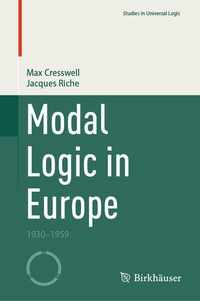
Modal Logic in Europe
Description

This book explores the birth of modern modal logic, which offers a precise formalism for encoding the concepts of possibility and necessity within the fundamental logical formalism and for using them in conjunction with the preexisting set of logical operators.
The editors of this volume have translated six foundational articles from the original German and French, three of which have never appeared in English before, and have provided a meticulous commentary on the texts, aiding the reader in understanding the theory. Furthermore, they introduce each article with a contextualization of the authors' lives and works, further enriching the collection. The original articles are by Oskar Becker, Mordchaj Wajsberg, Robert Feys, Arnould Bayart, and include the reproduction of an extract from Clarence I. Lewis's A Survey of Symbolic Logic .
This book will be of interest to scholars and students interested in the historical origins of modal logic, its later developments and extensions and in deepening their knowledge of the conceptual and technical foundations of this crucial area of the field.
More details
Other editions
Additional editions
Persons
Max Cresswell was Emeritus Professor of Philosophy at the Victoria University of Wellington, Wellington, New Zealand.
Jacques Riche is a Researcher in Computer Science at the Katholieke Universiteit, Leuven, Belgium.
Content
1. Introduction.- 2. C.I. Lewis 1918.- 3. Oskar Becker 1930.- 4. Kurt Gödel and Mordchaj Wajsberg 1933.- 5. Robert Feys 1937.- 6. Robert Feys 1950.- 7. Arnould Bayart's Modal Completeness Theorems.- Index.
