

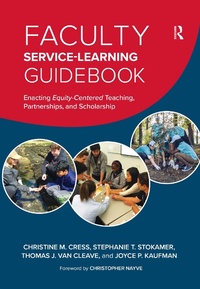
Faculty Service-Learning Guidebook
Enacting Equity-Centered Teaching, Partnerships, and Scholarship
1st Edition
Published on 3. July 2023
342 pages
978-1-000-97204-7 (ISBN)
Description

This is a practical guide to designing, teaching, and coordinating service-learning courses, and for developing reciprocal community partnerships and community-based research through a lens of equity that addresses the endemic racial, social, economic, and environmental disparities across society.
The text provides a comprehensive framework for developing both in-person and on-line service-learning, with a chapter on virtual delivery of courses that integrates the principles and practices described throughout the book. The authors uniquely integrate the how-to of conducting service-learning with the theoretical foundations to enact effective, equitable, and inclusive community engagement. Given this moment of enormous social inequality and divisiveness, the authors offer a new definition and set of educational principles that they characterize as Equity-Centered Community Engagement Excellence. These principles serve to guide academic and community engagement that is democratic, recognizes the voice and expertise of community partners, addresses the power imbalances between communities and academic institutions, and develops an educational experience that is potentially transformative and promotes civic responsibility.
Informed by the literature of critical service-learning, critical race theory, intercultural communication theory, and social-constructivism, this book attempts to deconstruct the assumption of the preeminence of academic knowledge to reconstruct a new operational paradigm of equity-centeredness that validates community capacity to guide faculty in their redesign of service-learning curriculum, activities, collaborations, and scholarship. It is based on the principles of:?Student Agency (demonstrated as enhanced skills, knowledge, and motivation)?Community Efficacy (recognition of community assets and capacity-building)?Scholarly Advocacy (leveraging evidence-based research-based for equity-centered learning, serving, and social justice). The authors offer examples of syllabi, lessons and assignments, reflection questions, evaluation rubrics, as well as an array of teaching tips that illustrate strategies for use in the classroom and in the field.
The book is addressed to faculty embarking on service-learning and to seasoned scholar practitioners looking for innovative ideas, as well as to campus administrators who coordinate community outreach or college student volunteer services, offering guidance on leveraging resources and fiscal support from external stakeholders. It is also designed to serve as a resource for professional development workshops and faculty scholar learning communities. It offers a rich compendium of ideas and examples from which faculty and practitioners can select exercises and elements to incorporate or adapt for their courses, whether designing short-term engagements or extended service-learning programs.
The text provides a comprehensive framework for developing both in-person and on-line service-learning, with a chapter on virtual delivery of courses that integrates the principles and practices described throughout the book. The authors uniquely integrate the how-to of conducting service-learning with the theoretical foundations to enact effective, equitable, and inclusive community engagement. Given this moment of enormous social inequality and divisiveness, the authors offer a new definition and set of educational principles that they characterize as Equity-Centered Community Engagement Excellence. These principles serve to guide academic and community engagement that is democratic, recognizes the voice and expertise of community partners, addresses the power imbalances between communities and academic institutions, and develops an educational experience that is potentially transformative and promotes civic responsibility.
Informed by the literature of critical service-learning, critical race theory, intercultural communication theory, and social-constructivism, this book attempts to deconstruct the assumption of the preeminence of academic knowledge to reconstruct a new operational paradigm of equity-centeredness that validates community capacity to guide faculty in their redesign of service-learning curriculum, activities, collaborations, and scholarship. It is based on the principles of:?Student Agency (demonstrated as enhanced skills, knowledge, and motivation)?Community Efficacy (recognition of community assets and capacity-building)?Scholarly Advocacy (leveraging evidence-based research-based for equity-centered learning, serving, and social justice). The authors offer examples of syllabi, lessons and assignments, reflection questions, evaluation rubrics, as well as an array of teaching tips that illustrate strategies for use in the classroom and in the field.
The book is addressed to faculty embarking on service-learning and to seasoned scholar practitioners looking for innovative ideas, as well as to campus administrators who coordinate community outreach or college student volunteer services, offering guidance on leveraging resources and fiscal support from external stakeholders. It is also designed to serve as a resource for professional development workshops and faculty scholar learning communities. It offers a rich compendium of ideas and examples from which faculty and practitioners can select exercises and elements to incorporate or adapt for their courses, whether designing short-term engagements or extended service-learning programs.
Reviews / Votes
"This book provides a counter narrative to the idea of higher education as the main driver of epistemological development. The ECCE framework co-created by the authors provides us with a roadmap for designing and implementing community-engaged scholarship and pedagogy that centers community-based knowledge as the north star for addressing the most intractable injustices facing society."Christopher Nayve, From the Foreword
"By synthesizing seminal scholarship in the field as well as offering dynamic resources and recommendations for those who design and facilitate equity-centered engagement, this book and, indeed, the Equity-Centered Community Engagement Excellence model are sources of hope and renewal as we enter a new era of teaching, partnerships, and scholarship."
Haden M. Botkin, International Journal of Research on Service-Learning and Community Engagement
More details
Edition
1. Auflage
Language
English
Place of publication
London
United Kingdom
Publishing group
Taylor & Francis Ltd
Target group
College/higher education
Professional and scholarly
ISBN-13
978-1-000-97204-7 (9781000972047)
Copyright in bibliographic data and cover images is held by Nielsen Book Services Limited or by the publishers or by their respective licensors: all rights reserved.
Schweitzer Classification
Other editions
Additional editions
Christine M. Cress | Stephanie T. Stokamer | Thomas J. Van Cleave
Faculty Service-Learning Guidebook
Enacting Equity-Centered Teaching, Partnerships, and Scholarship
Book
11/2022
1st Edition
Stylus Publishing
€46.50
Shipment within 3-4 weeks
Christine M. Cress | Stephanie T. Stokamer | Thomas J. Van Cleave
Faculty Service-Learning Guidebook
Enacting Equity-Centered Teaching, Partnerships, and Scholarship
Book
11/2022
1st Edition
Stylus Publishing
€193.50
Shipment within 3-4 weeks
Persons
Christine M. Cress is Professor of Educational Leadership, Higher Education Policy, and Community Engagement at Portland State University. She received her Ph.D. from UCLA and was a Fulbright Senior Scholar at Middle East Technical University in Ankara, Turkey. She has conducted professional trainings on curricular integration and the scholarship of service-learning at scores of colleges in North America, Europe, Japan, India, and Nepal. Earlier in her career, she was an academic and career adviser at Western Washington University, Whatcom Community College, and Northwest Indian College. For the last twenty years at PSU, she has directed Master and Doctoral degrees and a fully on-line Graduate Certificate in Service-Learning including facilitation of short-term international service-learning and COIL/Virtual Exchange classes in India, Japan, Morocco, and Turkey. Her cultural privilege is primarily northern European American with Cherokee (non-tribal affiliation) and Sene-Gambian heritage. She is a first-generation college student, adoptee and adoptive parent, and member of a multi-racial lesbian family. These myriad social positions influence her scholarship which addresses intersectionality, systemic oppression, and equity-centered education and community engagement. Stephanie T. Stokamer is Associate Professor of Civic Engagement and Director of Applied & Experiential Learning at Pacific University, where she leads the McCall Center for Civic Engagement. With a doctorate in educational leadership from Portland State University, she has facilitated and administered undergraduate and graduate community-based learning programs since 2005. Her scholarship focuses on service-learning and civic engagement, particularly with respect to pedagogical practices and faculty development. She is an AmeriCorps*VISTA alum and former National Service Fellow for the Corporation for National and Community Service. Stephanie comes to this work as a committed ally and accompl
Content
List of Figures List of Tables Foreword--Christopher Nayve Land Acknowledgments Positionality Statement List of Teaching Tips Introduction 1. Common Purposes 2. Community Engagement Excellence Pedagogical Component One. Cultivate 3. Co-Educational Partnerships 4. Cross-Cultural Collaborations Pedagogical Component Two. Create 5. Course Design 6. COIL and Virtual Exchange Courses Pedagogical Component Three. Craft 7. Communities of Learning, Leadership, and Empowerment 8. Critical Engagement and Conscientization Pedagogical Component Four. Compose 9. Community Engaged Scholarship 10. Course Iteration and Equity-Centered Continuation About the Authors Index
