

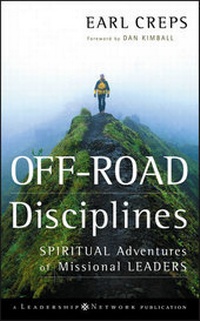
Off-Road Disciplines
Spiritual Adventures of Missional Leaders
Published on 14. December 2010
240 pages
978-1-118-04104-8 (ISBN)
Description

In Off-Road Disciplines, Earl Creps reveals that the on-road practices of prayer and Bible reading should be bolstered by the other kinds of encounters with God that occur unexpectedly--complete with the bumps and bruises that happen when you go "off-road." Becoming an off-road leader requires the cultivation of certain spiritual disciplines that allow the presence of the Holy Spirit to arrange your interior life. Earl Creps explores twelve central spiritual disciplines--six personal and six organizational--that Christian leaders of all ages and denominations need if they are to change themselves and their churches to reach out to the culture around them.
Reviews / Votes
"This is one of the most exciting books I have read in years. Itshifts our focus from doing church to being church and promises tobe a standard reference in all future discussions of missionalleadership." --Leonard Sweet, Drew University, George Fox University;author, Out of theQuestion . . . Into the Mystery: Getting Lostin the GodLife Relationship "If you are trying to figure out what is going on incontemporary culture, you've got to read Off-RoadDisciplines. Creps not only knows what is going on today, heteaches us how to engage today's people as well. The chapter on"reverse mentoring" is worth the price of the book. No one can beeffective in ministry today without the skills and attitudesassociated with listening and conversation. Off-Road Disciplinesgives us the map and points us in the right direction." --Todd Hunter, national director, Alpha USA, former nationaldirector, Vineyard USA "No matter how hard the leadership industry tries to refine thekey ingredient in effectiveness, a transformed leader is always theprecursor to a transformed church or organization. Because EarlCreps actually listens to the hearts of emerging leaders, he hasdiscovered spiritual pathways that are being more traveled thesedays. Here's a leadership book that actually believes substancetrumps style!" --Byron D. Klaus, president, Assemblies of God TheologicalSeminary "Earl Creps has written a deeply personal and challengingbook--one that caused me to think about my own spiritualjourney. Too many of us have made spiritual formation a series ofactivities and programs; Earl takes us off the map of commonpractice and into the places where the Spirit is at work. Itreminds us that true spiritual formation pervades our lives and theministries we serve, providing a helpful balance of being anddoing. It will be a great encouragement to all who read it." --Ed Stetzer, author, Breaking the Missional CodeMore details
Other editions
Additional editions
Book
10/2006
1st Edition
Jossey-Bass
€23.00
Shipment within 10-20 days
Persons
Earl Creps--a popular speaker and leader--is director of the Doctor of Ministry program and associate professor at the Assemblies of God Theological Seminary (AGTS) in Springfield, Missouri. He has been a pastor, ministries consultant, and university professor. Along the way, Creps earned a Ph.D. in communication at Northwestern University and a doctor of ministry degree in leadership at AGTS.
Content
About Leadership Network ix
Foreword xi
Introduction: Off-Road Disciplines xiii
Part One: Personal Disciplines
1. Death: The Discipline of Personal Transformation 3
2. Truth: The Discipline of Sacred Realism 15
3. Perspective: The Discipline of POV 27
4. Learning: The Discipline of Reverse Mentoring 41
5. Witness: The Discipline of Spiritual Friendship 55
6. Humility: The Discipline of Decreasing 71
Part Two: Organizational Disciplines
7. Assessment: The Discipline of Missional Efficiency 87
8. Harmony: The Discipline of Blending Differences 99
9. Reflection: The Discipline of Discernment 123
10. Opportunity: The Discipline of Making Room 139
11. Sacrifice: The Discipline of Surrendering 157
Preferences
12. Legacy: The Discipline of Passing the Baton 173
Epilogue: Three Coffee Houses 185
Notes 187
Acknowledgments 203
The Author 205
Index 207
Introduction Kevin left his job as an environmental consultant to become an entrepreneur. Sensing a once-in-a-lifetime opportunity at hand, he set up the coffee shop he had always wanted to own and operate with his family, in a suburb on the south end of our city. A few months into his venture and wanting his business somehow to help people connect with God, Kevin contacted local churches about the possibility of partnering with them to touch the city. Because we had worked together in a local church, Kevin knew of my interest in this subject and e-mailed me about the response of the congregational leaders. Of course, there are the obvious differences in superficial stuff: style, denominational background, and so on. But I found the difference in definition of and approach to their mission even more interesting. I recall some who are passionate about making ways for the culture to come to Christ, while others were, let's say, less passionate; still others just didn't see much benefit in talking about it with me. Some of these meetings have been electric, while others have seemed pretty empty. Some meetings have been entirely about how we could work together, while regarding others people either didn't respond or were coldly polite. The responses did not follow variables of style or labels. Kevin's informal sampling of church cultures revealed, in just a few weeks, two key dynamics that scholars of the Church have labored for years to discover: (1) leaders with a missional heart find a way, no matter how unconventional, to connect to culture; and (2) this heart is present (and absent) in every conceivable model of ministry. Missional leaders see the world through the eyes of Jesus and see Jesus in the world. They assume the role of helping the body of Christ understand itself and make of it much more than a missionary sending agency, as if the "mission field" existed only somewhere else to be reached by someone else. Rather, these leaders cannot conceive of the Church apart from living the mission of God to touch the world with redeeming love in Christ. "The classical doctrine of the missio Dei," explains missiologist David Bosch, "as God the Father sending the Son, and God the Father and the Son sending the Spirit, [is] expanded to include yet another 'movement': Father, Son, and Holy Spirit sending the church into the world."1 For missional leaders, then, mission does not refer to a framed paragraph hanging on the wall in the lobby and printed on all the staff business cards; it refers instead to the Church's very reason for being. To remove it or replace does not just make the Church less effective; it changes the Church into something else, something that does not resemble the New Testament account of our identity as a sent people. In practical terms, it is not difficult to demonstrate the vital role that mission plays in the vibrancy of Christian ministry. Studies of denominations and surveys of individual Christians find a leader's vision to reach a community indispensable to the growth and health of the Church, regardless of the specific philosophy of ministry involved.2 But references to academic scholarship are hardly necessary. Any church member on any Sunday can tell you that either mission lives in the heart of leaders or it does not live at all. So, how is such a heart developed?
This book argues that missional leadership derives not from methods or strategies but from the work of the Holy Spirit to rearrange one's interior life. This work is accomplished by rigorous application of what I call spiritual disciplines. You will find that my list of disciplines bears little resemblance to most of the practices traditionally thought of in this way. Although Richard Foster's classic tally in Celebration of Discipline includes what he calls "Outward" and "Corporate" disciplines, the average leader that I know mainly thinks of spiritual disciplines in terms of prayer and Bible reading.3 These two pillars of spiritual growth entail several dilemmas: Scarcity: despite their benefits, they are not practiced enough. Practicality: these two disciplines tend to operate in isolation from real life, serving as the "national anthem" before the ball game that starts whenever we go to work. Performance: they cannot be correlated to ministry "success" in any consistent way; in other words, unspiritual people accomplish a lot while more spiritual people labor in obscurity. Character: to speak for myself, I've met too many bad people who pray and read their Bibles rigorously and are unchanged by their efforts. Mission: churches are filled with people who are committed to prayer and Scripture but either have no concern for mission or actively resist the changes that it requires. Most of these dilemmas spring from the way prayer and Scripture study are isolated from the rest of the Christian life. As Foster contends, "the Disciplines are best exercised in the midst of our normal daily activities. If they are to have any transforming effect, the effect must be found in the ordinary junctures of human life."4 In other words, our practice of the disciplines tends to be undisciplined. However, if we do indeed meet God at the sidewalk level, then perhaps a missional heart can be formed in the same way by practicing what I call "off-road" disciplines, ones that seldom appear in more formal catalogues. In other words, the on-road practices of prayer and Bible reading should be supplemented by the other kinds of encounter with God that occur unexpectedly-complete with the bumps and bruises that are part of any other form of off-road experience. I contend here that an experience is a spiritual discipline if it has the potential to form God's heart in me, and if it functions as one because I embrace it as such. So, for example, death (Chapter One) represents a spiritual discipline when the collapse of my ministry paradigms creates the opportunity to crucify my longing to be the center of everything. In the end, the off-road disciplines, both personal and organizational serve to decenter me and my ideas by freeing up the place where Christ rightfully belongs in my life, my leadership, and my organization. As John the Baptist described it, "He must become greater; I must become less."5 This book is organized into two main sections, one personal and one organizational. Part One depicts six disciplines that shape the interior life of missional leaders as individuals, while Part Two offers the same number for the organizations we lead. In truth, this division was never part of the plan for the book. I only realized after the fact that the chapters fell into this alignment, perhaps subconsciously reflecting my belief that organizations are fundamentally spiritual, possessing an interior life of their own and requiring spiritual disciplines every bit as much as individual people do. I understand Christian leadership as spiritual direction for the interior life of organizations. On both levels, the off-road disciplines serve the function of making space in our lives so that Jesus assumes the central position within us and the Spirit conforms us to the mission. The alternative is to reduce mission to evangelism, evangelism to a program, a program to a strategy, and strategy to a technology we can control. Mission is everything Jesus came to do; it calls us to co-labor in the things we cannot control. A missional leader, then, lives under the often painful influence of these disciplines for the sake of forming the church into a sent people. I conclude that living a missional life of any kind is quite difficult, given the punishing experiences that seem to be necessary to maintain it. I want, with every fiber of my being, to be the center, and my natural longing for the central position does not die easily. It takes a cross.
Having spent years in relationship with natives to postmodernity (one element of our cultural "perfect storm"), I have learned the value of deconstructing myself, of letting others know that I am aware that my point of view is just that: a view from a point. They are already aware of these dynamics, but it is important that they realize that I am aware of them as well. So even though this book features some quotes and notes, these materials are not really its sources. These are the wellsprings of my work:
My life: I am a middle-class, Anglo, male baby boomer who grew up a Lutheran pastor's son, joining the Assemblies of God as a refugee from the 1970s Charismatic renewal in my denomination of origin. My beliefs: I am almost painfully orthodox doctrinally, but with a Pentecostal identity bundled with a Mainliner's open-mindedness. My research: I have spent several years traveling North America on behalf of my seminary, interviewing younger leaders in particular, and anyone who is doing anything different in general. I quote them using pseudonyms (sometimes), not at their request but out of respect for the risks some of them took to talk to me. My experience: I have pastored three congregations, all Assemblies of God: one boomer, one builder, and one gen X. My sins: much of this book is informed by my own shortcomings. Some friends are uncomfortable with this aspect of my writing, but I feel that the only way to rob these issues of power is to tell their...
Off-Road Disciplines
This book argues that missional leadership derives not from methods or strategies but from the work of the Holy Spirit to rearrange one's interior life. This work is accomplished by rigorous application of what I call spiritual disciplines. You will find that my list of disciplines bears little resemblance to most of the practices traditionally thought of in this way. Although Richard Foster's classic tally in Celebration of Discipline includes what he calls "Outward" and "Corporate" disciplines, the average leader that I know mainly thinks of spiritual disciplines in terms of prayer and Bible reading.3 These two pillars of spiritual growth entail several dilemmas: Scarcity: despite their benefits, they are not practiced enough. Practicality: these two disciplines tend to operate in isolation from real life, serving as the "national anthem" before the ball game that starts whenever we go to work. Performance: they cannot be correlated to ministry "success" in any consistent way; in other words, unspiritual people accomplish a lot while more spiritual people labor in obscurity. Character: to speak for myself, I've met too many bad people who pray and read their Bibles rigorously and are unchanged by their efforts. Mission: churches are filled with people who are committed to prayer and Scripture but either have no concern for mission or actively resist the changes that it requires. Most of these dilemmas spring from the way prayer and Scripture study are isolated from the rest of the Christian life. As Foster contends, "the Disciplines are best exercised in the midst of our normal daily activities. If they are to have any transforming effect, the effect must be found in the ordinary junctures of human life."4 In other words, our practice of the disciplines tends to be undisciplined. However, if we do indeed meet God at the sidewalk level, then perhaps a missional heart can be formed in the same way by practicing what I call "off-road" disciplines, ones that seldom appear in more formal catalogues. In other words, the on-road practices of prayer and Bible reading should be supplemented by the other kinds of encounter with God that occur unexpectedly-complete with the bumps and bruises that are part of any other form of off-road experience. I contend here that an experience is a spiritual discipline if it has the potential to form God's heart in me, and if it functions as one because I embrace it as such. So, for example, death (Chapter One) represents a spiritual discipline when the collapse of my ministry paradigms creates the opportunity to crucify my longing to be the center of everything. In the end, the off-road disciplines, both personal and organizational serve to decenter me and my ideas by freeing up the place where Christ rightfully belongs in my life, my leadership, and my organization. As John the Baptist described it, "He must become greater; I must become less."5 This book is organized into two main sections, one personal and one organizational. Part One depicts six disciplines that shape the interior life of missional leaders as individuals, while Part Two offers the same number for the organizations we lead. In truth, this division was never part of the plan for the book. I only realized after the fact that the chapters fell into this alignment, perhaps subconsciously reflecting my belief that organizations are fundamentally spiritual, possessing an interior life of their own and requiring spiritual disciplines every bit as much as individual people do. I understand Christian leadership as spiritual direction for the interior life of organizations. On both levels, the off-road disciplines serve the function of making space in our lives so that Jesus assumes the central position within us and the Spirit conforms us to the mission. The alternative is to reduce mission to evangelism, evangelism to a program, a program to a strategy, and strategy to a technology we can control. Mission is everything Jesus came to do; it calls us to co-labor in the things we cannot control. A missional leader, then, lives under the often painful influence of these disciplines for the sake of forming the church into a sent people. I conclude that living a missional life of any kind is quite difficult, given the punishing experiences that seem to be necessary to maintain it. I want, with every fiber of my being, to be the center, and my natural longing for the central position does not die easily. It takes a cross.
Deconstructing Myself
Having spent years in relationship with natives to postmodernity (one element of our cultural "perfect storm"), I have learned the value of deconstructing myself, of letting others know that I am aware that my point of view is just that: a view from a point. They are already aware of these dynamics, but it is important that they realize that I am aware of them as well. So even though this book features some quotes and notes, these materials are not really its sources. These are the wellsprings of my work:
My life: I am a middle-class, Anglo, male baby boomer who grew up a Lutheran pastor's son, joining the Assemblies of God as a refugee from the 1970s Charismatic renewal in my denomination of origin. My beliefs: I am almost painfully orthodox doctrinally, but with a Pentecostal identity bundled with a Mainliner's open-mindedness. My research: I have spent several years traveling North America on behalf of my seminary, interviewing younger leaders in particular, and anyone who is doing anything different in general. I quote them using pseudonyms (sometimes), not at their request but out of respect for the risks some of them took to talk to me. My experience: I have pastored three congregations, all Assemblies of God: one boomer, one builder, and one gen X. My sins: much of this book is informed by my own shortcomings. Some friends are uncomfortable with this aspect of my writing, but I feel that the only way to rob these issues of power is to tell their...
