

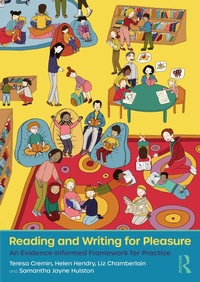
Reading and Writing for Pleasure
An Evidence-Informed Framework for Practice
Published on 12. September 2025
280 pages
978-1-040-41425-5 (ISBN)
Description

Reading and writing for pleasure represent issues of global concern and interest in policy, research and practice, underpinned by evidence illustrating their importance for young people's academic, social and emotional experiences and outcomes. In the face of a sustained decline in children's enjoyment in both reading and writing, this highly significant book presents findings from a three-year study of research and practice that nurtures young people's engagement as readers and writers.
The book offers a rich understanding of the study, highlighting the commonalities and synergies identified from the research literature and diverse practice contexts. It introduces a new and powerful Reading and Writing Framework for Practice for schools and charitable literacy programmes. The authors offer practical strategies and recommendations throughout for practitioners, researchers and policy makers who wish to advance this agenda in their own contexts. Areas covered include:
The nature of reading and writing for pleasure
Literate identities
Motivating readers and writers
Social interactions
Role models and connected communities
Future research, practice and policy
This field-defining text is a key resource for all those committed to halting the decline in young people's engagement as volitional readers and writers.
The book offers a rich understanding of the study, highlighting the commonalities and synergies identified from the research literature and diverse practice contexts. It introduces a new and powerful Reading and Writing Framework for Practice for schools and charitable literacy programmes. The authors offer practical strategies and recommendations throughout for practitioners, researchers and policy makers who wish to advance this agenda in their own contexts. Areas covered include:
The nature of reading and writing for pleasure
Literate identities
Motivating readers and writers
Social interactions
Role models and connected communities
Future research, practice and policy
This field-defining text is a key resource for all those committed to halting the decline in young people's engagement as volitional readers and writers.
Reviews / Votes
'This groundbreaking book offers an evidence-informed model that not only enriches the research base, but also empowers educators, strengthening professional practice and helping to create a new generation of motivated readers and writers.'Jonathan Douglas, CEO National Literacy Trust
'At a time when attainment data is being used to narrow what counts as successful literacy learning, this book provides critical insights for what many educators have known or suspected: that effective literacy education is contingent on cognition and desire, on individuals and communities in collaboration, and about access to culturally sustainable texts and social interactions.'
Navan Govender, Lecturer in Applied Language and Literacy Studies, University of Strathclyde, UK
'This book provides a well-researched framework to help children engage deeply with reading and writing and enjoy the experience. It offers educators advice on how to take action that has long lasting impact because the learning matters to the learners.'
Alyson Simpson, The Sydney School of Education and Social Work, University of Sydney, Australia
'This research-informed framework is essential reading for policymakers, educators and teachers seeking to nurture children's reading and writing for pleasure. It highlights the importance of agency, identity and supporting spontaneous, child-led interactions around texts to foster meaningful connections between young readers and writers. As a funder supporting literacy and oracy programmes in London, we recognise the Framework's value in shaping effective practice and helping to align policy, education and community initiatives to create lasting opportunities for volitional reading and writing'.
The Mercers' Company, as Trustee of The Mercers' Charitable Foundation and The St Paul's Schools' Foundation.
'We've got to work smartly to head off the crisis and enable more children to experience the enormous benefits of reading for pleasure. Reading and Writing for Pleasure: An Evidence-Informed Framework for Practice is the blueprint for any reading and literacy organisations, libraries, and schools who want to know how to get more children reading (and writing) for fun.'
Cassie Chadderton, CEO, World Book Day
'This is a noteworthy evidence-informed text. It challenges and encourages educators at home, in the literacy community, in policy and educational settings to engage with understanding the socio-emotional contexts of young peoples' identities as volitional readers and writers. The research reveals ways to enhance children's agency in literacy through relational pedagogy, social interactions and the use of reflective language.'
Janet Douglas Gardner, Associate Teaching Professor, London Metropolitan University, UK
'The Reading and Writing for Pleasure Framework is a must read for researchers, teachers and educators. It throws a much-needed spotlight on cultivating a love for reading and writing, emphasising the importance of engaging socially as readers and writers. It also highlights the value of local knowledge and the impact of flexibly responding to local needs. Communities, talk and relationships are seen to be key.'
Jo Tregenza, Reader in Education, University of Sussex, UK
More details
Language
English
Place of publication
London
United Kingdom
Publishing group
Taylor & Francis Ltd
Target group
Professional and scholarly
Illustrations
5 Tables, color; 6 Line drawings, color; 6 Illustrations, color
File size
4,66 MB
ISBN-13
978-1-040-41425-5 (9781040414255)
Copyright in bibliographic data and cover images is held by Nielsen Book Services Limited or by the publishers or by their respective licensors: all rights reserved.
Schweitzer Classification
Other editions
Additional editions
Teresa Cremin | Helen Hendry | Liz Chamberlain
Reading and Writing for Pleasure
An Evidence-Informed Framework for Practice
Book
09/2025
1st Edition
Routledge
€61.30
Shipment within 10-20 days
Teresa Cremin | Helen Hendry | Liz Chamberlain
Reading and Writing for Pleasure
An Evidence-Informed Framework for Practice
Book
09/2025
1st Edition
Routledge
€207.90
Shipment within 10-20 days
Persons
Teresa Cremin is Professor of Education, and co-director of The Open University's Literacy and Social Justice Centre. Her research focuses on volitional reading and writing, teachers' and children's literate identities and practices and creative pedagogies.
Helen Hendry is Senior Lecturer in Education (Primary) at The Open University and co-director of the Literacy and Social Justice Centre. Her research centres on early years' pedagogy, reading for pleasure and teacher professional development.
Liz Chamberlain is Emerita Professor and past co-director of The Open University's Children's Research Centre. Her research explores the knowledge intersection between practice, learners and practitioners through the lens of literacy education.
Samantha Jayne Hulston is a Research Associate at The Open University. Her research focuses on young children's embodied engagement with stories and the role of teachers in supporting children's playful exploration of texts.
Helen Hendry is Senior Lecturer in Education (Primary) at The Open University and co-director of the Literacy and Social Justice Centre. Her research centres on early years' pedagogy, reading for pleasure and teacher professional development.
Liz Chamberlain is Emerita Professor and past co-director of The Open University's Children's Research Centre. Her research explores the knowledge intersection between practice, learners and practitioners through the lens of literacy education.
Samantha Jayne Hulston is a Research Associate at The Open University. Her research focuses on young children's embodied engagement with stories and the role of teachers in supporting children's playful exploration of texts.
Content
Introduction: Exploring reading, writing and pleasure Part 1: Setting the context 1. The evidenced benefits and young people's attitudes 2. The wider landscape of influence 3. The research study Part 2: Examining synergies in approaches to reading and writing for pleasure 4. Young people's literate identities and motivation 5. Text access, choice and time 6. Social interactions 7. Role models and connected communities Part 3: Understanding the programmes' practices 8. The programmes' expectations 9. The programmes and their communities 10. The roles of those in the programmes 11. The programmes' resources Part 4: Considering implications for professional practice 12. The Reading and Writing for Pleasure Framework for Practice 13. Applying the Reading and Writing for Pleasure Framework for Practice Conclusion: Forging social and relational ways forward
