

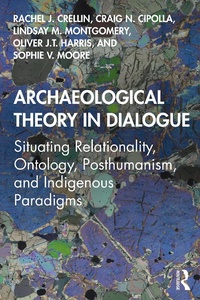
Archaeological Theory in Dialogue
Situating Relationality, Ontology, Posthumanism, and Indigenous Paradigms
1st Edition
Published on 9. November 2020
252 pages
978-0-429-64876-2 (ISBN)
Description

Archaeological Theory in Dialogue presents an innovative conversation between five scholars from different backgrounds on a range of central issues facing archaeology today.
Interspersing detailed investigations of critical theoretical issues with dialogues between the authors, the book interrogates the importance of four themes at the heart of much contemporary theoretical debate: relations, ontology, posthumanism, and Indigenous paradigms. The authors, who work in Europe and North America, explore how these themes are shaping the ways that archaeologists conduct fieldwork, conceptualize the past, and engage with the political and ethical challenges that our discipline faces in the twenty-first century.
The unique style of Archaeological Theory in Dialogue, switching between detailed arguments and dialogical exchange, makes it essential reading for both scholars and students of archaeological theory and those with an interest in the politics and ethics of the past.
Interspersing detailed investigations of critical theoretical issues with dialogues between the authors, the book interrogates the importance of four themes at the heart of much contemporary theoretical debate: relations, ontology, posthumanism, and Indigenous paradigms. The authors, who work in Europe and North America, explore how these themes are shaping the ways that archaeologists conduct fieldwork, conceptualize the past, and engage with the political and ethical challenges that our discipline faces in the twenty-first century.
The unique style of Archaeological Theory in Dialogue, switching between detailed arguments and dialogical exchange, makes it essential reading for both scholars and students of archaeological theory and those with an interest in the politics and ethics of the past.
Reviews / Votes
"If you thought archeology is simply the study of dusty or buried objects and fragments to offer explanations of how past people lived, this book will very quickly dismantle your misconception. Claimed by the social sciences and the humanities, and using techniques and knowledge from the natural sciences, archeology is a transdiscipline if there ever was one. This book shows that the field of archeology itself with its various theories and practices is as vibrant and dynamic as the world it investigates. Archeology unveils worldviews that can make us reflect on how we exist in this contemporary world but its unveiling is a creative and generative gesture as well, infusing one's ontology into one's reading of the past. The insightful reflections on ontology, metaontology, realism, decolonization, epistemology, and other ways of knowing presented in this book move archaology to the realm of postdisciplinarity, as championed by posthumanism. The present inquiry adopts a posthumanist feminist materialist stance with a respectful and engaging approach to Indigenous paradigms and thinks through objects and traces of the past while giving them agency and recognizing the vibrancy of being. Importantly, it also rejects the notion of universal subject inherited from centuries of Humanist thinking and thereby expands care and interest to the many who have been othered through it - be they human (women, non-western, Indigenous humans) or nonhuman, objects, plants, etc. This dialogical study thus challenges traditionally held views that rest on privilege and false universalizations and thereby demonstrates that the practice and theorizing at work in the vibrant field of archeology have deep ethical and political impact. Indeed, how we think the past - distant or not so distant - shapes both our present and our future. It is a transformative and essential read, no matter what the disciplinary orientation of its reader." - Professor Christine Daigle, Brock University, Canada"This is an exciting book. It immerses us in all the most captivating and dynamic conversations going on within archaeology right now, and between archaeologists and their (human and nonhuman) interlocutors. It takes on four of the most important paradigms being debated right now - relations, ontology, posthumanism, and Indigenous - and it does so in a dialogic, interactive format of collective authorship that practices what it preaches. I can't wait to give this book to my students!" - Professor Mary Weismantel, Northwestern University, USA
"Archaeological Theory in Dialogue provides vivid evidence of the health and richness of archaeological thinking. This is neither a manifesto for a self-proclaimed new paradigm, nor a set of unrelated papers, but a genuine engagement between scholars who exchange views on a series of issues of agreed importance to the continuing development of the discipline. The volume coheres around the themes of relationality, ontology, posthumanism, and indigenous perspectives, but the philosophical resources drawn on to address these topics range from the new materialisms, Deleuzian assemblage theory and actor network theory, to phenomenology and Indigenous philosophy, while the continuing significance of the Marxian tradition is also considered. In the process, the authors confront the problems of flat ontologies and anthropocentrism, experience and affect, while attempting to draw our attention back to questions of power, social justice, social responsibility, and the recognition of minoritarian and subaltern perspectives. The pressing nature of these debates, and the democratic spirit in which they are conducted makes this a vital and engaging contribution." - Professor Julian Thomas, University of Manchester, UK
More details
Edition
1. Auflage
Language
English
Place of publication
London
United Kingdom
Publishing group
Taylor & Francis Ltd
Target group
College/higher education
Product notice
Reflowable
Illustrations
1 Tables, black and white; 20 Halftones, black and white; 20 Illustrations, black and white
ISBN-13
978-0-429-64876-2 (9780429648762)
Copyright in bibliographic data and cover images is held by Nielsen Book Services Limited or by the publishers or by their respective licensors: all rights reserved.
Schweitzer Classification
Other editions
Additional editions
Rachel J. Crellin | Craig N. Cipolla | Lindsay M. Montgomery
Archaeological Theory in Dialogue
Situating Relationality, Ontology, Posthumanism, and Indigenous Paradigms
Book
11/2020
1st Edition
Routledge
€179.81
Shipment within 15-20 days
Rachel J. Crellin | Craig N. Cipolla | Lindsay M. Montgomery
Archaeological Theory in Dialogue
Situating Relationality, Ontology, Posthumanism, and Indigenous Paradigms
Book
11/2020
1st Edition
Routledge
€56.00
Shipment within 15-20 days
Persons
Rachel J. Crellin is Lecturer in Archaeology at the University of Leicester. Her research interests center on archaeological theory, especially new materialist, feminist, and posthumanist approaches. She is also a specialist in the Neolithic and Bronze Age of Britain, Ireland, and the Isle of Man, and a metalwork wear-analyst. She is the author of Change and Archaeology (Routledge).
Craig N. Cipolla is Curator of North American Archaeology at the Royal Ontario Museum and Associate Professor of Anthropology at the University of Toronto. His research interests include archaeological theory, colonial North America, and collaborative Indigenous archaeologies. His publications include Becoming Brothertown and Archaeological Theory in the New Millennium (co-authored with Oliver J.T. Harris, Routledge).
Lindsay M. Montgomery is Assistant Professor of Anthropology at the University of Arizona. Her research focuses on Indigenous history in the North American West, with particular interest in social justice, interethnic interaction, settler colonialism, and cultural resiliency among Native peoples. She is co-author of Objects of Survivance and is currently finishing a book entitled A History of Mobility (Routledge).
Oliver J.T. Harris is Associate Professor of Archaeology at the University of Leicester. He is co-author of The Body in History and Archaeological Theory in the New Millennium (Routledge), the latter with Craig N. Cipolla. He researches new materialist, posthumanist, and Deleuzian approaches to the past. He is currently finishing a book entitled Assembling Past Worlds (Routledge).
Sophie V. Moore is Lecturer in Medieval Archaeology at Newcastle University. Her research focuses on the experienced past, using phenomenological approaches to material culture to investigate lived moments in the Byzantine world. She is a member of the Sagalassos Fieldwork Project in Turkey, where she uses courseware ceramics to investigate the "dark age" transformation of urban space between the sixth and thirteenth centuries CE.
Craig N. Cipolla is Curator of North American Archaeology at the Royal Ontario Museum and Associate Professor of Anthropology at the University of Toronto. His research interests include archaeological theory, colonial North America, and collaborative Indigenous archaeologies. His publications include Becoming Brothertown and Archaeological Theory in the New Millennium (co-authored with Oliver J.T. Harris, Routledge).
Lindsay M. Montgomery is Assistant Professor of Anthropology at the University of Arizona. Her research focuses on Indigenous history in the North American West, with particular interest in social justice, interethnic interaction, settler colonialism, and cultural resiliency among Native peoples. She is co-author of Objects of Survivance and is currently finishing a book entitled A History of Mobility (Routledge).
Oliver J.T. Harris is Associate Professor of Archaeology at the University of Leicester. He is co-author of The Body in History and Archaeological Theory in the New Millennium (Routledge), the latter with Craig N. Cipolla. He researches new materialist, posthumanist, and Deleuzian approaches to the past. He is currently finishing a book entitled Assembling Past Worlds (Routledge).
Sophie V. Moore is Lecturer in Medieval Archaeology at Newcastle University. Her research focuses on the experienced past, using phenomenological approaches to material culture to investigate lived moments in the Byzantine world. She is a member of the Sagalassos Fieldwork Project in Turkey, where she uses courseware ceramics to investigate the "dark age" transformation of urban space between the sixth and thirteenth centuries CE.
Content
Chapter 1 - Introduction: locating the book; Chapter 2 - What do we mean by relational anyway?; Chapter 3 - Discussing relations: typology, difference, and change; Chapter 4 - Indigenous alterity as archaeological praxis; Chapter 5 - Discussing Indigenous difference: translation, ontology, and the future of European prehistory; Chapter 6 - A song of Byzantium; Chapter 7 - Discussing phenomenology and posthumanism: experience, assemblages, and beliefs; Chapter 8 - Posthumanist power; Chapter 9 - Discussing posthumanist approaches to power: Marxism, politics, affect; Chapter 10 - In search of different pasts; Chapter 11 - Discussing different pasts: categories, interdisciplinarity, and metaontologies; Chapter 12 - Conclusion: continuing dialogues
