

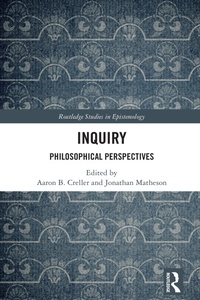
Inquiry
Philosophical Perspectives
Published on 29. July 2025
340 pages
978-1-040-41132-2 (ISBN)
Description

This volume brings together essays from several different perspectives on a topic in epistemology that is garnering increased attention: Inquiry. It is the first volume focused solely on philosophical issues related to inquiry.
Inquiry is a fundamental human practice. We have questions, and we want answers. These questions span numerous domains and range from the trivial to questions of the utmost importance. Without inquiry, and successful inquiry in particular, our fate is bleak. Inquiry is also familiar. Everyone engages in inquiry. In fact, inquiry (of some sort) is something that we engage in every day. However, while inquiry is both fundamental and familiar, only recently have epistemologists turned to focus explicitly on inquiry. The result is a growing literature concerning questions like the following:
Does inquiry have an aim?
If so, what is the aim of inquiry?
What norms govern inquiry?
How are epistemic norms and norms of inquiry related?
What does inquiry look like with an epistemic division of labor?
Is it ever permissible to interfere with the inquiry of another person?
What is the relationship between inquiry and belief? Knowledge? Wisdom?
How do bias and prejudice affect inquiry?
What is the nature and role of attitudes like curiosity and wonder?
Inquiry: Philosophical Perspectives builds on the existing debates surrounding these questions, advancing them, and taking them in new directions. It will appeal primarily to scholars and graduate students working in epistemology, philosophy of language, philosophy of mind, and philosophy of science.
Inquiry is a fundamental human practice. We have questions, and we want answers. These questions span numerous domains and range from the trivial to questions of the utmost importance. Without inquiry, and successful inquiry in particular, our fate is bleak. Inquiry is also familiar. Everyone engages in inquiry. In fact, inquiry (of some sort) is something that we engage in every day. However, while inquiry is both fundamental and familiar, only recently have epistemologists turned to focus explicitly on inquiry. The result is a growing literature concerning questions like the following:
Does inquiry have an aim?
If so, what is the aim of inquiry?
What norms govern inquiry?
How are epistemic norms and norms of inquiry related?
What does inquiry look like with an epistemic division of labor?
Is it ever permissible to interfere with the inquiry of another person?
What is the relationship between inquiry and belief? Knowledge? Wisdom?
How do bias and prejudice affect inquiry?
What is the nature and role of attitudes like curiosity and wonder?
Inquiry: Philosophical Perspectives builds on the existing debates surrounding these questions, advancing them, and taking them in new directions. It will appeal primarily to scholars and graduate students working in epistemology, philosophy of language, philosophy of mind, and philosophy of science.
More details
Series
Language
English
Place of publication
London
United Kingdom
Publishing group
Taylor & Francis Ltd
Target group
College/higher education
Illustrations
4 Tables, black and white; 2 Line drawings, black and white; 1 Halftones, black and white; 3 Illustrations, black and white
File size
4,06 MB
ISBN-13
978-1-040-41132-2 (9781040411322)
Copyright in bibliographic data and cover images is held by Nielsen Book Services Limited or by the publishers or by their respective licensors: all rights reserved.
Schweitzer Classification
Other editions
Additional editions
Book
07/2025
1st Edition
Routledge
€208.30
Shipment within 10-20 days
Persons
Aaron B. Creller is an associate professor in the Department of Philosophy and Religious Studies at the University of North Florida. His research areas are cross-cultural approaches to epistemology and philosophy of science. His recent monograph is the 2018 Making Space for Knowing: A Capacious Approach to Comparative Epistemology.
Jonathan Matheson is a professor of philosophy at the University of North Florida and the director of the Florida Blue Center for Ethics, where he is also a distinguished faculty fellow. His research interests are in epistemology where his work has focused on the epistemic significance of disagreement, as well as the nature and value of epistemic autonomy.
Jonathan Matheson is a professor of philosophy at the University of North Florida and the director of the Florida Blue Center for Ethics, where he is also a distinguished faculty fellow. His research interests are in epistemology where his work has focused on the epistemic significance of disagreement, as well as the nature and value of epistemic autonomy.
Content
Introduction 1. Is Skeptical Inquiry Possible? 2. Lysistrata's Lament: Interrogative Analogues of Testimonial Injustice 3. Epistemic Injustice and Inquiry 4. Is Comparative Philosophical Inquiry Risky Business? 5. To Counter Propaganda and Disinformation, Think Beyond Modernity 6. Transcultural Inquiry and the Method of Philosophical Sublation 7. The Zetetic Significance of Unpossessed Evidence 8. Inquiry and Normative Defeat 9. Navigating Inquiry 10. In Defense of Open-Minded Inquiry into Crazy Philosophical Arguments 11. Explanatory Inquiry, Achievement, and Enhancement 12. Inquiry and Higher-Order Evidence 13. Inquiry and Underdetermination 14. The Science Contract: Scientific Inquiry, Public Trust in Science, and the Division of Zetetic Labor 15. Instruments as Muses of Inquiry 16. Inquiry in the Entangled Bank - Translating and Interpreting Causation in Biology 17. Reshuffling the Deck: p4c Hawaii and Special Education
