

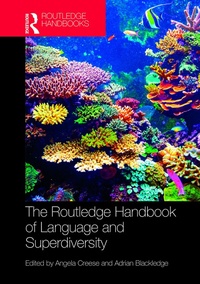
The Routledge Handbook of Language and Superdiversity
Published on 21. February 2018
582 pages
978-1-317-44467-1 (ISBN)
Description

The Routledge Handbook of Language and Superdiversity provides an accessible and authoritative overview of this growing area, the linguistic analysis of interaction in superdiverse cities. Developed as a descriptive term to account for the increasingly stratified processes and effects of migration in Western Europe, 'superdiversity' has the potential to contribute to an enhanced understanding of mobility, complexity, and change, with theoretical, practical, global, and methodological reach.
With seven sections edited by leading names, the handbook includes 35 state-of-the art chapters from international authorities. The handbook adopts a truly interdisciplinary approach, covering:
Cultural heritage
Sport
Law
Education
Business and entrepreneurship.
The result is a truly comprehensive account of how people live, work and communicate in superdiverse spaces.
This volume is key reading for all those engaged in the study and research of Language and Superdiversity within Applied Linguistics, Linguistic Anthropology and related areas.
With seven sections edited by leading names, the handbook includes 35 state-of-the art chapters from international authorities. The handbook adopts a truly interdisciplinary approach, covering:
Cultural heritage
Sport
Law
Education
Business and entrepreneurship.
The result is a truly comprehensive account of how people live, work and communicate in superdiverse spaces.
This volume is key reading for all those engaged in the study and research of Language and Superdiversity within Applied Linguistics, Linguistic Anthropology and related areas.
Reviews / Votes
Suresh Canagarajah, Penn State, USAI am of the view that this book will be an important publication in the fields of applied linguistics and sociolinguistics to further our understanding of language diversity in our globalizing world.. The editors succeed in showing the need for the handbook and the way it carves its own niche in the market.
He had a few very constructive suggestions, including adding a section on education, which I am discussing with the editors.
John Gray, Univ of East London, UK
A handbook at this stage would be an invaluable resource, given this proliferation and indeed recent critique of the concept... Such a volume would also sit well in the Applied Linguistics series, given the centrality of language in work on superdiversity.. There are many strengths - the involvement of a team of already recognised scholars of international standing; the interdisciplinary focus and the centrality of language are all noteworthy.
Main suggestion was to add a section on education, as SC above. This does reflect the background of both readers but it is clearly important.
More details
Series
Language
English
Place of publication
London
United Kingdom
Publishing group
Taylor & Francis Ltd
Target group
College/higher education
Product notice
Reflowable
Illustrations
49 s/w Abbildungen, 15 s/w Tabellen, 28 s/w Photographien bzw. Rasterbilder, 5 s/w Zeichnungen
15 Tables, black and white; 5 Line drawings, black and white; 28 Halftones, black and white; 49 Illustrations, black and white
File size
6,02 MB
ISBN-13
978-1-317-44467-1 (9781317444671)
Copyright in bibliographic data and cover images is held by Nielsen Book Services Limited or by the publishers or by their respective licensors: all rights reserved.
Schweitzer Classification
Other editions
Additional editions
Angela Creese | Adrian Blackledge
The Routledge Handbook of Language and Superdiversity
An Interdisciplinary Perspective
Book
03/2021
1st Edition
Routledge
€74.80
Shipment within 15-20 days
Angela Creese | Adrian Blackledge
The Routledge Handbook of Language and Superdiversity
An Interdisciplinary Perspective
Book
03/2018
1st Edition
Routledge
€364.57
Shipment within 10-20 days
Persons
Angela Creese is Professor of Educational Linguistics at the School of Education, University of Birmingham, UK. Her publications include Linguistic Ethnography (with Fiona Copland), Heteroglossia as Practice and Pedagogy (with Adrian Blackledge, 2014), and The Routledge Handbook of Multilingualism (with Marilyn Martin-Jones and Adrian Blackledge, Routledge).
Adrian Blackledge is Professor of Bilingualism in the School of Education, and Director of the MOSAIC Centre for Research on Multilingualism, University of Birmingham, UK. His recent publications include Heteroglossia as Practice and Pedagogy (with Angela Creese, 2014), The Routledge Handbook of Multilingualism (2012, with Marilyn Martin-Jones and Angela Creese, Routledge), and Multilingualism, A Critical Perspective (with Angela Creese, 2010).
Adrian Blackledge is Professor of Bilingualism in the School of Education, and Director of the MOSAIC Centre for Research on Multilingualism, University of Birmingham, UK. His recent publications include Heteroglossia as Practice and Pedagogy (with Angela Creese, 2014), The Routledge Handbook of Multilingualism (2012, with Marilyn Martin-Jones and Angela Creese, Routledge), and Multilingualism, A Critical Perspective (with Angela Creese, 2010).
Content
Dedication
Acknowledgements
List of illustrations
List of contributors
Introduction - Adrian Blackledge and Angela Creese
PART I - edited by Jenny Phillimore and Li Wei
Language and superdiversity
Repertoires, registers, and linguistic diversity
Alastair Pennycook
Linguistic (super)diversity, post-multilingualism and translanguaging moments
Li Wei
Superdiversity perspective and the sociolinguistics of social media
Sirpa Leppaenen, Saija Peuronen and Elina Westinen
Superdiversity as a lens to understand complexities
Dirk Geldof
"All the people speak bad English". Communicating across differences in a super-diverse context
Susanne Wessendorf
PART II - edited by Lisa Goodson and Caroline Tagg
Researching communication in superdiverse contexts
Superdiversity and linguistic ethnography: researching people and language in motion
Martha Karrebaek and Constadina Charalambous
Blurred vision? "Superdiversity" as a lens in research on communication in border contexts
Robert Gibb and Julien Danero Iglesias
Using researcher vignettes to explore co-production in a large diverse team: implications for research in superdiverse contexts
Lisa Goodson and Caroline Tagg
Moving methods online: Researching digital language practices
Jannis Androutsopoulos and Andreas Staehr
Reflecting on the ethics of researching communication in superdiverse contexts
Fiona Copland
PART III - edited by Adrian Blackledge and Mike Robinson
Language, superdiversity and heritage
The multivocality of heritage: Moments, encounters and mobilities
Ana Deumert
Dialect as heritage
Joan Beal
Discourses of 'Chineseness' and superdiversity
Jing Huang
Talking of heritage: The past in conversation
Mike Robinson
Superdiverse heritage and the question of authenticity: Reframing 'brokenness', comprehending change
Sabina Vakser
PART IV - edited by Zhu Hua and Janice Thompson
Language, superdiversity and sport
Language policy and planning and the Olympic Games
Rachelle Vessey
Linguistic practices, social identities and sports
Lian Malai Madsen
Football language in the age of superdiversity
Gunnar Bergh and Soelve Ohlander
Race, ethnicity and 'Africa' in football discourse - perspectives in the age of superdiversity
Samu Kytoelae
Language and sport, physical activity and health among Black and Asian ethnic minority groups
Symeon Dagkas and Whitney B. Curry
PART V - edited by Mike Baynham and Kiran Trehan
Language, superdiversity and business
Language, Superdiversity, and Self-Employment
Adrian Blackledge and Kiran Trehan
Mobile messaging by migrant micro-entrepreneurs in contexts of superdiversity
Caroline Tagg and Agnieszka Lyons
Managing superdiversity in multinational companies
Jiri Nekvapil and Tamah Sherman
You are now one of us
- negotiating 'fitting in' in the workplace Marta Kirilova and Jo Angouri
Multilingualism in migrant-tailored businesses: The case of telecommunications multinationals and "ethnic" call shops
Maria Sabate Dalmau
PART VI - edited by Bharat Malkani and Frances Rock
Language, superdiversity and law
Sociolinguistic superdiversity and asylum
Marco Jacquemet
Legal interpreting in domestic and international courts: Responsiveness in action
Ludmila Stern
Joanna Drugan and Krzysztof Kredens
Superdiversity and the relationship between law, language and translation in a supranational legal order
Karen McAuliffe and Aleksandar Trklja
The development of deaf legal discourse
Christopher Stone and Gene Mirus
PART VII - edited by Melanie Cooke and James Simpson
Language, superdiversity and education
Multilingual education policy, superdiversity and educational equity
Kendall A. King and Martha Bigelow
Translanguaging as pedagogy - a critical review
Jean Conteh
Adult migrant language education in a diversifying world
Sari Poeyhoenen, Mirja Tarnanen and James Simpson
The multilingual University
Mbulungeni Madiba
Linguistic diversity in online and mobile learning
Agnes Kukulska-Hulme and Mark Pegrum
Index
Acknowledgements
List of illustrations
List of contributors
Introduction - Adrian Blackledge and Angela Creese
PART I - edited by Jenny Phillimore and Li Wei
Language and superdiversity
Repertoires, registers, and linguistic diversity
Alastair Pennycook
Linguistic (super)diversity, post-multilingualism and translanguaging moments
Li Wei
Superdiversity perspective and the sociolinguistics of social media
Sirpa Leppaenen, Saija Peuronen and Elina Westinen
Superdiversity as a lens to understand complexities
Dirk Geldof
"All the people speak bad English". Communicating across differences in a super-diverse context
Susanne Wessendorf
PART II - edited by Lisa Goodson and Caroline Tagg
Researching communication in superdiverse contexts
Superdiversity and linguistic ethnography: researching people and language in motion
Martha Karrebaek and Constadina Charalambous
Blurred vision? "Superdiversity" as a lens in research on communication in border contexts
Robert Gibb and Julien Danero Iglesias
Using researcher vignettes to explore co-production in a large diverse team: implications for research in superdiverse contexts
Lisa Goodson and Caroline Tagg
Moving methods online: Researching digital language practices
Jannis Androutsopoulos and Andreas Staehr
Reflecting on the ethics of researching communication in superdiverse contexts
Fiona Copland
PART III - edited by Adrian Blackledge and Mike Robinson
Language, superdiversity and heritage
The multivocality of heritage: Moments, encounters and mobilities
Ana Deumert
Dialect as heritage
Joan Beal
Discourses of 'Chineseness' and superdiversity
Jing Huang
Talking of heritage: The past in conversation
Mike Robinson
Superdiverse heritage and the question of authenticity: Reframing 'brokenness', comprehending change
Sabina Vakser
PART IV - edited by Zhu Hua and Janice Thompson
Language, superdiversity and sport
Language policy and planning and the Olympic Games
Rachelle Vessey
Linguistic practices, social identities and sports
Lian Malai Madsen
Football language in the age of superdiversity
Gunnar Bergh and Soelve Ohlander
Race, ethnicity and 'Africa' in football discourse - perspectives in the age of superdiversity
Samu Kytoelae
Language and sport, physical activity and health among Black and Asian ethnic minority groups
Symeon Dagkas and Whitney B. Curry
PART V - edited by Mike Baynham and Kiran Trehan
Language, superdiversity and business
Language, Superdiversity, and Self-Employment
Adrian Blackledge and Kiran Trehan
Mobile messaging by migrant micro-entrepreneurs in contexts of superdiversity
Caroline Tagg and Agnieszka Lyons
Managing superdiversity in multinational companies
Jiri Nekvapil and Tamah Sherman
You are now one of us
- negotiating 'fitting in' in the workplace Marta Kirilova and Jo Angouri
Multilingualism in migrant-tailored businesses: The case of telecommunications multinationals and "ethnic" call shops
Maria Sabate Dalmau
PART VI - edited by Bharat Malkani and Frances Rock
Language, superdiversity and law
Sociolinguistic superdiversity and asylum
Marco Jacquemet
Legal interpreting in domestic and international courts: Responsiveness in action
Ludmila Stern
Joanna Drugan and Krzysztof Kredens
Superdiversity and the relationship between law, language and translation in a supranational legal order
Karen McAuliffe and Aleksandar Trklja
The development of deaf legal discourse
Christopher Stone and Gene Mirus
PART VII - edited by Melanie Cooke and James Simpson
Language, superdiversity and education
Multilingual education policy, superdiversity and educational equity
Kendall A. King and Martha Bigelow
Translanguaging as pedagogy - a critical review
Jean Conteh
Adult migrant language education in a diversifying world
Sari Poeyhoenen, Mirja Tarnanen and James Simpson
The multilingual University
Mbulungeni Madiba
Linguistic diversity in online and mobile learning
Agnes Kukulska-Hulme and Mark Pegrum
Index
