

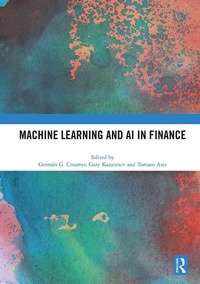
Machine Learning and AI in Finance
1st Edition
Published on 5. April 2021
130 pages
978-1-000-37200-7 (ISBN)
Description

The significant amount of information available in any field requires a systematic and analytical approach to select the most critical information and anticipate major events. During the last decade, the world has witnessed a rapid expansion of applications of artificial intelligence (AI) and machine learning (ML) algorithms to an increasingly broad range of financial markets and problems. Machine learning and AI algorithms facilitate this process understanding, modelling and forecasting the behaviour of the most relevant financial variables.
The main contribution of this book is the presentation of new theoretical and applied AI perspectives to find solutions to unsolved finance questions. This volume proposes an optimal model for the volatility smile, for modelling high-frequency liquidity demand and supply and for the simulation of market microstructure features. Other new AI developments explored in this book includes building a universal model for a large number of stocks, developing predictive models based on the average price of the crowd, forecasting the stock price using the attention mechanism in a neural network, clustering multivariate time series into different market states, proposing a multivariate distance nonlinear causality test and filtering out false investment strategies with an unsupervised learning algorithm.
Machine Learning and AI in Finance explores the most recent advances in the application of innovative machine learning and artificial intelligence models to predict financial time series, to simulate the structure of the financial markets, to explore nonlinear causality models, to test investment strategies and to price financial options.
The chapters in this book were originally published as a special issue of the Quantitative Finance journal.
The main contribution of this book is the presentation of new theoretical and applied AI perspectives to find solutions to unsolved finance questions. This volume proposes an optimal model for the volatility smile, for modelling high-frequency liquidity demand and supply and for the simulation of market microstructure features. Other new AI developments explored in this book includes building a universal model for a large number of stocks, developing predictive models based on the average price of the crowd, forecasting the stock price using the attention mechanism in a neural network, clustering multivariate time series into different market states, proposing a multivariate distance nonlinear causality test and filtering out false investment strategies with an unsupervised learning algorithm.
Machine Learning and AI in Finance explores the most recent advances in the application of innovative machine learning and artificial intelligence models to predict financial time series, to simulate the structure of the financial markets, to explore nonlinear causality models, to test investment strategies and to price financial options.
The chapters in this book were originally published as a special issue of the Quantitative Finance journal.
More details
Edition
1. Auflage
Language
English
Place of publication
London
United Kingdom
Publishing group
Taylor & Francis Ltd
Target group
College/higher education
ISBN-13
978-1-000-37200-7 (9781000372007)
Copyright in bibliographic data and cover images is held by Nielsen Book Services Limited or by the publishers or by their respective licensors: all rights reserved.
Schweitzer Classification
Other editions
Additional editions
German Creamer | Gary Kazantsev | Tomaso Aste
Machine Learning and AI in Finance
Book
09/2023
1st Edition
Routledge
€55.70
Shipment within 15-20 days
German Creamer | Gary Kazantsev | Tomaso Aste
Machine Learning and AI in Finance
Book
04/2021
1st Edition
Routledge
€191.89
Shipment within 15-20 days
Persons
German G. Creamer is Associate Professor at Stevens Institute of Technology. He is also a visiting scholar at Stern School of Business, NYU; Adjunct Associate Professor, Columbia University and former Senior Manager, American Express.
Gary Kazantsev is the Head of Quant Technology Strategy, Office of the CTO at Bloomberg L. P., New York, USA.
Tomaso Aste is Professor of Complexity Science, Department of Computer Science, University College London, UK.
Gary Kazantsev is the Head of Quant Technology Strategy, Office of the CTO at Bloomberg L. P., New York, USA.
Tomaso Aste is Professor of Complexity Science, Department of Computer Science, University College London, UK.
Content
Foreword
Marcos Lopez de Prado
Introduction
German G. Creamer, Gary Kazantsev and Tomaso Aste
1. Universal features of price formation in financial markets: perspectives from deep learning
Justin Sirignano and Rama Cont
2. Far from the madding crowd: collective wisdom in prediction markets
Giulio Bottazzi and Daniele Giachini
3. Forecasting limit order book liquidity supply-demand curves with functional autoregressive dynamics
Ying Chen, Wee Song Chua and Wolfgang Karl Haerdle
4. Forecasting market states
Pier Francesco Procacci and Tomaso Aste
5. Encoding of high-frequency order information and prediction of short-term stock price by deep learning
Daigo Tashiro, Hiroyasu Matsushima, Kiyoshi Izumi and Hiroki Sakaji
6. Attention mechanism in the prediction of stock price movement by using LSTM: Evidence from the Hong Kong stock market
Shun Chen and Lei Ge
7. Learning multi-market microstructure from order book data
Geonhwan Ju, Kyoung-Kuk Kim and Dong-Young Lim
8. A non-linear causality test: a machine learning approach for energy futures forecast
German G. Creamer and Chihoon Lee
9. The QLBS Q-Learner goes NuQLear: fitted Q iteration, inverse RL, and option portfolios
Igor Halperin
10. Detection of false investment strategies using unsupervised learning methods
Marcos Lopez de Prado and Michael J. Lewis
Marcos Lopez de Prado
Introduction
German G. Creamer, Gary Kazantsev and Tomaso Aste
1. Universal features of price formation in financial markets: perspectives from deep learning
Justin Sirignano and Rama Cont
2. Far from the madding crowd: collective wisdom in prediction markets
Giulio Bottazzi and Daniele Giachini
3. Forecasting limit order book liquidity supply-demand curves with functional autoregressive dynamics
Ying Chen, Wee Song Chua and Wolfgang Karl Haerdle
4. Forecasting market states
Pier Francesco Procacci and Tomaso Aste
5. Encoding of high-frequency order information and prediction of short-term stock price by deep learning
Daigo Tashiro, Hiroyasu Matsushima, Kiyoshi Izumi and Hiroki Sakaji
6. Attention mechanism in the prediction of stock price movement by using LSTM: Evidence from the Hong Kong stock market
Shun Chen and Lei Ge
7. Learning multi-market microstructure from order book data
Geonhwan Ju, Kyoung-Kuk Kim and Dong-Young Lim
8. A non-linear causality test: a machine learning approach for energy futures forecast
German G. Creamer and Chihoon Lee
9. The QLBS Q-Learner goes NuQLear: fitted Q iteration, inverse RL, and option portfolios
Igor Halperin
10. Detection of false investment strategies using unsupervised learning methods
Marcos Lopez de Prado and Michael J. Lewis
