

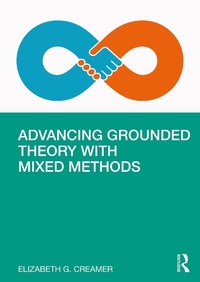
Advancing Grounded Theory with Mixed Methods
1st Edition
Published on 30. August 2021
194 pages
978-0-429-61488-0 (ISBN)
Description

This groundbreaking book introduces an innovative new perspective on mixed method grounded theory methodology (MM-GTM) by conceptualizing it holistically as a distinct, qualitatively driven methodology that appreciates the integrity of each of the methods it embraces. This practical and accessible text advocates for using MM-GTM in a way that promote meaningful interaction between qualitative and quantitative data during analysis. Its principal contribution is to provide a set of research tools to develop or refine a multi-faceted analytical framework in applied fields in the social and behavioral sciences, including nursing.
Used as either a resource or a textbook in a survey course about research methods, the text references dozens of examples about how a dialectical exchange between different sources of data can be built into core grounded theory procedures, including theoretical sampling, coding, case-based memoing, and integrated visual displays. With a whole chapter devoted to reporting, the book also considers the way that indexes of quality that extend beyond methodological transparency can be used to evaluate research that partners mixed methods with grounded theory and other qualitative methods.
Featuring student-friendly pedagogy throughout, including self-assessment questions, a glossary, and a framework that summarizes key points, this text is an essential read for all research methods students or early career researchers ambitious to develop a theoretical perspective with qualitative, mixed methods, or evaluation.
Used as either a resource or a textbook in a survey course about research methods, the text references dozens of examples about how a dialectical exchange between different sources of data can be built into core grounded theory procedures, including theoretical sampling, coding, case-based memoing, and integrated visual displays. With a whole chapter devoted to reporting, the book also considers the way that indexes of quality that extend beyond methodological transparency can be used to evaluate research that partners mixed methods with grounded theory and other qualitative methods.
Featuring student-friendly pedagogy throughout, including self-assessment questions, a glossary, and a framework that summarizes key points, this text is an essential read for all research methods students or early career researchers ambitious to develop a theoretical perspective with qualitative, mixed methods, or evaluation.
Reviews / Votes
While some grounded theorists have claimed for years that the Grounded Theory Methodology is inherently a form of Mixed-Methods Research, most have persisted in qualitative studies. Elizabeth Creamer sets out a systematic approach for making Mixed Methods Grounded Theory. In doing so, she has opened the door for the development of insightful theories that are grounded in a richer variety of data sources. - Gregory Hadley, Ph.D., Professor of Sociolinguistics and Western Cultural Studies, Niigata UniversityCreamer demonstrates both unique contributions of and parallels between mixed methods and grounded theory, prompting multiple fresh ideas on how to link theory with MM throughout a project. Especially valuable are her contributions on case-based and visual strategies, her attention to the possibilities offered by exploring methodological dissonance, and the variety of examples and exemplars she draws on. This will be a valuable resource for people from across a wide spectrum of experience and disciplines. - Dr. Patricia Bazeley, Author of Qualitative Data Analysis and Founding Member and Past President of the Mixed Methods International Research Association While some grounded theorists have claimed for years that the Grounded Theory Methodology is inherently a form of Mixed-Methods Research, most have persisted in qualitative studies. Elizabeth Creamer sets out a systematic approach for making Mixed Methods Grounded Theory. In doing so, she has opened the door for the development of insightful theories that are grounded in a richer variety of data sources. - Gregory Hadley, Ph.D., Professor of Sociolinguistics and Western Cultural Studies, Niigata University
Creamer demonstrates both unique contributions of and parallels between mixed methods and grounded theory, prompting multiple fresh ideas on how to link theory with MM throughout a project. Especially valuable are her contributions on case-based and visual strategies, her attention to the possibilities offered by exploring methodological dissonance, and the variety of examples and exemplars she draws on. This will be a valuable resource for people from across a wide spectrum of experience and disciplines. - Dr. Patricia Bazeley, Author of Qualitative Data Analysis and Founding Member and Past President of the Mixed Methods International Research Association
Creamer's writing style is fresh, exuberant, and scholarly. Herinsights throughout underscore her status as a veteran research methodologist...Creamer offers a significant contribution to both MM-GTM and MMR by addressing methodological issues that, up to now, have remained largely unrealized in GTM. - Gregory Hadley, Ph.D., Professor of Sociolinguistics and Western Cultural Studies, Niigata University
More details
Edition
1. Auflage
Language
English
Place of publication
London
United Kingdom
Publishing group
Taylor & Francis Ltd
Target group
College/higher education
Professional and scholarly
Product notice
Reflowable
Illustrations
40 Tables, black and white; 13 Line drawings, black and white; 13 Illustrations, black and white
ISBN-13
978-0-429-61488-0 (9780429614880)
Copyright in bibliographic data and cover images is held by Nielsen Book Services Limited or by the publishers or by their respective licensors: all rights reserved.
Schweitzer Classification
Other editions
Additional editions
Elizabeth G. Creamer
Advancing Grounded Theory with Mixed Methods
Book
08/2021
1st Edition
Routledge
€67.00
Shipment within 15-20 days
Elizabeth G. Creamer
Advancing Grounded Theory with Mixed Methods
Book
08/2021
1st Edition
Routledge
€179.51
Shipment within 15-20 days
Person
Elizabeth G. Creamer is professor emerita of educational research and evaluation in the School of Education in the Virginia Tech College of Liberal Arts and Human Sciences. She is the author, co-author, or editor of more than more than 7 books, and nearly 200 peer-reviewed journal articles, book chapters, and reviews. Her most recent book is An Introduction to Fully Integrated Mixed Methods Research (SAGE, 2018).
Content
Chapter 1: Establishing language and purpose; Chapter 2: Varied approaches to using mixed methods with theoretical frameworks; Chapter 3: Mixed methods and the process of theorizing; Chapter 4: Advancing theoretical reasoning with visualizations; Chapter 5: Leveraging dissonance to advance theoretical reasoning; Chapter 6: Highlighting quality through reporting
