

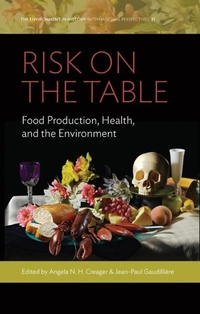
Risk on the Table
Food Production, Health, and the Environment
1st Edition
Published on 15. January 2021
366 pages
978-1-80539-912-4 (ISBN)
Description

Over the last century, the industrialization of agriculture and processing technologies have made food abundant and relatively inexpensive for much of the world's population. Simultaneously, pesticides, nitrates, and other technological innovations intended to improve the food supply's productivity and safety have generated new, often poorly understood risks for consumers and the environment. From the proliferation of synthetic additives to the threat posed by antibiotic-resistant bacteria, the chapters in Risk on the Table zero in on key historical cases in North America and Europe that illuminate the history of food safety, highlighting the powerful tensions that exists among scientific understandings of risk, policymakers' decisions, and cultural notions of "pure" food.
Reviews / Votes
"The book stands out for its multidisciplinary approach, integrating history, science, and policy analysis to explore the historical context and ongoing debates and challenges in food safety, including conflicting interests shaping policies and practices. The volume is particularly relevant in an era where food safety and environmental health are increasingly intertwined with global trade and industrial practices." * Agriculture and Human Values"The editors have brought together enough international work to form a broad picture of changes in the global food system. This is an extremely welcome view of how those changes were received in different places at different times." * Technology and Culture
"This collection draws insightful genealogies of a persistently virulent problem: food safety. The book brings together a series of well-written and exciting historical cases that together create a picture of the scientific and political struggles for food safety and their obstacles." * Alexander von Schwerin, Max Planck Institute for the History of Science
"'Risk on the Table' is a perfectly apt title for a book which deals with a major concern of modern societies: What shall we eat? Combining perspectives of 'food risk' as a matter of health concerns; environmental issues; and economic, social and employment problems, this book is truly innovative." * Karin Zachmann, The Technical University of Munich
More details
Series
Edition
1. Auflage
Language
English
Place of publication
Oxford
United Kingdom
Target group
Professional and scholarly
Illustrations
Bibliography; Index; 18 Illustrations
ISBN-13
978-1-80539-912-4 (9781805399124)
DOI
10.3167/9781789209440
Copyright in bibliographic data and cover images is held by Nielsen Book Services Limited or by the publishers or by their respective licensors: all rights reserved.
Schweitzer Classification
Other editions
Additional editions
Angela N. H. Creager | Jean-Paul Gaudilliere
Risk on the Table
Food Production, Health, and the Environment
Book
11/2024
Berghahn Books
€48.00
Shipment within 3-4 weeks
Angela N. H. Creager | Jean-Paul Gaudilliere
Risk on the Table
Food Production, Health, and the Environment
Book
01/2021
1st Edition
Berghahn Books
€163.80
Shipment within 3-4 weeks
Persons
Angela N. H. Creager is the Thomas M. Siebel Professor in the History of Science at Princeton University, where she directed the Shelby Cullom Davis Center for Historical Studies from 2016-20. Her current work focuses on the role of genetic tests in environmental science and regulation during the late twentieth century.
Content
List of Figures and Tables
Acknowledgements
List of Abbreviations
Introduction
Angela N. H. Creager & Jean-Paul Gaudilliere
Part I: Objectifying Dangers
Chapter 1. Salad Days: The Science and Medicine of Bad Greens, 1870-2000
?Anne Hardy?
Chapter 2. Radioactive Diet: Food, Metabolism, and the Environment, c. 1960
Soraya de Chadarevian?
Chapter 3. Poison and Cancer: The Politics of Food Carcinogens in 1950s West Germany?
Heiko Stoff
Chapter 4. "EAT. DIE." The Domestication of Carcinogens in the 1980s?
Angela N. H. Creager
Chapter 5. Risk on the Negotiating Table: Malnutrition, Mold Toxicity, and Postcolonial Development?
Lucas M. Mueller
Chapter 6. Contaminated Foods, Global Environmental Health, and the Political Recalcitrance of a Pollution Problem: The Case of PCBs from 1966 to the Present Day
?Aurelien Feron
Part II: Ordering Risks
Chapter 7. Trace Amounts at Industrial Scale: Arsenicals and Medicated Feed in the Production of the "Western Diet"
Hannah Landecker
Chapter 8. Between Bacteriology and Toxicology: Agricultural Antibiotics and US Risk Regulation (1948-77)?
Claas Kirchhelle
Chapter 9. Conflicts of Interest, Ignorance, and Hegemony in the Diethylstilboestral US Food Crisis?
Jean-Paul Gaudilliere
Chapter 10. Defining Food Additives: Origins and Shortfalls of the US Regulatory Framework?
Maricel V. Maffini and Sarah Vogel
Chapter 11. The Rise (and Fall) of the Food-Drug Line: Classification, Gatekeepers, and Spatial Mediation in Regulating US Food and Health Markets
Xaq Frohlich
Afterword?
Deborah Fitzgerald
Index
Acknowledgements
List of Abbreviations
Introduction
Angela N. H. Creager & Jean-Paul Gaudilliere
Part I: Objectifying Dangers
Chapter 1. Salad Days: The Science and Medicine of Bad Greens, 1870-2000
?Anne Hardy?
Chapter 2. Radioactive Diet: Food, Metabolism, and the Environment, c. 1960
Soraya de Chadarevian?
Chapter 3. Poison and Cancer: The Politics of Food Carcinogens in 1950s West Germany?
Heiko Stoff
Chapter 4. "EAT. DIE." The Domestication of Carcinogens in the 1980s?
Angela N. H. Creager
Chapter 5. Risk on the Negotiating Table: Malnutrition, Mold Toxicity, and Postcolonial Development?
Lucas M. Mueller
Chapter 6. Contaminated Foods, Global Environmental Health, and the Political Recalcitrance of a Pollution Problem: The Case of PCBs from 1966 to the Present Day
?Aurelien Feron
Part II: Ordering Risks
Chapter 7. Trace Amounts at Industrial Scale: Arsenicals and Medicated Feed in the Production of the "Western Diet"
Hannah Landecker
Chapter 8. Between Bacteriology and Toxicology: Agricultural Antibiotics and US Risk Regulation (1948-77)?
Claas Kirchhelle
Chapter 9. Conflicts of Interest, Ignorance, and Hegemony in the Diethylstilboestral US Food Crisis?
Jean-Paul Gaudilliere
Chapter 10. Defining Food Additives: Origins and Shortfalls of the US Regulatory Framework?
Maricel V. Maffini and Sarah Vogel
Chapter 11. The Rise (and Fall) of the Food-Drug Line: Classification, Gatekeepers, and Spatial Mediation in Regulating US Food and Health Markets
Xaq Frohlich
Afterword?
Deborah Fitzgerald
Index
