

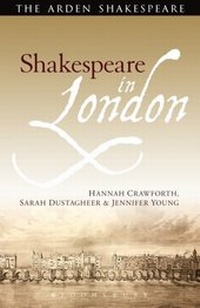
Shakespeare in London
1st Edition
Published on 26. February 2015
280 pages
978-1-4081-5179-2 (ISBN)
Description

Shakespeare in London offers a lively and engaging new reading of some of Shakespeare's major work, informed by close attention to the language of his drama. The focus of the book is on Shakespeare's London, how it influenced his drama and how he represents it on stage. Taking readers on an imaginative journey through the city, the book moves both chronologically, from beginning to end of Shakespeare's dramatic career, and also geographically, traversing London from west to east.
Each chapter focuses on one play and one key location, drawing out the thematic connections between that place and the drama it underwrites. Plays discussed in detail include Hamlet, Richard II, The Merchant of Venice, The Tempest, King Lear and Romeo and Juliet. Close textual readings accompany the wealth of contextual material, providing a fresh and exciting way into Shakespeare's work.
Each chapter focuses on one play and one key location, drawing out the thematic connections between that place and the drama it underwrites. Plays discussed in detail include Hamlet, Richard II, The Merchant of Venice, The Tempest, King Lear and Romeo and Juliet. Close textual readings accompany the wealth of contextual material, providing a fresh and exciting way into Shakespeare's work.
More details
Series
Edition
1. Auflage
Language
English
Place of publication
London
United Kingdom
Publishing group
Bloomsbury Publishing PLC
Target group
College/higher education
Professional and scholarly
Illustrations
6 bw illus
ISBN-13
978-1-4081-5179-2 (9781408151792)
Copyright in bibliographic data and cover images is held by Nielsen Book Services Limited or by the publishers or by their respective licensors: all rights reserved.
Schweitzer Classification
Other editions
Additional editions
Hannah Crawforth | Sarah Dustagheer | Jennifer Young
Shakespeare in London
Book
02/2015
The Arden Shakespeare
€49.70
Shipment within 10-20 days
Persons
Hannah Crawforth is Lecturer in Shakespeare Studies at King's College London, UK.
Sarah Dustagheer is Lecturer in Early Modern Literature at the University of Kent, UK.
Jennifer Young is Teaching Fellow in English Literature (1590-1700) at the University of Leeds, UK.
Sarah Dustagheer is Lecturer in Early Modern Literature at the University of Kent, UK.
Jennifer Young is Teaching Fellow in English Literature (1590-1700) at the University of Leeds, UK.
Content
List of Illustrations
Acknowledgements
Note on the Text
A Chronology of Shakespeare's Life and Early Modern London
Introduction: Shakespeare's London
1. Violence in Shakespeare's London:
Titus Andronicus (1594) and Tyburn
2. Politics in Shakespeare's London:
Richard II (1595) and Whitehall
3. Class in Shakespeare's London:
Romeo and Juliet (1595-6) and The Strand
4. Law in Shakespeare's London:
The Merchant of Venice (1596-8) and the Inns of Court
5. Religion in Shakespeare's London:
Hamlet (1600-1) and St Paul's
6. Medicine in Shakespeare's London:
King Lear (1605-6) and Bedlam
7. Economics in Shakespeare's London:
Timon of Athens (1607) and the King's Bench Prison, Southwark
8. Experimentation in Shakespeare's London:
The Tempest (1610-11) and Lime Street
Epilogue: Henry VIII (1613) and the Tower of London
Works Cited
Suggested Further Reading
Index
Acknowledgements
Note on the Text
A Chronology of Shakespeare's Life and Early Modern London
Introduction: Shakespeare's London
1. Violence in Shakespeare's London:
Titus Andronicus (1594) and Tyburn
2. Politics in Shakespeare's London:
Richard II (1595) and Whitehall
3. Class in Shakespeare's London:
Romeo and Juliet (1595-6) and The Strand
4. Law in Shakespeare's London:
The Merchant of Venice (1596-8) and the Inns of Court
5. Religion in Shakespeare's London:
Hamlet (1600-1) and St Paul's
6. Medicine in Shakespeare's London:
King Lear (1605-6) and Bedlam
7. Economics in Shakespeare's London:
Timon of Athens (1607) and the King's Bench Prison, Southwark
8. Experimentation in Shakespeare's London:
The Tempest (1610-11) and Lime Street
Epilogue: Henry VIII (1613) and the Tower of London
Works Cited
Suggested Further Reading
Index
