

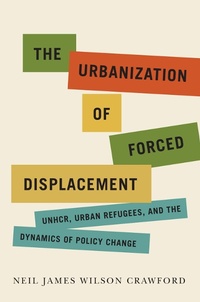
The Urbanization of Forced Displacement
UNHCR, Urban Refugees, and the Dynamics of Policy Change
1st Edition
Published on 31. January 2022
343 pages
978-0-2280-0935-1 (ISBN)
Description

Displacement in the twenty-first century is urbanized. The United Nations Refugee Agency (UNHCR), the world's largest humanitarian organization and the main body charged with assisting displaced people globally, estimates that over 60 per cent of refugees now live in urban areas, a proportion that only increases in the case of internally displaced people and asylum seekers.
Though cities and local authorities have become essential participants in the protection of refugees, only three decades ago they were considered to sit firmly beyond UNHCR's remit, with urban refugees typically characterized as aberrations. In The Urbanization of Forced Displacement Neil James Wilson Crawford examines the organization's response to the growing number of refugees migrating to urban areas. Introducing a broader study of policy-making in international organizations, Crawford addresses how and why UNHCR changed its policy and practice in response to shifting trends in displacement. Citing over 400 primary UN documents, Crawford provides an in-depth study of the internal and external pressures faced by UNHCR - pressures from above, below, and within - that explain why it has radically transformed its position from the 1990s onward.
UNHCR and global refugee policies have come to play an increasingly important role in the governance of global displacement. The Urbanization of Forced Displacement sheds new light on how the organization works and how it conceives its role in global politics today.
Though cities and local authorities have become essential participants in the protection of refugees, only three decades ago they were considered to sit firmly beyond UNHCR's remit, with urban refugees typically characterized as aberrations. In The Urbanization of Forced Displacement Neil James Wilson Crawford examines the organization's response to the growing number of refugees migrating to urban areas. Introducing a broader study of policy-making in international organizations, Crawford addresses how and why UNHCR changed its policy and practice in response to shifting trends in displacement. Citing over 400 primary UN documents, Crawford provides an in-depth study of the internal and external pressures faced by UNHCR - pressures from above, below, and within - that explain why it has radically transformed its position from the 1990s onward.
UNHCR and global refugee policies have come to play an increasingly important role in the governance of global displacement. The Urbanization of Forced Displacement sheds new light on how the organization works and how it conceives its role in global politics today.
Reviews / Votes
"The Urbanization of Forced Displacement addresses an issue of significant concern to people working in the fields of refugee, migration, humanitarian, and urban studies, as well as those with an interest in the policymaking process of international organizations. As someone who was intimately engaged in many of the events and decisions examined in the book, I found Crawford's analysis to be engaging and enlightening." Jeff Crisp, Oxford University and former head of policy development and evaluation, UNHCR "Neil Crawford's The Urbanization of Forced Displacement is a timely intervention on the debates about how and why international organizations experience policy change. [...] the analysis of the UNHCR's experience of authority expansion to displaced groups in urban settings is sharp, and scholars of forced migration and refugee studies will find a fresh insight in it. Moreover, the book's findings on the power of epistemic communities will be relevant to multiple audiences beyond the academic world. For policy-makers, Crawford offers an insightful analysis of the workings of international organizations. For civil society actors, it is an important source on the significance of knowledge and expertise in steering an international organization's direction, and therefore, in crafting their impact strategies. In a time when science and epistemic communities are under constant criticism and challenges from different political forces, Crawford's analysis reminds readers that knowledge and expertise still matter." International Affairs "[T]he author skillfully avoids treating an actor, like a state or an international institution, as a temporally stable, homogenous, and self-conscious unit. The book provides a productive example of how actors within and around UNHCR consist of internal contestations involving different branches and individuals, how they respond to change in the international system and discourse that they are embedded in, and how all these change over time [...]. The Urbanization of Forced Displacement is an important read for graduate and undergraduate students as well as researchers and policymakers working on forced migration." International Migration Review "[Crawford] significantly contributes to the understanding of forced displacement in urban settings and the role of UNHCR in global politics while offering valuable insights for researchers and policy-makers alike. An important reference that enriches the field of international relations." Refuge: Canada's Journal of RefugeesMore details
Series
Language
English
Place of publication
Montreal, QC
Canada
Target group
Professional and scholarly
Edition type
Digital original
File size
2,03 MB
ISBN-13
978-0-2280-0935-1 (9780228009351)
Copyright in bibliographic data and cover images is held by Nielsen Book Services Limited or by the publishers or by their respective licensors: all rights reserved.
Schweitzer Classification
Other editions
Additional editions
Neil James Wilson Crawford
The Urbanization of Forced Displacement
UNHCR, Urban Refugees, and the Dynamics of Policy Change
Book
12/2021
McGill-Queen's University Press
€154.50
Article not available at the moment
Neil James Wilson Crawford
The Urbanization of Forced Displacement
UNHCR, Urban Refugees, and the Dynamics of Policy Change
Book
12/2021
McGill-Queen's University Press
€31.50
Shipment within 15-20 days
Person
Neil James Wilson Crawford is assistant professor at the University of Stirling, United Kingdom.
Content
- Cover
- Copyright
- Contents
- Acknowledgments
- Abbreviations
- Key UNHCR Urban Documents
- 1 Introduction The Urbanization of Forced Displacement
- 2 Conceptualizing Policy Change
- 3 Policy-Making in the United Nations
- 4 UNHCR and Urban Refugees Avoiding Dependency, 1994-97
- 5 UNHCR and Urban Refugees Decorating Our Bookshelves, 1998-2003
- 6 UNHCR and Urban Refugees Beyond Sprawling Camps, 2004-09
- 7 UNHCR in an Urban World
- Notes
- References
- Index
