

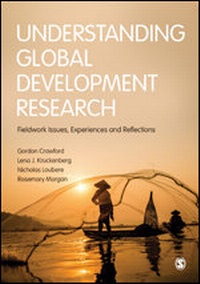
Understanding Global Development Research
Fieldwork Issues, Experiences and Reflections
1st Edition
Published on 26. January 2017
288 pages
978-1-4739-8708-1 (ISBN)
Description

For experienced and inexperienced researchers and practitioners alike, this engaging book opens up new perspectives on conducting fieldwork in the Global South.
Following an inter-disciplinary and inter-generational approach, Understanding Global Development brings into dialogue reflections on fieldwork experiences by leading scholars along with accounts from early career researchers. Contributions are organised around six key issues:
Meaningful participation in fieldwork
Working in dangerous environments
Gendered experiences of fieldwork
Researching elites
Conducting fieldwork with marginalised people
Fieldwork in development practice.
The experience-led discussion of each of the topics conveys a sense of what it actually feels like to be out in the field and provides readers with useful insights and practical advice. A relational framework highlights issues relating to power, identity and ethics in development fieldwork, and encourages reflection on how researcher engagement with the field shapes our understanding of global development.
Following an inter-disciplinary and inter-generational approach, Understanding Global Development brings into dialogue reflections on fieldwork experiences by leading scholars along with accounts from early career researchers. Contributions are organised around six key issues:
Meaningful participation in fieldwork
Working in dangerous environments
Gendered experiences of fieldwork
Researching elites
Conducting fieldwork with marginalised people
Fieldwork in development practice.
The experience-led discussion of each of the topics conveys a sense of what it actually feels like to be out in the field and provides readers with useful insights and practical advice. A relational framework highlights issues relating to power, identity and ethics in development fieldwork, and encourages reflection on how researcher engagement with the field shapes our understanding of global development.
Reviews / Votes
A must read for all students, researchers and aid workers contemplating field work in emerging economies. -- Admos Chimhowu This is an up-to-date, thought-provoking and well-balanced publication that brings together the best insights of leading and young scholars at the nexus of development and participatory field research. Its relational, ethics- and power-sensitive perspective makes this book special. -- Michael SchoenhuthMore details
Edition
First Edition
Language
English
Place of publication
London
United Kingdom
Target group
College/higher education
Professional and scholarly
ISBN-13
978-1-4739-8708-1 (9781473987081)
Copyright in bibliographic data and cover images is held by Nielsen Book Services Limited or by the publishers or by their respective licensors: all rights reserved.
Schweitzer Classification
Other editions
Additional editions
Gordon Crawford | Lena J. Jaspersen | Nicholas Loubere
Understanding Global Development Research
Fieldwork Issues, Experiences and Reflections
Book
02/2017
1st Edition
SAGE Publications Ltd
€97.80
Shipment within 15-20 days
Gordon Crawford | Lena J. Jaspersen | Nicholas Loubere
Understanding Global Development Research
Fieldwork Issues, Experiences and Reflections
Book
02/2017
1st Edition
SAGE Publications Ltd
€179.20
Shipment within 15-20 days
Persons
Gordon Crawford is a Research Professor in Global Development at the Centre for Trust, Peace and Social Relations at Coventry University, United Kingdom. He has a B.A. in Sociology, an M.A. in Development Studies and a Ph.D. in Politics from the University of Leeds. He joined Coventry University in October 2015 after teaching and researching at the University of Leeds from 1993, where he was Professor of Development Politics. He was previously Director of the Centre for Global Development (CGD) at Leeds. His research examines issues of human rights, democracy and development, especially in countries of the Global South, and he has undertaken extensive fieldwork in Ghana. His current research includes work on natural resource politics and on social movement struggles for right-based development. Recent publications include Human Rights, Power and Civic Action (co-edited with Bard A. Andreassen) (2013). He is an Editorial Group member of the journal Africa Spectrum. Lena J. Jaspersen is a University Academic Fellow in Innovation Management at the University of Leeds, where she co-developed and teaches the flagship interdisciplinary Innovation Thinking and Practice module with Tony Morgan and teaches qualitative research methods at the PhD level. Her main research interests include collaborative research and innovation, and the role of partnerships in addressing global development challenges.
Lena's background brings an international and interdisciplinary dimension to her writing, teaching and research. She holds Masters' degrees in Sociology and International Relations and was awarded a PhD with Recommendation of Research Excellence from the University of Leeds. Lena is also currently part of the team at the Leeds Institute of Teaching Excellence carrying out pedagogical research into interdisciplinary team-based teaching and learning with a focus on digital and employability skills.
Lena has a strong interest in innovation and research methods. She's a co-author of the 7th edition of the bestselling Management and Business Research (Sage, 2021), which provides readers with a clear and comprehensive overview of methods for conducting management and business research. Lena's other publications include a recent article in the British Journal of Management, containing a systematic overview of methods for qualitative network research, Understanding Global Development Research (Sage, 2017) and the UN-real World of Human Rights (Nomos, 2012).
Nicholas Loubere is a contemporary Sinologist and a Development Studies scholar whose research focuses on patterns and processes of local socioeconomic development in China. Currently, he is involved in projects examining the implementation and outcomes of microcredit programmes in rural China; the organisation and management of Chinese cooperatives; the provision and utilisation of internet finance in China; and Chinese migration to Africa. He is also the co-chief editor of www.chinoiresie.info. Before joining the Centre for East and South-East Asian Studies at Lund University, Nicholas was a Postdoctoral Fellow in the Australian Centre on China in the World at the Australian National University. Nicholas completed a Ph.D. in East Asian Studies at the University of Leeds, an M.A. in International Relations at Xiamen University and a B.A. in English Literature at Northern Illinois University. Rosemary Morgan is an Assistant Scientist at Johns Hopkins' Bloomberg School of Public Health on the project 'Research in Gender and Ethics (RinGs): Building Stronger Health Systems'. Prior to joining Johns Hopkins University, Rosemary was a Lecturer in Global Health Policy for the Global Public Health Unit at the University of Edinburgh, and a Research and Teaching Fellow at the Nuffield Centre for International Health and Development at the University of Leeds, where she worked on two international health projects: 'Health System Stewardship and Regulation in Vietnam, India and China' (HESVIC); and the 'Consortium for Health Policy and Systems Analysis in Africa' (CHEPSAA). She holds a Ph.D. in International Health and Development from the University of Leeds, an M.Sc. in Policy Studies from the University of Edinburgh, and a B.A. in Sociology from the University of British Columbia.
Lena's background brings an international and interdisciplinary dimension to her writing, teaching and research. She holds Masters' degrees in Sociology and International Relations and was awarded a PhD with Recommendation of Research Excellence from the University of Leeds. Lena is also currently part of the team at the Leeds Institute of Teaching Excellence carrying out pedagogical research into interdisciplinary team-based teaching and learning with a focus on digital and employability skills.
Lena has a strong interest in innovation and research methods. She's a co-author of the 7th edition of the bestselling Management and Business Research (Sage, 2021), which provides readers with a clear and comprehensive overview of methods for conducting management and business research. Lena's other publications include a recent article in the British Journal of Management, containing a systematic overview of methods for qualitative network research, Understanding Global Development Research (Sage, 2017) and the UN-real World of Human Rights (Nomos, 2012).
Nicholas Loubere is a contemporary Sinologist and a Development Studies scholar whose research focuses on patterns and processes of local socioeconomic development in China. Currently, he is involved in projects examining the implementation and outcomes of microcredit programmes in rural China; the organisation and management of Chinese cooperatives; the provision and utilisation of internet finance in China; and Chinese migration to Africa. He is also the co-chief editor of www.chinoiresie.info. Before joining the Centre for East and South-East Asian Studies at Lund University, Nicholas was a Postdoctoral Fellow in the Australian Centre on China in the World at the Australian National University. Nicholas completed a Ph.D. in East Asian Studies at the University of Leeds, an M.A. in International Relations at Xiamen University and a B.A. in English Literature at Northern Illinois University. Rosemary Morgan is an Assistant Scientist at Johns Hopkins' Bloomberg School of Public Health on the project 'Research in Gender and Ethics (RinGs): Building Stronger Health Systems'. Prior to joining Johns Hopkins University, Rosemary was a Lecturer in Global Health Policy for the Global Public Health Unit at the University of Edinburgh, and a Research and Teaching Fellow at the Nuffield Centre for International Health and Development at the University of Leeds, where she worked on two international health projects: 'Health System Stewardship and Regulation in Vietnam, India and China' (HESVIC); and the 'Consortium for Health Policy and Systems Analysis in Africa' (CHEPSAA). She holds a Ph.D. in International Health and Development from the University of Leeds, an M.Sc. in Policy Studies from the University of Edinburgh, and a B.A. in Sociology from the University of British Columbia.
Content
Chapter 1: Global Development Fieldwork: A Relational Perspective - Gordon Crawford, Lena J. Kruckenberg, Nicholas Loubere and Rosemary Morgan
Section I: Encountering the Field
Chapter 2: Liberating Development Inquiry: Freedom, Openness and Participation in Fieldwork - Robert Chambers and Nicholas Loubere
Chapter 3: Democracy of the Ground? Encountering Elite Domination During Fieldwork - Ashish Shah
Chapter 4: Combining Participatory Tools with Ethnography in Rural Cambodia - Sarah Milne
Section II: Gender and Fieldwork
Chapter 5: Gender is not a Noun, It's an Adjective: Using Gender as a Lens within Development Research - Ruth Pearson and Rosemary Morgan
Chapter 6: Encounters with Diversity: Reflecting on Different Perceptions of Gender in the Field - Johanna Bergstroem
Chapter 7: Gendered Agency in Constrained Circumstances: Researching Women Selling Sex in Kenya - Egle Cesnulyte
Section III: Fieldwork at the Margins
Chapter 8: On the Margins of World Society: Working with Impoverished, Excluded and Marginalised People - Joanna Pfaff-Czarnecka and Lena J. Kruckenberg
Chapter 9: Encounters at the Margins: Situating the Researcher Under Conditions of Aid - Swetha Rao Dhananka
Chapter 10: Marginalisation(s) at the Margins: Studying Identity, Ethnicity and Conflict in Rural Bolivia - Lorenza B. Fontana
Section IV: Engaging with 'Elite' Actors
Chapter 11: Encounters with the Powerful: Researching Elites - Jean Grugel and Rosemary Morgan
Chapter 12: The Ups and Downs of 'Studying Up': Researching Elites in China - John Osburg
Chapter 13: The Nature of Power in Elite Interviews: Researching Environmental Politics in the Southern Cone of South America - Karen M. Siegel
Section V: Danger in the Field
Chapter 14: Under Threat: Working in Dangerous Environments - Jenny Pearce and Nicholas Loubere
Chapter 15: Perceiving Threats to Health in the Field: Researching Zoonotic Diseases at the Human-Animal Interface - Scott Naysmith
Chapter 16: Children in the Streets: Activism and Representation in Dangerous Fields - Nelly Ali
Section VI: Development in Theory and Practice
Chapter 17: Beyond the Ivory Tower: Researching Development Practice - David Mosse and Lena J. Kruckenberg
Chapter 18: Multipositionality in the 'Field' - Kathy Dodworth
Chapter 19: Irrelevance Dressed as Success?: Dis-spirited Reflections on Knowledge-based Development - Lata Narayanaswamy
Chapter 20: Towards a Relational Understanding of Development Research - Gordon Crawford, Lena J. Kruckenberg, Nicholas Loubere and Rosemary Morgan
Section I: Encountering the Field
Chapter 2: Liberating Development Inquiry: Freedom, Openness and Participation in Fieldwork - Robert Chambers and Nicholas Loubere
Chapter 3: Democracy of the Ground? Encountering Elite Domination During Fieldwork - Ashish Shah
Chapter 4: Combining Participatory Tools with Ethnography in Rural Cambodia - Sarah Milne
Section II: Gender and Fieldwork
Chapter 5: Gender is not a Noun, It's an Adjective: Using Gender as a Lens within Development Research - Ruth Pearson and Rosemary Morgan
Chapter 6: Encounters with Diversity: Reflecting on Different Perceptions of Gender in the Field - Johanna Bergstroem
Chapter 7: Gendered Agency in Constrained Circumstances: Researching Women Selling Sex in Kenya - Egle Cesnulyte
Section III: Fieldwork at the Margins
Chapter 8: On the Margins of World Society: Working with Impoverished, Excluded and Marginalised People - Joanna Pfaff-Czarnecka and Lena J. Kruckenberg
Chapter 9: Encounters at the Margins: Situating the Researcher Under Conditions of Aid - Swetha Rao Dhananka
Chapter 10: Marginalisation(s) at the Margins: Studying Identity, Ethnicity and Conflict in Rural Bolivia - Lorenza B. Fontana
Section IV: Engaging with 'Elite' Actors
Chapter 11: Encounters with the Powerful: Researching Elites - Jean Grugel and Rosemary Morgan
Chapter 12: The Ups and Downs of 'Studying Up': Researching Elites in China - John Osburg
Chapter 13: The Nature of Power in Elite Interviews: Researching Environmental Politics in the Southern Cone of South America - Karen M. Siegel
Section V: Danger in the Field
Chapter 14: Under Threat: Working in Dangerous Environments - Jenny Pearce and Nicholas Loubere
Chapter 15: Perceiving Threats to Health in the Field: Researching Zoonotic Diseases at the Human-Animal Interface - Scott Naysmith
Chapter 16: Children in the Streets: Activism and Representation in Dangerous Fields - Nelly Ali
Section VI: Development in Theory and Practice
Chapter 17: Beyond the Ivory Tower: Researching Development Practice - David Mosse and Lena J. Kruckenberg
Chapter 18: Multipositionality in the 'Field' - Kathy Dodworth
Chapter 19: Irrelevance Dressed as Success?: Dis-spirited Reflections on Knowledge-based Development - Lata Narayanaswamy
Chapter 20: Towards a Relational Understanding of Development Research - Gordon Crawford, Lena J. Kruckenberg, Nicholas Loubere and Rosemary Morgan
