

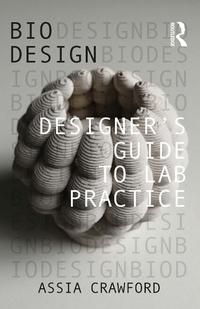
Designer's Guide to Lab Practice
1st Edition
Published on 12. September 2023
170 pages
978-1-000-93739-8 (ISBN)
Description

This book explores the growing field of bio-design through interdisciplinary creative practice. The volume illustrates a range of experimental working techniques while offering a foundational understanding of lab practice principles. The book highlights the myriad of opportunities presented by microorganisms that have reshaped the planet and made it habitable.
The book provides an account of the creation of living materials from the point of view of an architectural design practitioner. The transition from traditional design practice to laboratory investigation is captured, highlighting strategies of creating partnerships across a range of fields. The book demonstrates laboratory methods and ways of investigating the development of living materials and celebrates the growing body of practitioners, scientists, activists and anthropologists who are reimagining new strategies for addressing contemporary environmental challenges.
Designer's Guide to Lab Practice looks at ways in which integrating living components with needs of their own would not only help offset the environmental impact that we have on our planet but could also create a closer relationship with nature. It is a working manual as well as a guide to emerging practitioners seeking to transition into a field that is yet to be defined and that offers the promise of a new era of human habitat making as a direct response to the looming ecological crisis.
The book provides an account of the creation of living materials from the point of view of an architectural design practitioner. The transition from traditional design practice to laboratory investigation is captured, highlighting strategies of creating partnerships across a range of fields. The book demonstrates laboratory methods and ways of investigating the development of living materials and celebrates the growing body of practitioners, scientists, activists and anthropologists who are reimagining new strategies for addressing contemporary environmental challenges.
Designer's Guide to Lab Practice looks at ways in which integrating living components with needs of their own would not only help offset the environmental impact that we have on our planet but could also create a closer relationship with nature. It is a working manual as well as a guide to emerging practitioners seeking to transition into a field that is yet to be defined and that offers the promise of a new era of human habitat making as a direct response to the looming ecological crisis.
More details
Series
Edition
1. Auflage
Language
English
Place of publication
London
United Kingdom
Publishing group
Taylor & Francis Ltd
Target group
College/higher education
Professional and scholarly
Illustrations
10 Line drawings, black and white; 40 Halftones, black and white; 50 Illustrations, black and white
ISBN-13
978-1-000-93739-8 (9781000937398)
Copyright in bibliographic data and cover images is held by Nielsen Book Services Limited or by the publishers or by their respective licensors: all rights reserved.
Schweitzer Classification
Other editions
Additional editions
Assia Crawford
Designer's Guide to Lab Practice
Book
09/2023
1st Edition
Routledge
€63.36
Shipment within 10-20 days
Assia Crawford
Designer's Guide to Lab Practice
Book
09/2023
1st Edition
Routledge
€215.62
Shipment within 10-20 days
Person
Assia Crawford is Assistant Professor in the College of Architecture and Planning at the University of Colorado Denver, USA. Her creative practice research focuses on the development of biological material alternatives and digital fabrication practices for a post-Anthropocene era. Her work sits on the intersection of architecture, science and critical theory, and employs experimental and speculative design to address ecological challenges faced by communities at a time of environmental uncertainty.
Assia is a registered architect with Architects Registration Board (ARB) the UK's regulator of architects and holds a PhD in architecture. She has previously held positions as the architect for the Hub for Biotechnology in the Built Environment (HBBE) and artist-in-residence at the Wellcome Centre for Mitochondrial Research. Assia is an editor of Biotechnology Design Journal and runs Wild Futures Lab, a research and teaching bio-design fabrication wet lab, which explores fabrication and making in the age of environmental decline.
Assia is a registered architect with Architects Registration Board (ARB) the UK's regulator of architects and holds a PhD in architecture. She has previously held positions as the architect for the Hub for Biotechnology in the Built Environment (HBBE) and artist-in-residence at the Wellcome Centre for Mitochondrial Research. Assia is an editor of Biotechnology Design Journal and runs Wild Futures Lab, a research and teaching bio-design fabrication wet lab, which explores fabrication and making in the age of environmental decline.
Content
1. This is not the Beginning 2. Design in the Lab 3. Working Methods 4. Experiments in Design 5. Where to Next?
