

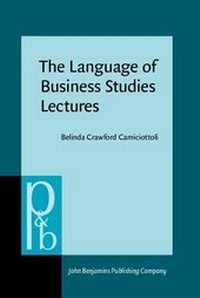
The Language of Business Studies Lectures
A corpus-assisted analysis
1st Edition
Published on 15. May 2007
XVI, 236 pages
978-90-272-9242-1 (ISBN)
Description

New opportunities in the global workplace have heightened interest in business studies. In response to this trend, this book presents an in-depth analysis of a corpus of authentic business studies lectures, focusing on spoken, academic, disciplinary and professional features (e.g., speech rate, interactive devices, specialized lexis) that are crucial to comprehension, but often problematic for non-native speakers. The investigation adopts an original multi-pronged approach including quantitative, qualitative and comparative analyses. It utilizes techniques drawn mainly from corpus linguistics and discourse analysis, but also integrates observational and ethnographic methods to provide unique extra-linguistic insights. The study is thus a full-circle interpretive account of this dynamic spoken genre where academia and profession converge. The book shows how business studies lectures are characterised by a synergy of discourses and communicative channels that reflect the community of practice, highlighting the need to help international business students develop multiple literacies to overcome present and future challenges.
More details
Other editions
Additional editions
Book
05/2007
John Benjamins Publishing Co
€111.30
Shipment within 10-15 days
Person
Content
- The Language of Business Studies Lectures
- Editorial page
- Title page
- LCC data
- Table of contents
- Preface
- List of acronyms and abbreviations
- List of tables and figures
- chapter 1
- Introduction
- 1.1 Rationale for the study
- 1.2 The university lecture: pros and cons
- 1.3 Aims of the study
- 1.4 Target readership
- 1.5 Overview of the book
- chapter 2
- Background to the study
- The merger of discourses
- 2.1 Introduction
- 2.2 Spoken discourse
- 2.2.1 The linguistic/discursive approach
- 2.2.2 The interactional approach
- 2.3 Academic discourse
- 2.4 Disciplinary discourse: the field of economics
- 2.5 Professional discourse: the world of business
- 2.6 A conceptual framework for analyzing business studies lectures
- chapter 3
- The business studies lecture corpus
- Design, collection and analysis
- 3.1 Introduction
- 3.2 Corpus design
- 3.3 Collecting the data
- 3.4 Transcribing the data
- 3.5 Methodology: an integrated approach
- 3.5.1 Quantitative and qualitative analysis
- 3.5.2 Comparative analysis
- 3.5.3 Behavioural observation
- 3.5.4 Participant feedback
- chapter 4
- Speaking to the audience
- 4.1 Introduction
- 4.2 Speech rate
- 4.3 Lecture style
- 4.3.1 Discourse dysfluencies
- 4.3.2 Reduced forms
- 4.4 Lexical informality
- 4.4.1 Vagueness
- 4.4.2 Idioms
- 4.5 Syntactic informality
- 4.5.1 Ellipsis
- 4.5.2 Non-restrictive which-clauses
- 4.6 Lexical density
- 4.7 Summary of findings
- chapter 5
- Interacting with the learners
- 5.1 Introduction
- 5.2 Discourse structuring
- 5.2.1 Lecture macrostructure
- 5.2.2 Macromarkers
- 5.2.3 Micromarkers
- 5.3 Evaluation
- 5.3.1 Relevance markers
- 5.3.2 Affect markers
- 5.4 Lecturer-audience interaction
- 5.4.1 Questions
- 5.4.2 Comprehension checks
- 5.4.3 Dialogic episodes
- 5.5 Audience responsiveness and feedback
- 5.6 Summary of findings
- chapter 6
- Teaching the discipline and the profession
- 6.1 Introduction
- 6.2 Disciplinary/professional orientations: a descriptive profile
- 6.3 Real vs. hypothetical worlds
- 6.4 Argumentation
- 6.5 Specialized lexis
- 6.5.1 Global analysis
- 6.5.2 Keyword analysis
- 6.5.3 Connections to Business English
- 6.5.4 Compounds and buzzwords
- 6.6 Metaphors
- 6.6.1 Global analysis
- 6.6.2 Comparative analysis
- 6.7 Summary of findings
- chapter 7
- Beyond speaking
- Multimodal aspects
- 7.1 Introduction
- 7.2 The visual mode
- 7.2.1 The analytical framework
- 7.2.2 The analysis
- 7.2.2.1 Visual typologies in the BSLC
- 7.2.2.2 Comparative analyses
- 7.3 The nonverbal mode
- 7.3.1 Methodology in nonverbal studies
- 7.3.2 The analysis
- 7.3.2.1 Interpersonal episodes
- 7.3.2.2 Nonverbal behaviours of the lecturers
- 7.3.2.3 A microanalysis of one lecturer's nonverbal behaviours
- 7.4 Summary of findings
- chapter 8
- Final remarks
- 8.1 Introduction
- 8.2 Aims, findings, pedagogical implications and research prospects
- 8.3 Methodological insights
- 8.4 Business studies lectures and interdiscursivity revisited
- References
- Appendix A
- Transcript samples fromthe twelve lectures of the BSLC
- Appendix B
- Specialized lexis in the BSLC ranked according to frequency (number of tokens in parentheses)
- Name index
- Subject index
- The series Pragmatics & Beyond New Series
