

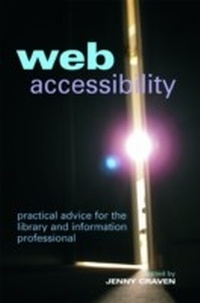
Web Accessibility
Description

With ever greater provision of resources in electronic formats, formal recognition is increasingly being given to the growing awareness within the information profession that it is a moral duty as well as a legal requirement to take every feasible step to ensure that no one is excluded from access to goods and services, including web-based information and resources.
This timely book provides a practical introduction to web accessibility and usability specifically for information professionals, offering advice from a range of experts and experienced practitioners on the concerns relevant to library and information organizations. Contents include:
- tools used for widening access to the web
- Design for All - how web accessibility affects different people
- the importance of web accessibility
- accessibility advice and guidance
- accessibility evaluation and assessment
- issues for library and information services
- Design for All in the library and information science curriculum
- best practice examples of web accessibility
- web accessibility in the future.
Although its main focus is on UK legislation and other requirements, many of the featured guidelines and recommendations are of an international nature, so are transferable to other countries.
Readership: This approachable guide will enable information practitioners and students new to web accessibility to gain a good understanding of the issues involved in this vital area. The book can be used as a resource for developing staff training and awareness activities, or for developing course content. It will also be of value to website managers involved in web design and development who need to broaden a basic understanding of accessibility and usability issues.
All prices
More details
Other editions
Additional editions
Person
Jenny Craven MA MCLIP is a Research Associate at the Centre for Research in Library and Information Management (CERLIM), at Manchester Metropolitan University. She has worked on a number of research projects concerned with web accessibility and library services for visually impaired people (see www.cerlim.ac.uk/projects/index-accessib).
Content
1. Introduction - Jenny Craven 2. Tools used for widening access to the web - E. A. Draffan 3. Design for All - how web accessibility affects different people - Simon Ball 4. The importance of web accessibility - David Sloan 5. Accessibility advice and guidance - Julie Howell 6. Accessibility evaluation and assessment - David Sloan 7. Issues for library and information services - Peter Brophy 8. Design for All in the library and information science curriculum - Richard Eskins and Jenny Craven 9. Best practice examples of web accessibility - Jenny Craven 10. Web accessibility in the future - Brian Kelly
