

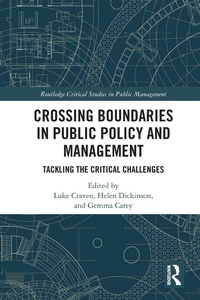
Crossing Boundaries in Public Policy and Management
Tackling the Critical Challenges
Published on 7. December 2018
272 pages
978-1-351-79652-1 (ISBN)
Description

This book aims to develop four key challenges that remain unresolved in the boundary-spanning literature, which span from the conceptual, to the practice, to the translational. In doing so, it tackles the question of boundary-spanning from four different angles, providing an in-depth investigation of the current state of the field in each of these realms, in addition to new directions for solving the identified challenges. Finally, the book synthesises the lessons from each of these challenges into a coherent and integrated final piece of the boundary dilemma. In doing so, it will provide depth and a clearer agenda for future research and practice.
Crossing Boundaries in Public Policy and Management digs into the heart of enduring questions and challenges for cross-boundary working, providing in-depth conceptual contributions on the fundamental challenges of boundary work. It displays the latest state of knowledge on the topic and will be of interest to researchers, academics, practitioners, and students in the fields of public management, public policy, public administration, public-private relationships and coordination and collaboration.
Crossing Boundaries in Public Policy and Management digs into the heart of enduring questions and challenges for cross-boundary working, providing in-depth conceptual contributions on the fundamental challenges of boundary work. It displays the latest state of knowledge on the topic and will be of interest to researchers, academics, practitioners, and students in the fields of public management, public policy, public administration, public-private relationships and coordination and collaboration.
Reviews / Votes
"Crossing Boundaries shifts the level of the debate by offering engaging and real challenges to those who both research and promote multi-disciplinary work." -John Diamond, Edge Hill University, UK"This book fills a gap in boundary-spanning collaboration in the public sector. It consolidates and integrates current theory and practice from leading scholarly thought and countless practitioner experiences. Then it translates lessons learned from action research into new insights on good practice. The book reaches out to academics, students, and practitioners alike who study and practice collaborative leadership." - John Wilkins, York University, Canada
More details
Series
Language
English
Place of publication
London
United Kingdom
Publishing group
Taylor & Francis Ltd
Target group
College/higher education
Product notice
Reflowable
Illustrations
32 Tables, black and white
File size
3,46 MB
ISBN-13
978-1-351-79652-1 (9781351796521)
Copyright in bibliographic data and cover images is held by Nielsen Book Services Limited or by the publishers or by their respective licensors: all rights reserved.
Schweitzer Classification
Other editions
Additional editions
Luke Craven | Helen Dickinson | Gemma Carey
Crossing Boundaries in Public Policy and Management
Tackling the Critical Challenges
Book
12/2020
1st Edition
Routledge
€68.50
Shipment within 15-20 days
Luke Craven | Helen Dickinson | Gemma Carey
Crossing Boundaries in Public Policy and Management
Tackling the Critical Challenges
Book
11/2018
1st Edition
Routledge
€206.60
Shipment within 10-20 days
Persons
Luke Craven is a Research Fellow in the Public Service Research Group at UNSW Canberra.
Helen Dickinson is Associate Professor of Public Service Research and Director of the Public Service Research Group UNSW Canberra.
Gemma Carey is Associate Director and the Research Director of the Centre for Social Impact UNSW and an NHMRC Fellow.
Helen Dickinson is Associate Professor of Public Service Research and Director of the Public Service Research Group UNSW Canberra.
Gemma Carey is Associate Director and the Research Director of the Centre for Social Impact UNSW and an NHMRC Fellow.
Content
Introduction: The Inexorable Appeal of Boundaries in Public Policy and Management
Luke Craven, Gemma Carey, and Helen Dickinson
Part 1: The Concept Challenge
Chapter 1: The Rise of Boundaries
Helen Dickinson and Catherine Smith
Chapter 2: Classifications of Boundaries
Helen Dickinson and Catherine Smith
Chapter 3: Boundary Concepts
Helen Dickinson and Catherine Smith
Chapter 4: Where Next for Boundaries?
Helen Dickinson and Catherine Smith
Part 2: The Practical Challenge
Chapter 5: The Challenges of Crossing Boundary Practice
Paul Williams
Chapter 6: Lesson for Policy and Practice
Paul Williams
Chapter 7: Training and Development
Paul Williams
Chapter 8: Conclusions
Paul Williams
Part 3: The Craft Challenge
Chapter 9: Boundary Spanners: Toward a Theory of Practice
Gemma Carey, Kerry Jacobs, Ellie Malbon, Fiona Buick, Anna Li, and Paul Williams
Chapter 10: The Theory Underpinning Crossing-Boundary Facilitation
Christine Flynn
Chapter 11: Towards the Craft and Practice of Facilitation Across Collaborative Boundaries
Christine Flynn
Chapter 12: Conclusion
Gemma Carey, Luke Craven and Helen Dickinson
Part 4: The Methodology Challenge
Chapter 13: Review, Methodological Approaches to Understanding Collaborative Practice
Luke Craven, Gemma Carey, Helen Dickinson, and Iona Rennie
Chapter 14: A Spotlight on Systems Methodologies: Methods to Understand Complex Issues
Luke Craven, Gemma Carey, Helen Dickinson, and Iona Rennie
Conclusion: The Future of Boundary Spanning Research and Practice
Gemma Carey, Luke Craven and Helen Dickinson
Luke Craven, Gemma Carey, and Helen Dickinson
Part 1: The Concept Challenge
Chapter 1: The Rise of Boundaries
Helen Dickinson and Catherine Smith
Chapter 2: Classifications of Boundaries
Helen Dickinson and Catherine Smith
Chapter 3: Boundary Concepts
Helen Dickinson and Catherine Smith
Chapter 4: Where Next for Boundaries?
Helen Dickinson and Catherine Smith
Part 2: The Practical Challenge
Chapter 5: The Challenges of Crossing Boundary Practice
Paul Williams
Chapter 6: Lesson for Policy and Practice
Paul Williams
Chapter 7: Training and Development
Paul Williams
Chapter 8: Conclusions
Paul Williams
Part 3: The Craft Challenge
Chapter 9: Boundary Spanners: Toward a Theory of Practice
Gemma Carey, Kerry Jacobs, Ellie Malbon, Fiona Buick, Anna Li, and Paul Williams
Chapter 10: The Theory Underpinning Crossing-Boundary Facilitation
Christine Flynn
Chapter 11: Towards the Craft and Practice of Facilitation Across Collaborative Boundaries
Christine Flynn
Chapter 12: Conclusion
Gemma Carey, Luke Craven and Helen Dickinson
Part 4: The Methodology Challenge
Chapter 13: Review, Methodological Approaches to Understanding Collaborative Practice
Luke Craven, Gemma Carey, Helen Dickinson, and Iona Rennie
Chapter 14: A Spotlight on Systems Methodologies: Methods to Understand Complex Issues
Luke Craven, Gemma Carey, Helen Dickinson, and Iona Rennie
Conclusion: The Future of Boundary Spanning Research and Practice
Gemma Carey, Luke Craven and Helen Dickinson
