

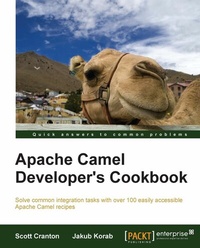
Apache Camel Developer's Cookbook
For Apache Camel developers, this is the book you'll always want to have handy. It's stuffed full of great recipes that are designed for quick practical application. Expands your Apache Camel abilities immediately.
1st Edition
Published on 3. June 2024
424 pages
978-1-78217-031-0 (ISBN)
Description

For Apache Camel developers, this is the book you ll always want to have handy. It s stuffed full of great recipes that are designed for quick practical application. Expands your Apache Camel abilities immediately.Key Features - A practical guide to using Apache Camel delivered in dozens of small, useful recipes.
- Written in a Cookbook format that allows you to quickly look up the features you need, delivering the most important steps to perform with a brief follow-on explanation of what's happening under the covers.
- The recipes cover the full range of Apache Camel usage from creating initial integrations, transformations and routing, debugging, monitoring, security, and more.
Book DescriptionApache Camel is a de-facto standard for developing integrations in Java, and is based on well-understood Enterprise Integration Patterns. It is used within many commercial and open source integration products. Camel makes common integration tasks easy while still providing the developer with the means to customize the framework when the situation demands it. Tasks such as protocol mediation, message routing and transformation, and auditing are common usages of Camel. Apache Camel Developer's Cookbook provides hundreds of best practice tips for using Apache Camel in a format that helps you build your Camel projects. Each tip or recipe provides you with the most important steps to perform along with a summary of how it works, with references to further reading if you need more information. This book is intended to be a reliable information source that is quicker to use than an Internet search. Apache Camel Developer's Cookbook is a quick lookup guide that can also be read from cover to cover if you want to get a sense of the full power of Apache Camel. This book provides coverage of the full lifecycle of creating Apache Camel-based integration projects, including the structure of your Camel code and using the most common Enterprise Integration patterns. Patterns like Split/Join and Aggregation are covered in depth in this book. Throughout this book, you will be learning steps to transform your data. You will also learn how to perform unit and integration testing of your code using Camel's extensive testing framework, and also strategies for debugging and monitoring your code. Advanced topics like Error Handling, Parallel Processing, Transactions, and Security will also be covered in this book. This book provides you with practical tips on using Apache Camel based on years of hands-on experience from hundreds of integration projects.What you will learn - Learn ways to structure your Camel projectsUnderstand common Enterprise Integration Pattern usageTransform your messagesUse Camel s built-in testing frameworkExtend Camel to better interoperate with your existing codeLearn the strategies for Error HandlingUse Camel s parallel processing and threading capabilitiesSecure your Camel integration routesUnderstand ACID Transaction processing within Camel
Who this book is forApache Camel Developer's Cookbook is intended for developers who have some familiarity with Apache Camel and who want a quick lookup reference to practical, proven tips on how to perform common tasks. Every recipe also includes a summary and reference pointers for more details that make it easy for you to get a deeper understanding of the Apache Camel capabilities that you will use day to day.
- Written in a Cookbook format that allows you to quickly look up the features you need, delivering the most important steps to perform with a brief follow-on explanation of what's happening under the covers.
- The recipes cover the full range of Apache Camel usage from creating initial integrations, transformations and routing, debugging, monitoring, security, and more.
Book DescriptionApache Camel is a de-facto standard for developing integrations in Java, and is based on well-understood Enterprise Integration Patterns. It is used within many commercial and open source integration products. Camel makes common integration tasks easy while still providing the developer with the means to customize the framework when the situation demands it. Tasks such as protocol mediation, message routing and transformation, and auditing are common usages of Camel. Apache Camel Developer's Cookbook provides hundreds of best practice tips for using Apache Camel in a format that helps you build your Camel projects. Each tip or recipe provides you with the most important steps to perform along with a summary of how it works, with references to further reading if you need more information. This book is intended to be a reliable information source that is quicker to use than an Internet search. Apache Camel Developer's Cookbook is a quick lookup guide that can also be read from cover to cover if you want to get a sense of the full power of Apache Camel. This book provides coverage of the full lifecycle of creating Apache Camel-based integration projects, including the structure of your Camel code and using the most common Enterprise Integration patterns. Patterns like Split/Join and Aggregation are covered in depth in this book. Throughout this book, you will be learning steps to transform your data. You will also learn how to perform unit and integration testing of your code using Camel's extensive testing framework, and also strategies for debugging and monitoring your code. Advanced topics like Error Handling, Parallel Processing, Transactions, and Security will also be covered in this book. This book provides you with practical tips on using Apache Camel based on years of hands-on experience from hundreds of integration projects.What you will learn - Learn ways to structure your Camel projectsUnderstand common Enterprise Integration Pattern usageTransform your messagesUse Camel s built-in testing frameworkExtend Camel to better interoperate with your existing codeLearn the strategies for Error HandlingUse Camel s parallel processing and threading capabilitiesSecure your Camel integration routesUnderstand ACID Transaction processing within Camel
Who this book is forApache Camel Developer's Cookbook is intended for developers who have some familiarity with Apache Camel and who want a quick lookup reference to practical, proven tips on how to perform common tasks. Every recipe also includes a summary and reference pointers for more details that make it easy for you to get a deeper understanding of the Apache Camel capabilities that you will use day to day.
All prices
More details
Other editions
Additional editions
Scott Cranton | Jakub Korab
Camel Enterprise Integration Cookbook
Book
12/2013
Packt Publishing
€64.10
Shipment within 3-4 weeks
Content
Table of Contents - Structuring Routes
- Routing
- Transformation
- Unit Testing
- Extending Camel
- Split/Join
- Error Handling
- Parallel Processing
- Monitoring and Debugging
- Security
- Web Services
- Transactions
- Routing
- Transformation
- Unit Testing
- Extending Camel
- Split/Join
- Error Handling
- Parallel Processing
- Monitoring and Debugging
- Security
- Web Services
- Transactions

