

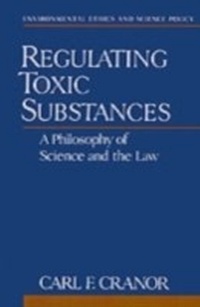
Regulating Toxic Substances
A Philosophy of Science and the Law
1st Edition
Published on 18. February 1993
273 pages
978-0-19-534491-2 (ISBN)
Description

The proliferation of chemical substances in commerce poses scientific and philosophical problems. The scientific challenge is to develop data, methodologies, and techniques for identifying and assessing toxic substances before they cause harm to human beings and the environment. The philosophical problem is how much scientific information we should demand for this task consistent with other social goals we might have. In this book, Cranor utilizes material from ethics, philosophy of law, epidemiology, tort law, regulatory law, and risk assessment, to argue that the scientific evidential standards used in tort law and administrative law to control toxics ought to be evaluated with the purposes of the law in mind. Demanding too much for this purpose will slow the evaluation and lead to an excess of toxic substances left unidentified and unassessed, thus leaving the public at risk. Demanding too little may impose other costs. An appropriate balance between these social concerns must be found. Justice requires we use evidentiary standards more appropriate to the legal institutions in question and resist the temptation to demand the most intensive scientific evaluation of each substance subject to legal action.
More details
Other editions
Additional editions
Book
10/1997
Oxford University Press Inc
€115.70
Shipment within 15-20 days
Book
05/1993
Oxford University Press Inc
€62.30
Shipment within 15-20 days
Content
- Intro
- Contents
- Introduction: Assessing Toxic Substances Through a Glass Darkly
- 1. The Scientific Background
- Predicting Risks from Animal Bioassays
- Background
- Regulatory Science and Policy Choices
- Normative Implications of the Scientific Uncertainties in Risk Assessment
- Problems in the Statistics of Human Epidemiological Studies and Animal Bioassays
- Discovering Risks
- Practical Evidence-Gathering Problems
- Theoretical Difficulties
- Traditional Practices in Interpreting Epidemiological Studies
- An Alternative to Traditional Practices
- Clean Hands Science, Dirty Hands Public Policy
- Professional Ethics
- Public Policy Issues
- Conclusion
- 2. Scientific Evidence in the Tort Law
- Institutional Background
- The Challenge to Present Evidentiary Procedures
- Legal Issues
- Arguments for the Scientific Standards Test
- Arguments Against Competitor Views
- Black's Proposal
- A Common Conceptual Framework for Evaluating Scientific and Legal Burdens of Proof
- An Alternative View
- Conclusion
- 3. Joint Causation, Torts, and Administrative Law in Environmental Health Protections
- Joint Causation and the Tort Law
- Liability Rules for Causation
- Proof of Causation
- Administrative Law
- No Moral or Policy Bars to Regulation when Joint Causation Obtains
- The Case for Regulation of Toxic Substances when Joint Causation Obtains
- Other Considerations for Using Administrative Remedies
- Conclusion
- 4. Scientific Procedures in Regulatory Agencies
- Institutional Background
- Major Laws Regulating Carcinogens
- Premarket Regulatory Statutes
- Postmarket Regulatory Statutes
- Procedural Requirements
- Substantive Statutory Requirements
- Approaches to Risk Assessment in Regulatory Agencies
- A Brief History of Agency Use of Risk Assessment
- Current Agency Risk Assessment Practices
- Two Unacceptable Approaches to Risk Assessment
- Shortcomings of Present and Recommended Practices
- An Alternative Approach
- Coping with Scientific Uncertainty
- Mitigating the Demanding Evidentiary Standards of Science
- Expediting Risk Assessment
- Making Public Policy on Expedited Risk Assessments Through the Agencies and Courts
- Conclusion
- 5. Epistemic and Moral Justification
- Epistemic Justification
- Moral Justification
- Principles Implicit in the Occupational Safety and Health Act
- Philosophical Theories of Distrubution
- Notes
- Appendix A: Uncertainties in Carcinogen Risk Assessments
- Appendix B: Cancer Potency Estimates of CDHS and EPA
- Appendix C: Relative Risk as a Function of Alpha and Beta Values
- Appendix D: Statutes Authorizing Regulation of Carcinogens
- Appendix E: Derivation of TD[sub(50)] Potency Values
- Bibliography
- Index
- A
- B
- C
- D
- E
- F
- G
- H
- I
- J
- K
- L
- M
- N
- O
- P
- Q
- R
- S
- T
- U
- V
- W
- X
- Z
