

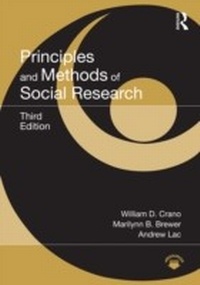
Principles and Methods of Social Research
3rd Edition
Published on 9. September 2014
504 pages
978-1-317-66607-3 (ISBN)
Description

Used to train generations of social scientists, this thoroughly updated classic text covers the latest research techniques and designs. Applauded for its comprehensive coverage, the breadth and depth of content is unparalleled. Through a multi-methodology approach, the text guides readers toward the design and conduct of social research from the ground up. Explained with applied examples useful to the social, behavioral, educational, and organizational sciences, the methods described are intended to be relevant to contemporary researchers.
The underlying logic and mechanics of experimental, quasi-experimental, and non-experimental research strategies are discussed in detail. Introductory chapters covering topics such as validity and reliability furnish readers with a firm understanding of foundational concepts. Chapters dedicated to sampling, interviewing, questionnaire design, stimulus scaling, observational methods, content analysis, implicit measures, dyadic and group methods, and meta-analysis provide coverage of these essential methodologies. The book is noted for its:
-Emphasis on understanding the principles that govern the use of a method to facilitate the researcher's choice of the best technique for a given situation.
- Use of the laboratory experiment as a touchstone to describe and evaluate field experiments, correlational designs, quasi experiments, evaluation studies, and survey designs.
-Coverage of the ethics of social research including the power a researcher wields and tips on how to use it responsibly.
The new edition features:-A new co-author, Andrew Lac, instrumental in fine tuning the book's accessible approach and highlighting the most recent developments at the intersection of design and statistics.
-More learning tools including more explanation of the basic concepts, more research examples, tables, and figures, and the addition of bold faced terms, chapter conclusions, discussion questions, and a glossary.
-Extensive revision of chapter (3) on measurement reliability theory that examines test theory, latent factors, factor analysis, and item response theory.
-Expanded coverage of cutting-edge methodologies including mediation and moderation, reliability and validity, missing data, and more physiological approaches such as neuroimaging and fMRIs.
-A new web based resource package that features Power Points and discussion and exam questions for each chapter and for students chapter outlines and summaries, key terms, and suggested readings.
Intended as a text for graduate or advanced undergraduate courses in research methods (design) in psychology, communication, sociology, education, public health, and marketing, an introductory undergraduate course on research methods is recommended.
The underlying logic and mechanics of experimental, quasi-experimental, and non-experimental research strategies are discussed in detail. Introductory chapters covering topics such as validity and reliability furnish readers with a firm understanding of foundational concepts. Chapters dedicated to sampling, interviewing, questionnaire design, stimulus scaling, observational methods, content analysis, implicit measures, dyadic and group methods, and meta-analysis provide coverage of these essential methodologies. The book is noted for its:
-Emphasis on understanding the principles that govern the use of a method to facilitate the researcher's choice of the best technique for a given situation.
- Use of the laboratory experiment as a touchstone to describe and evaluate field experiments, correlational designs, quasi experiments, evaluation studies, and survey designs.
-Coverage of the ethics of social research including the power a researcher wields and tips on how to use it responsibly.
The new edition features:-A new co-author, Andrew Lac, instrumental in fine tuning the book's accessible approach and highlighting the most recent developments at the intersection of design and statistics.
-More learning tools including more explanation of the basic concepts, more research examples, tables, and figures, and the addition of bold faced terms, chapter conclusions, discussion questions, and a glossary.
-Extensive revision of chapter (3) on measurement reliability theory that examines test theory, latent factors, factor analysis, and item response theory.
-Expanded coverage of cutting-edge methodologies including mediation and moderation, reliability and validity, missing data, and more physiological approaches such as neuroimaging and fMRIs.
-A new web based resource package that features Power Points and discussion and exam questions for each chapter and for students chapter outlines and summaries, key terms, and suggested readings.
Intended as a text for graduate or advanced undergraduate courses in research methods (design) in psychology, communication, sociology, education, public health, and marketing, an introductory undergraduate course on research methods is recommended.
Reviews / Votes
"A classic resource continues to improve! Sophisticated theoretical and methodological grounding, but accessible to the beginning researcher. ...A great discussion of indirect and implicit measures. .... A must-have resource for any advanced undergraduate or graduate course in research methods." - Duane T. Wegener, Ohio State University, USA"This outstanding textbook blends the Donald Campbell tradition of adhering to fundamental concepts of validity, with new research practices. This is the textbook of choice for the newcomer who seeks clear explanations regarding basic and applied issues, as well as the seasoned researcher who seeks a comprehensive reference book." - Ximena Arriaga, Purdue University, USA
"The book presents complex ideas in a manner that is accessible to undergraduates while retaining the nuance necessary for graduate coursework. Both classic and contemporary content that is expressed with verve and precision." - James P. Dillard, Pennsylvania State University, USA
"This book offers a comprehensive yet accessible look at research methods. I read an early edition years ago and it had a profound influence on my career. It's even better now. A must-read for Ph.D. students in the social sciences -- social psychology in particular! "- Zakary Tormala, Stanford University, USA
"The depth of understanding in research methodology provided in this book is second to none. I used this book as a graduate student, and when I started teaching graduate students I found that no other text provided the amount of detail required at the graduate level. ... I [am] using this text in Basic and Applied Research Methods ...a graduate course for students in our counseling psychology MA program." - Joseph A. Camilleri, Westfield State University, USA
"I have been using this book as my primary text for Research Methods ...a first-year graduate...course for our Clinical, Developmental and Psychometrics programs. I have been very happy with the book. ...The proposed changes will make for an even stronger book. ...My students like the book and find it accessible yet informative. ...The book has a great balance between coverage and depth and serves my purposes well for an introductory graduate Research methods course in Psychology." - Tiffany Yip, Fordham University, USA
"The book is a perfect fit for my interests given my training in experimental social psychology and academic appointment in communication. ... The research examples in the book are about topics that interest my students and me. ...[This is] is the only research methods textbook that meets my interests for the beginning graduate level." - Gwen M. Wittenbaum, Michigan State University, USA
"I feel positively about the proposed changes. ... These changes will make the book a better teaching tool. ... This book can be used for a graduate level research proposal or methods class. ...This book will definitely fit psychology, human development, and education graduate programs." - Wen-Pin Chang, Creighton University, USA
More details
Edition
3rd edition
Language
English
Place of publication
London
United Kingdom
Publishing group
Taylor & Francis Ltd
Target group
Professional and scholarly
Edition type
Revised edition
Illustrations
69 s/w Abbildungen, 47 s/w Tabellen, 4 s/w Photographien bzw. Rasterbilder, 65 s/w Zeichnungen
47 Tables, black and white; 65 Line drawings, black and white; 4 Halftones, black and white; 69 Illustrations, black and white
ISBN-13
978-1-317-66607-3 (9781317666073)
Copyright in bibliographic data and cover images is held by Nielsen Book Services Limited or by the publishers or by their respective licensors: all rights reserved.
Schweitzer Classification
Other editions
Additional editions
William D. Crano | Marilynn B. Brewer | Andrew Lac
Principles and Methods of Social Research
Book
09/2014
3rd Edition
Routledge
€111.50
Article exhausted; check for reprint

William D. Crano | Marilynn B. Brewer | Andrew Lac
Principles and Methods of Social Research
Book
09/2014
3rd Edition
Routledge
€212.50
Article exhausted; check for reprint
Persons
William D. Crano is the Oskamp Distinguished Chair and Head of the Department of Psychology at Claremont Graduate University.
Marilynn B. Brewer is Professor Emeritus from the Ohio State University and a Visiting Professor of Psychology at the University of New South Wales.
Andrew Lac is Research Professor of Psychology at Claremont Graduate University.
Marilynn B. Brewer is Professor Emeritus from the Ohio State University and a Visiting Professor of Psychology at the University of New South Wales.
Andrew Lac is Research Professor of Psychology at Claremont Graduate University.
Content
Part 1: Introduction to Social Research Methods 1. Basic Concepts 2. Internal and External Validity 3. Measurement Reliability 4. Measurement Validity Part 2: Research Design Strategies: Experiments, Quasi-experiments, and Non-experiments 5. Designing Experiments: Variations on the Basics 6. Constructing Laboratory Experiments 7. External Validity of Laboratory Experiments 8. Conducting Experiments outside the Laboratory 9. Nonexperimental Research: Correlational Design and Analyses 10. Quasi-Experiments and Evaluation Research Part 3: Data Collecting Methods 11. Survey Studies: Design and Sampling 12. Systematic Observational Methods 13. Interviewing 14. Content Analysis 15. Questionnaire Design and Scale Construction 16. Implicit Measures of Cognition and Affect 17. Scaling Stimuli: Social Psychophysics 18. Methods for Assessing Dyads and Groups Part 4: Concluding Perspectives 19. Synthesizing Research Results: Meta-Analysis 20. Social Responsibility and Ethics in Social Research
