

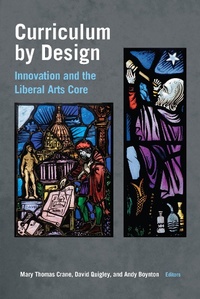
Curriculum by Design
Innovation and the Liberal Arts Core
Published on 16. May 2023
272 pages
978-1-5315-0135-8 (ISBN)
Description

This book tells the story of how a team of colleagues at Boston College took an unusual approach (working with a design consultancy) to renewing their core and in the process energized administrators, faculty, and students to view liberal arts education as an ongoing process of innovation. It aims to provide insight into what they did and why they did it and to provide a candid account of what has worked and what has not worked. Although all institutions are different, they believe their experiences can provide guidance to others who want to change their general education curriculum or who are being asked to teach core or general education courses in new ways.
The book also includes short essays by a number of faculty colleagues who have been teaching in BC's new innovative core courses, providing practical advice about the challenges of trying interdisciplinary teaching, team teaching, project-or problem-based learning, intentional reflection, and other new structures and pedagogies for the first time. It will also address some of the nuts and bolts issues they have encountered when trying to create structures to make curriculum change sustainable over time and to foster ongoing innovation.
The book also includes short essays by a number of faculty colleagues who have been teaching in BC's new innovative core courses, providing practical advice about the challenges of trying interdisciplinary teaching, team teaching, project-or problem-based learning, intentional reflection, and other new structures and pedagogies for the first time. It will also address some of the nuts and bolts issues they have encountered when trying to create structures to make curriculum change sustainable over time and to foster ongoing innovation.
More details
Edition
New edition
Language
English
Place of publication
New York
United States
Target group
Professional and scholarly
Edition type
New edition
File size
4,79 MB
ISBN-13
978-1-5315-0135-8 (9781531501358)
Copyright in bibliographic data and cover images is held by Nielsen Book Services Limited or by the publishers or by their respective licensors: all rights reserved.
Schweitzer Classification
Other editions
Additional editions
Mary Thomas Crane | David Quigley | Andy Boynton
Curriculum by Design
Innovation and the Liberal Arts Core
Book
05/2023
Fordham University Press
€117.50
Shipment within 3-4 weeks
Persons
Mary Thomas Crane (Edited By)
Mary Thomas Crane is the Thomas F. Rattigan Professor of English and director of the Institute for the Liberal Arts at Boston College. She works on early modern English literature and is the author of Framing Authority: Sayings, Self, and Society in Sixteenth-Century England (Princeton University Press, 1993), Shakespeare's Brain: Reading with Cognitive Theory (Princeton University Press, 2000), and Losing Touch with Nature: Literature and the New Science in Sixteenth-Century England (Johns Hopkins University Press, 2014). She has taught the Enduring Question course "Revolutionary Media: How Reading Changes Us."
David Quigley (Edited By)
David Quigley is the provost and dean of faculties and a professor of history at Boston College. He was previously dean of the Morrissey College of Arts and Sciences at BC. He is the author of Second Founding: New York City, Reconstruction, and the Making of American Democracy (2004). He has taught the Enduring Question course "Worlds of Moby-Dick: What Historical Forces Shape a Book's Greatness."
Andy Boynton (Edited By)
Andy Boynton is the John and Linda Powers Family Dean of the Carroll School of Management at Boston College. He is the author of The Idea Hunter: How to Find the Best Ideas and Make them Happen and has a blog on leadership and innovation on Forbes .com.
Mary Thomas Crane is the Thomas F. Rattigan Professor of English and director of the Institute for the Liberal Arts at Boston College. She works on early modern English literature and is the author of Framing Authority: Sayings, Self, and Society in Sixteenth-Century England (Princeton University Press, 1993), Shakespeare's Brain: Reading with Cognitive Theory (Princeton University Press, 2000), and Losing Touch with Nature: Literature and the New Science in Sixteenth-Century England (Johns Hopkins University Press, 2014). She has taught the Enduring Question course "Revolutionary Media: How Reading Changes Us."
David Quigley (Edited By)
David Quigley is the provost and dean of faculties and a professor of history at Boston College. He was previously dean of the Morrissey College of Arts and Sciences at BC. He is the author of Second Founding: New York City, Reconstruction, and the Making of American Democracy (2004). He has taught the Enduring Question course "Worlds of Moby-Dick: What Historical Forces Shape a Book's Greatness."
Andy Boynton (Edited By)
Andy Boynton is the John and Linda Powers Family Dean of the Carroll School of Management at Boston College. He is the author of The Idea Hunter: How to Find the Best Ideas and Make them Happen and has a blog on leadership and innovation on Forbes .com.
Content
Preface: Curriculum Revision and the Foundations of American Higher Education
David Quigley xi
PART I: INNOVATION AND THE LIBERAL ARTS CORE 1
Choreographing the Conversation: How Designers Helped Clear an Academic Logjam
William Bole 3
What Do We Know? Or, The Perils of Expertise
Toby Bottorf 13
Innovation
Andy Boynton 21
Ambitious Plans Meet Reality: How We Made the Renewed Core Work
Mary Thomas Crane 31
Slowing Down and Opening Up: Preparing Faculty to Co-design a General Education Course
Stacy Grooters 41
Core Renewal as Creative Fidelity
Gregory Kalscheur, S.J. 50
Reflection and Core Renewal
Jack Butler, S.J. 62
Surprised by Conversation: A Reflection on Core Renewal at Boston College
Brian D. Robinette 69
PART II: TEACHING THE RENEWED CORE 73
Complex Problem Courses 75
Teaching about a Planet in Peril
Prasannan Parthasarathi and Juliet B. Schor 77
Experimenting with Science and Technology in American Society
Jenna Tonn 82
Global Implications of Climate Change: Importance of Mentorship in a Core Education
Tara Pisani Gareau and Brian J. Gareau 104
Enduring Question Courses: Bringing Together Divergent Disciplines 115
How to Live in the Material World: Two Perspectives
Elizabeth Kowaleski Wallace and Dunwei Wang 117
Aesthetic and Spiritual Exercises, in and beyond the Classroom
Daniel Callahan and Brian D. Robinette 123
Enduring Question Courses: Differentiating Similar Disciplines 133
Death in Ancient Greece and Modern Russia: Reflecting on Our Reflection Sessions
Hanne Eisenfeld and Thomas Epstein 135
Spending a Semester with "A Possession for All Time": Justice and War in Thucydides
Robert C. Bartlett 144
Inquiring about Humans and Nature: Creativity, Planning, and Serendipity
Holly VandeWall and Min Hyoung Song 150
The Liberal Arts Core: Engaging with Current Events, 2016-2020 157
Crossings: Teaching "Roots and Routes: Reading/Writing Identity, Migration, and Culture"
Lynne Anderson and Elizabeth Graver 159
The Architecture of a Black Feminist Classroom: Pedagogical Praxis
in "Where #BlackLivesMatter Meets #MeToo"
Regine Michelle Jean-Charles 167
Truth-Telling in History and Literature: Constructive Uncertainty
Allison Adair and Sylvia Sellers-Garcia 178
Covid Core Lessons
Elizabeth H. Shlala 190
Acknowledgments 199
Appendix A: The Vision Animating the Boston College Core Curriculum 203
Appendix B: Boston College Core Curriculum Required Courses 209
Appendix C: Complex Problem and Enduring Question Courses, 2015-2021 211
List of Contributors 235
Index 243
David Quigley xi
PART I: INNOVATION AND THE LIBERAL ARTS CORE 1
Choreographing the Conversation: How Designers Helped Clear an Academic Logjam
William Bole 3
What Do We Know? Or, The Perils of Expertise
Toby Bottorf 13
Innovation
Andy Boynton 21
Ambitious Plans Meet Reality: How We Made the Renewed Core Work
Mary Thomas Crane 31
Slowing Down and Opening Up: Preparing Faculty to Co-design a General Education Course
Stacy Grooters 41
Core Renewal as Creative Fidelity
Gregory Kalscheur, S.J. 50
Reflection and Core Renewal
Jack Butler, S.J. 62
Surprised by Conversation: A Reflection on Core Renewal at Boston College
Brian D. Robinette 69
PART II: TEACHING THE RENEWED CORE 73
Complex Problem Courses 75
Teaching about a Planet in Peril
Prasannan Parthasarathi and Juliet B. Schor 77
Experimenting with Science and Technology in American Society
Jenna Tonn 82
Global Implications of Climate Change: Importance of Mentorship in a Core Education
Tara Pisani Gareau and Brian J. Gareau 104
Enduring Question Courses: Bringing Together Divergent Disciplines 115
How to Live in the Material World: Two Perspectives
Elizabeth Kowaleski Wallace and Dunwei Wang 117
Aesthetic and Spiritual Exercises, in and beyond the Classroom
Daniel Callahan and Brian D. Robinette 123
Enduring Question Courses: Differentiating Similar Disciplines 133
Death in Ancient Greece and Modern Russia: Reflecting on Our Reflection Sessions
Hanne Eisenfeld and Thomas Epstein 135
Spending a Semester with "A Possession for All Time": Justice and War in Thucydides
Robert C. Bartlett 144
Inquiring about Humans and Nature: Creativity, Planning, and Serendipity
Holly VandeWall and Min Hyoung Song 150
The Liberal Arts Core: Engaging with Current Events, 2016-2020 157
Crossings: Teaching "Roots and Routes: Reading/Writing Identity, Migration, and Culture"
Lynne Anderson and Elizabeth Graver 159
The Architecture of a Black Feminist Classroom: Pedagogical Praxis
in "Where #BlackLivesMatter Meets #MeToo"
Regine Michelle Jean-Charles 167
Truth-Telling in History and Literature: Constructive Uncertainty
Allison Adair and Sylvia Sellers-Garcia 178
Covid Core Lessons
Elizabeth H. Shlala 190
Acknowledgments 199
Appendix A: The Vision Animating the Boston College Core Curriculum 203
Appendix B: Boston College Core Curriculum Required Courses 209
Appendix C: Complex Problem and Enduring Question Courses, 2015-2021 211
List of Contributors 235
Index 243
