

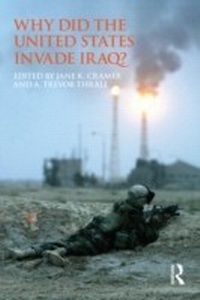
Why Did the United States Invade Iraq?
1st Edition
Published on 1. March 2013
272 pages
978-1-136-64150-3 (ISBN)
Description

This edited volume presents the foremost scholarly thinking on why the US invaded Iraq in 2003, a pivotal event in both modern US foreign policy and international politics.
In the years since the US invasion of Iraq it has become clear that the threat of weapons of mass destruction was not as urgent as the Bush administration presented it and that Saddam Hussein was not involved with either Al Qaeda or 9/11. Many consider the war a mistake and question why Iraq was invaded. A majority of Americans now believe that the public were deliberately misled by the Bush administration in order to bolster support for the war. Public doubt has been strengthened by the growing number of critical scholarly analyses and in-depth journalistic investigations about the invasion that suggest the administration was not candid about its reasons for wanting to take action against Iraq.
This volume begins with a survey of private scholarly views about the war's origins, then assesses the current state of debate by organising the best recent thinking by foreign policy and international relations experts on why the US invaded Iraq. The book covers a broad range of approaches to explaining Iraq - the role of the uncertainty of intelligence, cognitive biases, ideas, Israel, and oil, highlighting areas of both agreement and disagreement.
This book will be of much interest to students of the Iraq War, US foreign and security policy, strategic studies, Middle Eastern politics and IR/Security Studies in general.
In the years since the US invasion of Iraq it has become clear that the threat of weapons of mass destruction was not as urgent as the Bush administration presented it and that Saddam Hussein was not involved with either Al Qaeda or 9/11. Many consider the war a mistake and question why Iraq was invaded. A majority of Americans now believe that the public were deliberately misled by the Bush administration in order to bolster support for the war. Public doubt has been strengthened by the growing number of critical scholarly analyses and in-depth journalistic investigations about the invasion that suggest the administration was not candid about its reasons for wanting to take action against Iraq.
This volume begins with a survey of private scholarly views about the war's origins, then assesses the current state of debate by organising the best recent thinking by foreign policy and international relations experts on why the US invaded Iraq. The book covers a broad range of approaches to explaining Iraq - the role of the uncertainty of intelligence, cognitive biases, ideas, Israel, and oil, highlighting areas of both agreement and disagreement.
This book will be of much interest to students of the Iraq War, US foreign and security policy, strategic studies, Middle Eastern politics and IR/Security Studies in general.
Reviews / Votes
'This edited volume pursues the true causes of the Iraq War. It tests leading explanations of the Iraq war against historical evidence, and updates our historical understanding of events surrounding the war with new evidence that recently surfaced about what information leaders had, what they chose to share with the public, the timing of their decisions behind closed doors. The volume also explores the ideologies that guided these leaders. It will not be the last word on this tragic war, but it reveals how new information can be used to refine our understanding of this important instance of war...' - Stephen Van Evera, Massachusetts Institute of Technology'Just as scholars continue to debate the origins of World War I, we will never know for certain what motivated George W. Bush to launch a war against Iraq in March 2003. The reasons for this misguided use of American military power are still shrouded in mystery, and the search for truth is clouded by partisanship and ideology. This book pierces that veil. .... The volume demonstrates that it is possible to have a serious and fruitful debate about the Iraq war after the fact, and therefore should help to inform future policy makers as they contemplate the use of force in similar circumstances.' -- Christopher Preble, Cato Institute, Washington DC
'What determined and motivated the decision to invade Iraq in 2003, perhaps the greatest debacle in American foreign policy history after Vietnam? This book brings together an excellent band of authors in a vigorous, engaging, and highly informative effort to parse this important issue.' -- John Mueller, Ohio State University
More details
Series
Language
English
Place of publication
London
United Kingdom
Publishing group
Taylor & Francis Ltd
Target group
College/higher education
Professional and scholarly
Product notice
Reflowable
Illustrations
8 s/w Tabellen
8 Tables, black and white
File size
1,64 MB
ISBN-13
978-1-136-64150-3 (9781136641503)
Copyright in bibliographic data and cover images is held by Nielsen Book Services Limited or by the publishers or by their respective licensors: all rights reserved.
Schweitzer Classification
Other editions
Additional editions
Jane Cramer | A. Trevor Thrall
Why Did the United States Invade Iraq?
Book
08/2011
1st Edition
Routledge
€231.90
Shipment within 15-20 days
Jane Cramer | A. Trevor Thrall
Why Did the United States Invade Iraq?
Book
08/2011
1st Edition
Routledge
€63.50
Shipment within 15-20 days
Persons
Jane K. Cramer is Assistant Professor of Political Science at the University of Oregon. Her research focuses on the causes of national overestimations of security threats, as well as other aspects of the domestic politics behind foreign policymaking, especially the diversionary theory of war.
A. Trevor Thrall is Associate Professor of Government and Politics and directs the Biodefense graduate program at George Mason University. Much of his work focuses on the intersection of war, news, and public opinion. His recent work has investigated presidential threat inflation, public support for missile defense, and how changes in the news media have affected US foreign policy.
A. Trevor Thrall is Associate Professor of Government and Politics and directs the Biodefense graduate program at George Mason University. Much of his work focuses on the intersection of war, news, and public opinion. His recent work has investigated presidential threat inflation, public support for missile defense, and how changes in the news media have affected US foreign policy.
Content
1. Introduction: Why Did the United States Invade Iraq? 2. Explaining the War in Iraq 3. Ideas, American Grand Strategy, and the War in Iraq 4. Ideas and Entrepreneurs: A Constructivist Explanation of the Iraq War 5. Explaining the Iraq War: The Israel Lobby Theory 6. Neoconservatism and American Hegemony 7. Blood for Oil, in Iraq and Elsewhere 8. Oil and the Decision to Invade Iraq 9. Tony Blair Nurtures the Special Relationship 10. In Pursuit of Primacy: Why the United States Invaded Iraq
