

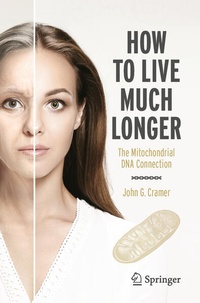
How to Live Much Longer
Description

This book is about why we age and how to fix it. Human aging, a complex biological process, has long eluded a unified explanation. The book explains that aging is fundamentally a cellular energy crisis, driven by the progressive accumulation of damage to the vulnerable DNA of mitochondria, the cell's primary energy producers. Drawing on this perspective, which emphasizes energy conservation and flow in biological systems, new light is cast on the traditional theories of aging, demonstrating that the recognized "Hallmarks of Aging" are all downstream consequences of the fundamental energy falloff. While currently available longevity interventions offer modest, short-term benefits that address some aging symptoms, none can resolve this underlying energy shortage. The path to true age reversal requires the application of strong measures, primarily the new technology of high-volume mitochondrial transplantation. The Age Reversal Revolution is about to shake the foundations of our civilization, and this book provides the key to understanding it and joining in its benefits.
More details
Other editions
Additional editions
Person
John G. Cramer is Emeritus Professor of Physics, University of Washington, Seattle. He has had five decades of teaching and research in experimental and theoretical nuclear and ultra-relativistic heavy ion physics, including work at SPS/CERN and RHIC/Brookhaven. He has also worked in the foundations of quantum mechanics and originated the transactional interpretation of quantum mechanics, described in detail in his book "The Quantum Handshake" (Springer, 2016). He is a co-author of over 300 scientific journal publications, over 141 conference-proceeding publications, and several chapters in multi-author nuclear physics books. John has written "The Alternate View" science column in "Analog Science Fiction and Fact Magazine" (1984 - present), as well as three "hard" science fiction novels: "Twistor" (Morrow, 1989), "Einstein's Bridge" (Avon, 1997), and "Fermi's Question" (Baen, 2023). John has recently focused on human aging, seeking to understand its causes and treatments. He is a volunteer for the first human trial of large-volume mitochondrial transplantation, to be conducted soon. John was born in Houston, Texas, on October 24, 1934, and was educated in the Houston Public Schools (Poe, Lanier, Lamar) and Rice University (BA-1957, MA-1959, PhD-1961). He was a Postdoc and Assistant Professor at Indiana University (1961-1964) before joining the Physics Faculty of the University of Washington.
Content
Going Gentle into that Good Night An Analogy.- Ancient History The Origin of Earth Life and Its Consequences.- Onward and Downward Aging Theories Philosophies & Fallacies.- Tours of the Mitochondrion and mtDNA.- Hallmarks of Aging Aging Clocks and Aging Tests.- The Longevity Handymen Short Term Fixes and Patch Ups.- Longer Term Interventions Senolytics Epigenetics Telomeres.- Actually Understanding and Reversing Aging.- Engineering Methuselah.- The Coming Mitochondrial Revolution.
