

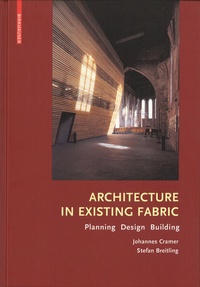
Architecture in Existing Fabric
Description

Die architektonische Arbeit im Kontext bestehender Bauten hat in den letzten Jahren immens an Bedeutung gewonnen. Für den Großteil der Architekten werden hier die zukünftigen Marktchancen liegen. Das Buch bietet eine umfassende Orientierung für diesen Bereich und richtet sich damit an alle Praktiker, Studenten und Bauherren, deren Interesse über eine erste Begegnung mit dem großen Aufgabenfeld hinausgeht.
Entgegen einer konventionellen Auffassung, dass das gestaltende Entwerfen den Neubau-Projekten vorbehalten sei, beschreiben die Autoren differenziert aktive, kreative Strategien für Planung, Entwurf und Ausführung. Die Themen reichen von städtebaulichen Fragen über den Projektablauf und die Leistungsphasen bis hin zum Gebäudemanagement. Besondere Schwerpunkte bilden Fragen der Zusammenarbeit der beteiligten Experten sowie eine "Grammatik des Entwerfens".
Zur Erläuterung des weiten und komplexen Themenspektrums sind 30 Beispiele von Projekten aus Europa und Nordamerika eingebunden, bei denen Bauten aus unterschiedlichsten Entstehungszeiten - vom Mittelalter bis in die 1960er Jahre - auf vorbildliche Weise "in die Gegenwart überführt" wurden.
More details
Other editions
Additional editions
Persons
Content
- Intro
- Architecture and the existing fabric
- Architecture and time
- The built environment and identity
- Old and new
- The value of the built environment
- The planning process
- Special features of the planning process
- Protective measures and essential repairs
- Preparatory investigations
- The level of planning detail
- Casa de las Conchas, Salamanca, Spain
- The participants
- The client
- The architect
- The planning authorities
- Overview: Planning permission procedure
- Naumburg City Museum, Germany
- The contractors
- Decision-making and communication
- Preparatory investigations
- Recording historic buildings
- Property and geographic details
- Documentary evidence and archives
- Recording the building as found
- Metric building survey
- Overview: Precision levels in measured surveys
- Building survey
- Houses on the Mühlenstrasse, Havelberg, Germany
- Building archaeology
- Nidaros Cathedral, Trondheim, Norway
- Heubach Castle, Germany
- Balbarini townhouse, Pisa, Italy
- Bernhard chapel, Owen, Germany
- Schminke house, Löbau, Germany
- Structural survey
- Technical and material investigations
- Evaluation and interpretation - strengths and weaknesses
- Design strategies
- Designing with history
- Disposition
- Definition of appropriate function
- Municipal archives in the Church of San Agostin, Valladolid, Spain
- Sensitive interventions
- Tabourettli Theatre in the old Spalenhof, Basel, Switzerland
- Auxiliary constructions
- Bank in a 19th century building, Budapest, Hungary
- Design strategies
- Corrective maintenance
- Private residence, Venice, Italy
- Medieval house, Bamberg, Germany
- Modernisation
- Palazzo as museum, Venice, Italy
- Adaptation
- Loft in an industrial building, Madrid, Spain
- Conversion and extension of an industrial building, Göttelborn, Germany
- Hotel in a monastery church, Maastricht, Netherlands
- Tyrolean Museum of History, Tyrol Castle, Italy
- Single family houses, Utrecht, Netherlands
- Historic office building, Zurich, Switzerland
- Replacement
- Architectonic expression
- Correspondence
- Swimming pool, Spexhall Manor, Great Britain
- German Federal Foreign Office, Berlin, Germany
- Unification
- Fragmentation
- Town hall conversion and extension, Utrecht, Netherlands
- Nuevos Ministerios, Madrid, Spain
- Junction and delineation
- British Museum, Queen Elizabeth II Great Court, London, Great Britain
- Documentation centre of the former Nazi party rally ground, Germany
- Detail planning
- Prerequisites
- Development not demolition
- An element-for-element approach
- Library, Eichstätt, Germany
- Planning on the basis of an accurate measured survey
- Principles
- Repair not renew
- A cumulative process
- Naumburg City Museum, Germany
- Reclaimed materials
- Solutions: two examples
- Upgrading the thermal performance of windows
- Villa, Buchschlag, Germany
- Repairing timber roof structures
- Building works
- Site facilities
- The workshop principle
- Protective measures for building elements on site
- Heubach Castle, library and museum, Heubach, Germany
- Supervising building works
- Samples, tests and mock-ups
- Specifications and quantities
- Construction time and Costing
- Scheduling works
- Architect's fees
- Sustainability
- Facility Management
- Monitoring and maintenance
- Preserving property value
- Appendix
- Bibliography
- Index of architects
- Subject index
- Illustration credits
- On the authors
